
What’s the real difference between asthma and COPD?
If you’re struggling to breathe, wheezing, or coughing up phlegm, it’s easy to assume it’s just one lung problem. But asthma and COPD are not the same - even though they feel similar. One is often reversible and starts young. The other builds slowly, gets worse over time, and rarely improves. Mistaking one for the other can mean getting the wrong treatment - and that’s dangerous.
In the UK, around 5.4 million people live with asthma. COPD affects about 1.2 million, with many more undiagnosed. Both are common. But their causes, how they progress, and how they’re treated? Totally different.
Asthma: A reversible, trigger-driven condition
Asthma is an inflammatory condition where your airways become swollen and super sensitive. It’s not about damaged lungs - it’s about overreactive airways. One moment you’re fine. The next, you’re gasping after climbing stairs or breathing in cold air.
Most people with asthma notice symptoms at night or early morning. Wheezing, chest tightness, coughing - these come and go. Between attacks, many feel completely normal. That’s the key: asthma is intermittent. You don’t live with constant breathlessness.
Triggers are a big clue. If your symptoms flare up around pollen, dust mites, pets, exercise, or cold air, it’s likely asthma. Around 65% of asthma patients also have hay fever or eczema. That allergic link is common.
Diagnosis? Doctors check your lung function with a spirometer. If your FEV1 improves by 12% or more after using a rescue inhaler, that’s asthma. FeNO tests - measuring nitric oxide in your breath - often show high levels (over 50 ppb), pointing to eosinophil inflammation. Blood tests may show high eosinophils too.
COPD: A progressive, permanent damage
COPD isn’t about sensitivity. It’s about destruction. It’s a group of diseases - mainly emphysema and chronic bronchitis - that permanently damage your lungs. The air sacs break down. The airways get clogged with mucus. And it doesn’t heal.
Unlike asthma, COPD symptoms don’t come and go. You wake up with a cough. You cough all day. You’re out of breath walking to the shop. Even on your best days, you’re not fully normal. About 87% of COPD patients have a daily productive cough with thick phlegm. Dry cough? That’s more asthma.
COPD almost always shows up after 40. Over 90% of cases are linked to smoking. A few non-smokers get it from long-term exposure to fumes or dust. But smoking is the main culprit - 90% of COPD cases trace back to it.
Spirometry shows airflow limitation, but here’s the difference: COPD patients rarely show more than 12% improvement after a bronchodilator. Their lungs are scarred, not just tight. CT scans often show emphysema - holes in the lung tissue - which asthma patients almost never have.
Advanced COPD can lead to cyanosis - blue lips or fingernails - from low oxygen. That’s rare in asthma. COPD patients also often have other smoking-related issues: heart disease, osteoporosis, or weight loss.
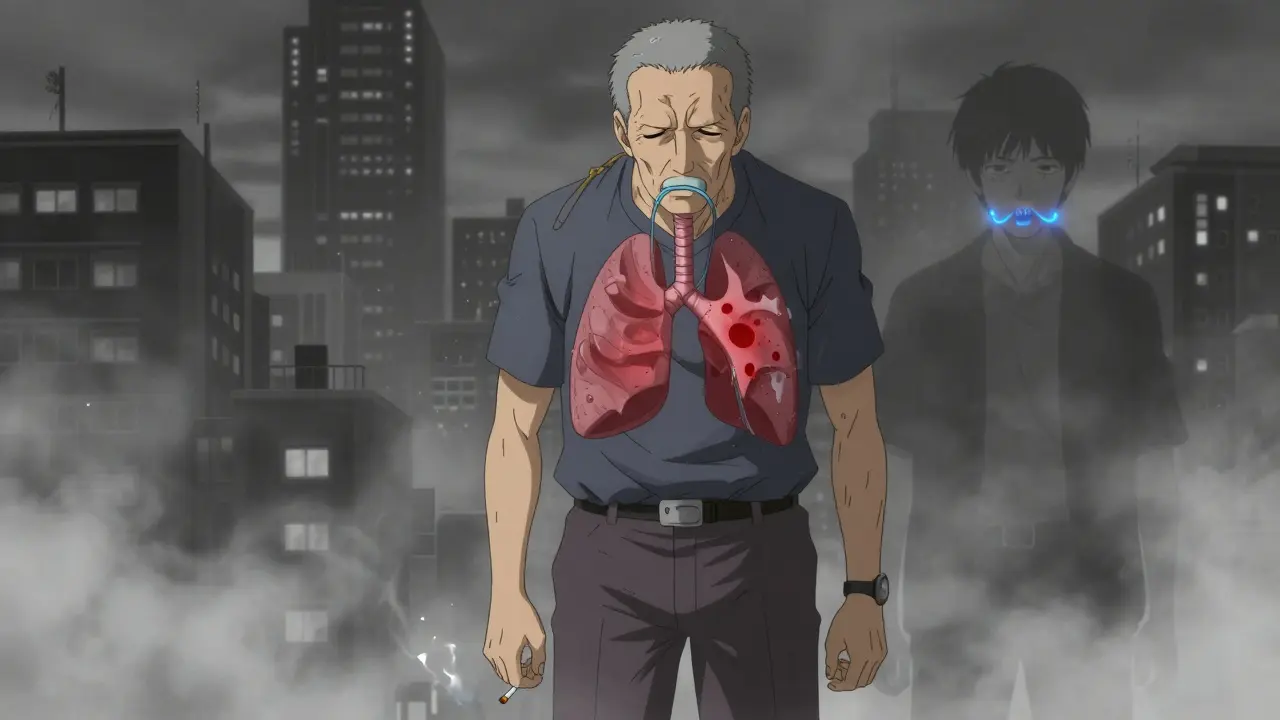
How symptoms compare side by side
| Feature | Asthma | COPD |
|---|---|---|
| Onset age | Often before age 20 | Usually after age 40 |
| Primary symptom | Wheezing, chest tightness | Chronic cough with phlegm |
| Cough type | Dry in 73% of cases | Productive in 87% of cases |
| Pattern | Episodic - good days and bad days | Constant - slowly worsens |
| Reversibility | Highly reversible with inhalers | Minimal or no reversibility |
| Triggers | Allergens, cold air, exercise | Smoking, pollution, infections |
| Cyanosis | Virtually absent | Common in advanced stages |
| FeNO levels | Usually >50 ppb | Usually <25 ppb |
| Blood eosinophils | Often >300 cells/μL | Usually <100 cells/μL |
Treatment: Why one size doesn’t fit both
Asthma treatment is about control. You start with a rescue inhaler - usually albuterol - for quick relief. If symptoms happen more than twice a week, you add an inhaled corticosteroid to calm the inflammation. For severe cases, biologics like mepolizumab target specific immune cells.
Eighty-nine percent of asthma patients get good control with this step-by-step approach. Many live symptom-free for long stretches. The goal? Prevent attacks, not just treat them.
COPD treatment is different. Bronchodilators - long-acting ones - are the foundation. These relax the airways and help you breathe easier every day. Inhaled steroids? Only added if you have frequent flare-ups. That’s because steroids don’t fix the damage - they just reduce inflammation in some cases.
Pulmonary rehab helps COPD patients more than asthma patients. After a 6-8 week program, COPD patients typically walk 54 meters farther in six minutes. Asthma patients? Only 12 meters. Why? Because COPD patients start from a lower baseline. Their lungs are damaged. Asthma patients are usually healthy between attacks.
Smoking cessation is the single most important thing for COPD. Quitting cuts disease progression by half. For asthma? Smoking doesn’t make it worse - unless you’ve already developed COPD. Then it’s a double hit.

What is ACOS - and why it matters
About 1 in 5 people with obstructive lung disease have something called Asthma-COPD Overlap Syndrome (ACOS). These patients have features of both: chronic symptoms like COPD, but also eosinophilic inflammation like asthma.
They often have high blood eosinophils (>300 cells/μL) but show little reversibility on spirometry - a confusing mix. They get more flare-ups than people with just asthma or just COPD. ER visits are twice as common.
Treatment? Doctors often use triple therapy: two long-acting bronchodilators plus an inhaled steroid. But there’s still debate. No large trials prove it’s better than standard care. Still, if you’ve been misdiagnosed for years and keep getting worse, ACOS might be the reason.
Prognosis: What to expect long-term
Asthma has a strong outlook. With proper treatment, 92% of people with moderate asthma survive 10 years. Deaths have dropped sharply - from over 10,000 a year in the 1990s to around 3,500 now - thanks to better inhalers and awareness.
COPD is more serious. It’s the fourth leading cause of death in the US. About 152,000 people die from it each year. Even with treatment, 78% of moderate COPD patients survive 10 years. And once lung damage is done, it’s permanent.
Some people with long-term asthma - over 20 years - develop fixed airflow limitation. That’s called asthma with irreversible obstruction. It looks like COPD. But it’s rare. Most people who think they have COPD but never smoked? They might actually have this.
When to see a doctor
If you’re over 40, have a chronic cough with phlegm, and you’ve smoked - get tested for COPD. Don’t assume it’s just a smoker’s cough.
If you’re under 30, have wheezing that comes and goes, and you have allergies - asthma is likely. But if your symptoms are getting worse, or your inhaler isn’t helping, see a specialist.
And if you’ve been diagnosed with one but aren’t improving? Ask about ACOS. Misdiagnosis is still common - 1 in 4 people over 40 with breathing problems get the wrong label.
Don’t wait until you’re gasping. A simple spirometry test takes 10 minutes. It can change everything.
Can you have asthma and COPD at the same time?
Yes. This is called Asthma-COPD Overlap Syndrome (ACOS). It affects 15-25% of people with obstructive lung disease. These patients have chronic symptoms like COPD but also show signs of allergic inflammation like asthma - high eosinophils, reversible airflow in some cases, and frequent flare-ups. Treatment often combines both asthma and COPD medications.
Is COPD just bad asthma?
No. COPD is not a severe form of asthma. Asthma is reversible airway inflammation. COPD is permanent lung damage from smoking or pollution. The inflammation types are different. The treatments are different. And the long-term outlook is worse for COPD. Mixing them up delays proper care.
Can asthma turn into COPD?
Asthma doesn’t automatically turn into COPD. But people with long-standing asthma - especially if they smoke - can develop fixed airflow obstruction that looks like COPD. This isn’t the same as COPD from smoking, but it causes similar symptoms. Quitting smoking is critical if you have asthma and smoke.
Do inhalers work the same for asthma and COPD?
Not exactly. Asthma patients often rely on quick-relief inhalers (SABAs) and daily steroids. COPD patients need long-acting bronchodilators (LABAs/LAMAs) as their main treatment. Steroids are only added if they have frequent flare-ups. Using asthma-only inhalers for COPD won’t help much - and can mask worsening disease.
Can you outgrow asthma or COPD?
Some children outgrow asthma - about half do by adulthood. But asthma that starts in adulthood rarely goes away. COPD never goes away. It’s a lifelong condition. The goal isn’t to cure it - it’s to slow it down. Quitting smoking, taking meds, and doing pulmonary rehab can help you live better for longer.
How do I know if my breathing problem is asthma or COPD?
Start with your symptoms. If you’re young, wheeze at night, have allergies, and feel fine between attacks - it’s likely asthma. If you’re over 40, have a daily cough with phlegm, smoke or used to smoke, and feel breathless all the time - it’s likely COPD. But the only way to know for sure is spirometry and possibly FeNO or blood eosinophil tests. Don’t guess - get tested.
Christina Widodo
January 12, 2026 AT 10:25So if I'm under 30, wheeze at night, and have eczema since childhood, but my inhaler barely helps anymore, am I just getting older or is this ACOS creeping in? I've been told it's 'severe asthma' for 8 years but my FENO's always high and my cough never stops. Feels like no one knows what to call this anymore.
Sumit Sharma
January 12, 2026 AT 16:35ACOS isn't a diagnosis-it's a clinical convenience for lazy pulmonologists who can't be bothered to track longitudinal spirometry trends. If you have persistent eosinophilia, fixed airflow obstruction, and a smoking history-even if it's 10 pack-years-you're not asthmatic, you're COPD with allergic inflammation. Stop calling it asthma. It's not helping anyone. Get a CT. Look for emphysema. If it's there, your treatment algorithm changes. Period.
Lawrence Jung
January 14, 2026 AT 12:03Isn't it funny how we medicalize everything now? Back in my day you just smoked or you didn't. If you coughed you coughed. If you wheezed you wheezed. Now we got subtypes and biomarkers and overlap syndromes like it's some kind of cosmic puzzle. The lungs don't care about your FENO levels. They just want you to stop breathing poison.
Sona Chandra
January 14, 2026 AT 17:22I had asthma since I was 5. I'm 42 now. I quit smoking 3 years ago. My doctor says I have 'asthma with irreversible obstruction.' But my cousin who smoked for 40 years and never had allergies has COPD. We both get the same inhalers. Why do I feel like I'm being punished for having a sensitive system? This whole system is rigged.
Katherine Carlock
January 15, 2026 AT 02:29I just want to say thank you for writing this. I was diagnosed with COPD at 38 because I had a cough and smoked a little in college. Turns out I had undiagnosed asthma my whole life. My FENO was sky high, my eosinophils were off the charts, and my spirometry improved 25% after a steroid burst. I'm not COPD. I'm asthma that got ignored for years. Please get tested. Don't let anyone label you based on age or smoking history alone.
Jennifer Phelps
January 15, 2026 AT 20:40My dad had COPD he smoked for 50 years but he never wheezed only coughed all day and had that blue tint around his lips at the end. My brother has asthma he's 24 and his inhaler is his lifeline but he runs marathons. How can they be the same thing when they feel so different
Prachi Chauhan
January 17, 2026 AT 07:41Look I'm not a doctor but I've been breathing wrong since I was a kid. In India we don't have spirometers everywhere. My aunt gave me a nebulizer and said 'breathe slow' and that was it. Now I'm 30 and I get dizzy if I climb two flights. Is this asthma or just bad air? I don't know. But I know I don't want to end up like my uncle who died with a tube down his throat. Just tell me what to do. Not the science. Just what to do.
beth cordell
January 18, 2026 AT 01:47THIS. 🙌 I’m 35, never smoked, allergic to everything, and was told I had ‘mild COPD’ because my FEV1 was 78%. I cried. Then I got a second opinion and they said ‘you have severe allergic asthma with eosinophilic inflammation.’ I’m on biologics now. I can breathe again. Don’t let a lazy GP label you. Advocate. Get tested. 🌿💨
Lauren Warner
January 18, 2026 AT 10:31Let’s be real. The entire asthma/COPD distinction is a product of pharmaceutical marketing. Steroid inhalers for asthma. Bronchodilators for COPD. Triple therapy for ACOS. Profit. The truth? Most people with obstructive lung disease are just breathing polluted air, undernourished, and stressed. We treat symptoms, not causes. And we call it science. Sad.