
If you or your child struggles to read for more than a few minutes without headaches, blurry vision, or double letters on the page, it might not be a glasses issue. It could be convergence insufficiency - a common but often missed binocular vision disorder. Unlike nearsightedness or astigmatism, this isn’t about how clearly the eyes see. It’s about whether both eyes can work together to focus on close-up tasks like reading, using a phone, or doing homework.
What Is Convergence Insufficiency?
Convergence insufficiency (CI) happens when your eyes don’t turn inward properly when looking at something nearby. Think of it like trying to cross your eyes on purpose - but your brain can’t make it happen smoothly or consistently. When this fails, one eye drifts outward, causing double vision, eye fatigue, or the brain shutting off input from one eye to avoid confusion. That’s why people with CI often say they feel like their eyes are "tired," even after just 10 minutes of reading.
It’s not rare. Around 5 to 13% of people have it, especially kids and young adults who spend hours on screens or books. Many are misdiagnosed with ADHD because they lose focus, skip lines, or avoid reading. Standard eye exams often miss it because they only check clarity - not how well the eyes coordinate.
How Is It Diagnosed?
A regular eye test won’t catch convergence insufficiency. You need a specialized binocular vision exam. Here’s what it includes:
- Near Point of Convergence (NPC): How close you can bring a small target (like a pencil) to your nose before one eye drifts out. Normal is under 7 cm. With CI, it’s often over 10 cm.
- Positive Fusional Vergence (PFV): Tests how much your eyes can strain inward before double vision kicks in. Normal is 15 prism diopters or higher. People with CI often score below 10.
- Convergence Insufficiency Symptom Survey (CISS): A simple 15-question checklist. Scores above 16 strongly suggest CI. Questions include: "Do your eyes feel tired when reading?" or "Do words seem to move on the page?"
These tests are quick, non-invasive, and done by optometrists trained in vision therapy. If you’ve had multiple eye exams and still have symptoms, ask for this specific battery of tests.
The Gold Standard: Office-Based Vision Therapy
Not all treatments are equal. For years, people were told to do "pencil push-ups" at home - slowly moving a pencil toward their nose while trying to keep it single. But research shows this alone doesn’t work well.
The Convergence Insufficiency Treatment Trial (CITT), a major study funded by the National Eye Institute and published in 2008, compared three treatments:
- Office-based vision therapy with home reinforcement
- Home-based pencil push-ups
- Home-based computer therapy
The results were clear: office-based vision therapy was the most effective. After 12 weeks, 75% of patients in the office group had full or major improvement. Only 43% improved with pencil push-ups, and just 33% with computer-only therapy.
What does office-based therapy look like?
- Weekly 45- to 60-minute sessions with a trained vision therapist
- 15 minutes of daily home exercises, five days a week
- Exercises include: pencil push-ups (done correctly with feedback), jump convergence (quickly switching focus between near and far objects), stereograms (3D images that require both eyes to fuse), and convergence cards with dot patterns
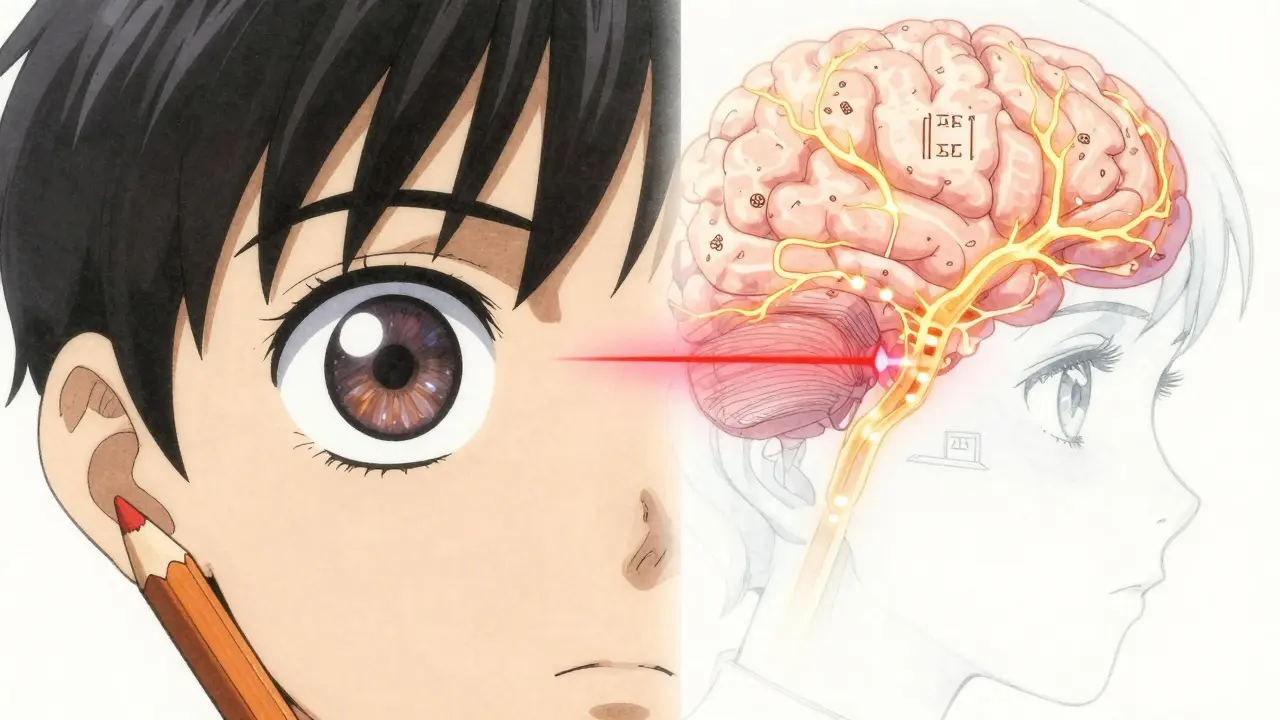
Therapy isn’t just about moving your eyes - it’s retraining your brain to control them. That’s why supervision matters. A therapist adjusts difficulty in real time, corrects technique, and ensures you’re not suppressing one eye.
Other Treatments - And Why They Fall Short
Some people try prism glasses - lenses that bend light to help the eyes align. Base-out prisms can force convergence during therapy but cause fatigue. Base-in prisms help with reading comfort but don’t fix the underlying weakness. They’re like crutches - they help you walk now, but don’t make your legs stronger.
Patching? Don’t do it. Covering one eye prevents binocular vision entirely. The American Association for Pediatric Ophthalmology and Strabismus says patching "is not a good option to strengthen convergence" because it stops both eyes from working together.
Computer-based programs like AmblyoPlay are convenient and can be helpful as a supplement. But they lack the personalized feedback of a therapist. Studies show they’re better than pencil push-ups alone - but not as good as supervised therapy.
How Long Does It Take? What to Expect
Most people see improvement within 4 to 6 weeks. Full results usually take 8 to 12 weeks. You’ll notice:
- Reading feels easier - no more headaches or eye strain
- Words stay still on the page
- You can read longer without losing focus
- Double vision disappears
Parents of children in therapy report 85% see better reading stamina. About 78% report fewer headaches. And 65% notice improved school performance.
But success depends on consistency. Patients who do at least 80% of their home exercises have an 82% success rate. Those who skip more than half see results drop to 45%.
Cost, Insurance, and Access
The biggest barrier? Cost and access.
A full course of office-based therapy typically runs $2,500 to $4,000. Insurance rarely covers it - only 32% of private plans in the U.S. include vision therapy. Many families pay out of pocket.
There are only about 1,200 certified vision therapists in the U.S. for a population of over 330 million. Finding one can take time. Look for providers certified by the College of Optometrists in Vision Development (COVD) - they have higher success rates.
Some newer digital tools offer telehealth options. AmblyoPlay’s remote supervision feature, launched in 2023, improved home adherence by 16% compared to traditional programs. It’s not a replacement for in-person care, but it helps when travel or cost is an issue.

Long-Term Results
Good news: the benefits last. The CITT-2 study, published in 2022, followed patients for a year. 82% maintained their improvements - meaning the brain learned to keep the eyes working together.
Some people need a short "tune-up" after six months, especially if they go back to heavy screen use. But for most, the therapy is a one-time fix.
What’s Next? New Tech and Research
Researchers are exploring virtual reality (VR) for convergence therapy. A 2023 pilot study at SUNY College of Optometry found VR-based training led to 23% faster symptom relief than traditional methods. Companies like Vivid Vision are building AI-driven systems that adapt exercises based on real-time eye movement data.
Future goals? Shorter treatment times, lower costs, and better insurance coverage. The National Eye Institute is funding new studies to find the minimal effective dose - how little therapy you need to get the same results.
When to Seek Help
If you or your child:
- Complains of eye strain, headaches, or double vision while reading or using screens
- Skips lines, loses place, or avoids reading
- Has been told they’re "lazy" or "not paying attention" in school
- Has normal vision but still struggles with near tasks
- then ask for a binocular vision evaluation. Don’t assume it’s just a phase. Convergence insufficiency is treatable. And with the right therapy, it doesn’t have to hold you back from reading, learning, or enjoying daily tasks without pain.
Is convergence insufficiency the same as lazy eye?
No. Lazy eye (amblyopia) is when one eye has poor vision even with glasses. Convergence insufficiency is when both eyes have good vision but can’t work together to focus on close objects. One is about clarity; the other is about coordination. They can happen together, but they’re treated differently.
Can adults get convergence insufficiency?
Yes. While it’s more common in children, adults can develop it too - especially after head injuries, prolonged screen use, or neurological changes. The same therapy works for adults. In fact, many adults report dramatic improvements in reading comfort and work performance after treatment.
Do glasses fix convergence insufficiency?
Regular prescription glasses won’t fix it. You might need reading glasses if you’re over 40, but that doesn’t address the eye coordination problem. Special prism lenses can help temporarily, but they don’t strengthen the muscles or retrain the brain. Vision therapy does.
How do I find a vision therapist near me?
Start with the College of Optometrists in Vision Development (COVD) website. They have a directory of certified providers. You can also ask your optometrist if they offer vision therapy or can refer you to a specialist. If you’re in the UK, look for practitioners registered with the British Association of Behavioural Optometry (BABO).
Is vision therapy just for kids?
No. While children are often diagnosed because of school struggles, adults benefit just as much. Many professionals - writers, programmers, designers - find that therapy lets them work longer without fatigue. The brain’s ability to adapt doesn’t disappear with age.
Can I do vision therapy at home without seeing a therapist?
You can try home exercises, but research shows they’re far less effective. The CITT study found home-based pencil push-ups worked for only 43% of people - less than half the success rate of supervised therapy. Without feedback, you’re likely doing the exercises wrong or not pushing hard enough. If cost is an issue, ask about hybrid programs that combine occasional in-office visits with home tech tools.
Sarah Triphahn
January 13, 2026 AT 13:20So let me get this straight - we’re spending thousands on eye exercises like some kind of 1990s rehab program? My kid’s glasses were $40. Why is this even a thing? If your eyes are tired, maybe stop staring at screens for 12 hours a day. Simple solution. Stop medicalizing laziness.
shiv singh
January 14, 2026 AT 06:43Oh wow another American medical scam. In India we just tell kids to go outside, play cricket, and stop reading like zombies. You pay $4000 for eye therapy? Bro. We have kids walking 5km to school with no glasses and they read better than your privileged little screen-addicted brats. This is capitalism turning a basic biological function into a profit center.
Robert Way
January 15, 2026 AT 11:19i had this and did pencil pushups for like 2 weeks and it was fine. why do you need a therapist? also my optom is like 50 bucks and he just looked at me and said "youre fine". maybe you just need to blink more??
Allison Deming
January 16, 2026 AT 19:44It is profoundly disturbing that our healthcare system has reduced neurovisual integration - a complex, neuroplastic, brain-mediated process - to a commodified series of repetitive, unmonitored tasks that are then marketed as "therapy". The fact that insurance refuses to cover evidence-based, supervised intervention while allowing unregulated digital apps to flourish speaks to a deeper societal failure in valuing holistic health over transactional convenience. This isn't about vision. It's about the erosion of care.
Susie Deer
January 17, 2026 AT 04:30USA is broke because people pay for this nonsense. In real countries you get a doctor who tells you to stop reading so much. No therapy. No $4000. Just life. Stop buying into the medical-industrial complex. Your eyes are fine. Your attention span is broken.
TooAfraid ToSay
January 18, 2026 AT 11:26Wait wait wait. So you’re telling me the real reason my son hates reading is because his eyes can’t cross properly? Not because the school system is broken? Not because books are boring? Not because he’s been taught to associate reading with punishment? This is just another way to make parents feel guilty while corporations make money. I’m not falling for it.
Dylan Livingston
January 18, 2026 AT 22:47Oh darling, of course you’re spending $4000 on eye therapy. You’re the same person who paid $300 for a jade roller to "fix your aura". At least this one has peer-reviewed studies. But still - you’re outsourcing your child’s attention span to a $120/hour therapist because you’re too busy scrolling TikTok to read with them. The real diagnosis? Parental burnout.
Andrew Freeman
January 19, 2026 AT 19:49the citta study was funded by the vision therapy lobby. they also own the equipment. also why are we using prism diopters like its 1978? my phone has a retina display. my eyes arent made for paper anymore. maybe we need to change the environment not the eyes
says haze
January 21, 2026 AT 17:27Convergence insufficiency is not a disorder - it’s a symptom of a civilization that has outsourced cognitive effort to external stimuli. The eyes are merely the final conduit of a deeper malaise: the abandonment of sustained attention in favor of algorithmic distraction. The fact that we treat this as a biomechanical failure rather than a cultural collapse reveals our collective refusal to confront the truth - we have forgotten how to look. The therapy works not because it strengthens muscles, but because it forces the mind to relearn stillness.
Alvin Bregman
January 23, 2026 AT 05:28i used to have this bad when i was in college reading 100 pages a night. i started taking breaks every 20 mins and just looking out the window. no therapy. no glasses. just rest. now i read all day for work and my eyes are fine. maybe its not the eyes. maybe its the pace we live at.
Sarah -Jane Vincent
January 24, 2026 AT 23:50they’re hiding the truth. this is all about getting kids on ADHD meds. if they fix the eyes then the school system can’t blame the child. the CDC knows this. the AMA knows this. they don’t want you to know vision therapy works because then the pharmaceutical industry loses billions. this post is a cover-up. ask yourself who profits
Henry Sy
January 26, 2026 AT 07:49my uncle did this therapy after his stroke and said it felt like his brain got rewired. i thought he was crazy until i tried it myself after a bad concussion. i used to get migraines reading menus. now i can read a whole damn novel without wanting to stab my eyes out. it’s not magic. it’s neuroplasticity. stop being a skeptic and just try it if you’re suffering.
Anna Hunger
January 28, 2026 AT 06:31Thank you for this meticulously researched and clinically grounded exposition. The evidence-based approach to convergence insufficiency, particularly the CITT trial findings, represents a critical advancement in pediatric and adult optometric care. I strongly encourage all practitioners to integrate standardized binocular vision assessments into routine examinations, and to advocate for insurance reform to ensure equitable access to supervised vision therapy. This is not a fringe intervention - it is a necessary component of comprehensive visual health.
Jason Yan
January 28, 2026 AT 14:31What’s wild is how many of us grew up with this and just thought we were "bad readers". I avoided books for years because my eyes hurt. I thought I was dumb. Then I found a vision therapist at 28 and now I read for pleasure. It’s not about discipline. It’s not about willpower. It’s biology. And it’s fixable. I wish someone had told me this when I was 10. You’re not lazy. Your eyes just need a little help remembering how to work together.