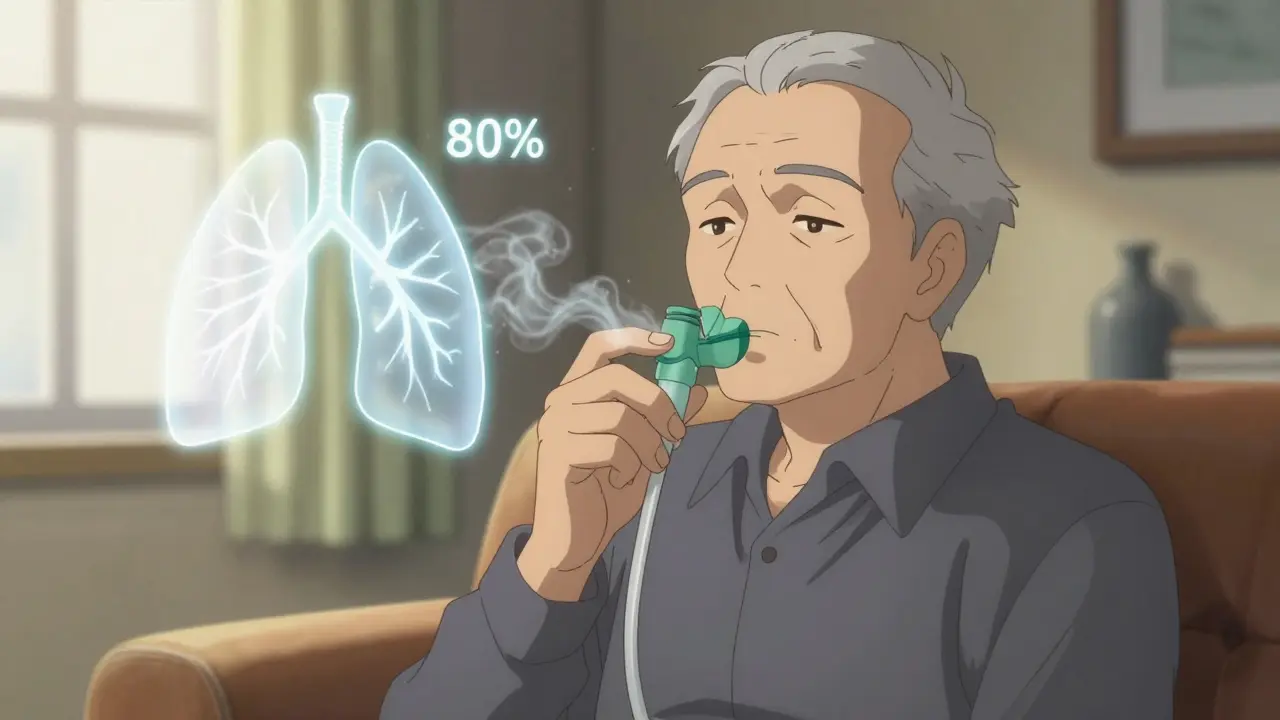
Most people don’t realize they have COPD until it’s already advanced. By then, simple tasks like walking to the mailbox or getting dressed leave them gasping. The truth? COPD doesn’t come on suddenly. It creeps in slowly, often mistaken for aging or being out of shape. But understanding the stages - mild, moderate, severe - can change everything. It’s not just about labels. It’s about catching it early enough to slow it down, or even stop it from getting worse.
What COPD Really Is
Chronic Obstructive Pulmonary Disease isn’t just one condition. It’s a group of lung diseases - mostly emphysema and chronic bronchitis - that make it hard to breathe because your airways are narrowed and damaged. Unlike asthma, where airways can open up with medication, COPD damage is mostly permanent. The main cause? Smoking. But long-term exposure to fumes, dust, or pollution also plays a role. It’s not rare. In the U.S. alone, about 16 million people are diagnosed, and another 14 million likely have it and don’t know.
The key to diagnosing COPD? Spirometry. That’s the breathing test where you blow hard into a tube. Doctors measure how much air you can force out in one second - that’s your FEV1. Then they compare it to what’s normal for someone your age, height, and gender. If your FEV1 is below 80% of predicted and your FEV1/FVC ratio is under 0.70 after using a bronchodilator, you have COPD. No guesswork. No assumptions. Just hard numbers.
Stage 1: Mild COPD - You Might Not Even Notice
Stage 1 means your FEV1 is 80% or higher of what’s expected. Sounds fine, right? But here’s the catch: many people in this stage don’t feel sick. They think they’re just getting older. Maybe they’re slower on walks. Maybe they cough a little in the morning. They blame it on being out of shape.
But research shows 65% of people in Stage 1 already get short of breath when walking fast or climbing hills. About 42% have a daily cough with phlegm. These aren’t normal signs of aging. They’re early warning signals. The problem? Only 12% of people over 40 who smoke and have symptoms actually get tested. That means most Stage 1 cases go undiagnosed for years - sometimes over five.
Here’s the good news: Stage 1 is the best time to act. Quitting smoking can cut the rate of lung decline in half. Instead of losing 60 mL of lung function per year, you drop to about 30 mL. Add in a simple pulmonary rehab program - even just a few weeks of breathing exercises and light activity - and you can improve your daily life significantly. One person diagnosed at 62 with an FEV1 of 85% told their doctor, “I’ve kept my numbers stable for two years since quitting. Maybe I’ll never get worse.” That’s possible. And it starts here.

Stage 2: Moderate COPD - Life Starts to Change
Now your FEV1 drops to between 50% and 79%. This is where symptoms become harder to ignore. You’re not just slow on walks anymore. You stop every few minutes on level ground just to catch your breath. Eighty-three percent of people in this stage say they can’t walk more than a few blocks without pausing. Mucus builds up. You’re coughing more. You might start avoiding stairs or skipping social events because you’re too tired.
Doctors start adding long-acting bronchodilators - either LABA or LAMA - to your daily routine. These aren’t rescue inhalers. They’re maintenance meds that open your airways for 12 to 24 hours. Studies show they can improve your FEV1 by 100 to 150 mL. That might not sound like much, but it means you can walk farther, climb stairs without stopping, and sleep better.
Pulmonary rehab becomes essential. It’s not just exercise. It’s education, breathing techniques, and emotional support. People who do it regularly increase their 6-minute walk distance by 45 to 75 meters. That’s the difference between needing help to get groceries and doing it yourself. Vaccines matter too. Getting the flu shot cuts your risk of flare-ups by 32%. Pneumonia shots are just as important.
But here’s the twist: symptom severity doesn’t always match FEV1. Someone with Stage 2 COPD can feel as bad as someone with Stage 3. That’s why doctors now use tools like the CAT score (COPD Assessment Test) and mMRC dyspnea scale to measure how much your breathing affects your life. If your CAT score is 10 or higher, you’re in a high-symptom group - even if your FEV1 is still in the 70s. Treatment should match how you feel, not just the number on the chart.
Stage 3: Severe COPD - Daily Life Becomes a Struggle
FEV1 drops to 30-49%. This is where COPD stops being something you manage and starts being something that controls you. Ninety-two percent of people at this stage get out of breath just getting dressed or washing up. Oxygen levels in the blood often dip below 90% during normal activities. You’re not just tired - you’re exhausted. And you’re more likely to have flare-ups - sudden worsening of symptoms that often land you in the hospital.
Treatment gets more aggressive. You’ll likely be on a combo inhaler - LAMA plus LABA - which reduces moderate-to-severe flare-ups by 14% compared to single drugs. If your blood test shows high eosinophils (over 300 cells/μL), you might add an inhaled steroid. It won’t fix your lungs, but it cuts flare-ups by 25% in those with the right profile.
Exercise is still critical, even if you’re breathless. A 6-minute walk test is done every year to track progress. It’s not about speed - it’s about how far you go before stopping. Many patients in this stage report panic attacks triggered by small tasks. One Reddit user wrote, “I can’t walk to my mailbox (20 feet) without stopping. My FEV1 is 38%. My doctors keep saying I’m ‘only’ Stage 3, so I must be exaggerating.” That’s the cruel gap between clinical numbers and real life. Your suffering is real, even if the test says you’re “only” moderate.
Many people here are also dealing with heart problems. About 65% of Stage 2 and 3 COPD patients have cardiovascular disease. Your lungs are struggling, but your heart is working harder to pump oxygen. That’s why some experts now say COPD staging should include heart health checks. It’s not just lungs anymore.

Stage 4: Very Severe COPD - Living on Oxygen
FEV1 is below 30%. This is the most advanced stage. Breathing isn’t just hard - it’s exhausting. Eighty-nine percent of people need supplemental oxygen for at least 15 hours a day. You can’t walk across a room without stopping. You might sleep with a mask on your face to help you breathe at night. Hospital visits for flare-ups become common. Each one carries a 22% risk of dying within the next year.
Oxygen therapy is no longer optional. The NOTT trial showed that using oxygen 15+ hours a day increases one-year survival from 73% to 90%. That’s life-changing. Non-invasive ventilation (NIV) - a machine that helps you breathe through a mask - can cut hospital readmissions by 28%. It’s not a cure, but it gives you back some control.
But the real challenge isn’t medical. It’s emotional and financial. Many Stage 4 patients spend $287 a month out-of-pocket for oxygen equipment, even with Medicare. Forty-four percent say social isolation is worse than the breathlessness. They stop seeing friends because they’re too tired. They feel like a burden. One patient said, “I used to love gardening. Now I can’t even stand up to water the plants.”
There’s hope, though. New biologics are in development - drugs that target specific inflammation pathways in the lungs. And AI is helping doctors interpret spirometry faster and more accurately. At Massachusetts General, AI reduced staging errors by 35%. But the biggest barrier isn’t technology. It’s detection. Only 36% of primary care visits for breathing problems include spirometry. That means most people aren’t getting tested until it’s too late.
What You Can Do Right Now
If you’re over 40, smoke or used to smoke, and have any breathing trouble - coughing, wheezing, getting winded easily - get tested. Don’t wait. Don’t assume it’s just aging. Spirometry takes five minutes. It’s cheap. It’s covered by insurance. And it’s the only way to know for sure.
Even if you’re already diagnosed, don’t give up. Progression isn’t inevitable. Quitting smoking at any stage helps. Pulmonary rehab works. Sticking to meds saves lives. And if you’re struggling with isolation or depression, talk to someone. Support groups exist. Online communities like the COPD Foundation have thousands of people who get it.
The numbers don’t define you. But they can guide you. Stage 1 isn’t a death sentence. Stage 4 isn’t the end. It’s a signal - a chance to act before it’s too late. The goal isn’t to be perfect. It’s to breathe a little easier, for a little longer.
Can COPD be reversed?
No, COPD damage can’t be reversed. But its progression can be slowed - sometimes dramatically. Quitting smoking, using prescribed inhalers, doing pulmonary rehab, and avoiding lung irritants can keep your lung function stable for years. Some people with mild COPD who quit early never progress to the next stage.
Is COPD the same as asthma?
No. Asthma is usually reversible with medication and often starts in childhood. COPD is progressive, caused mostly by smoking or long-term exposure to irritants, and mostly affects adults over 40. While both cause wheezing and shortness of breath, COPD symptoms get worse over time and don’t fully improve with inhalers like asthma does.
Why do some people with low FEV1 feel fine, while others with higher numbers feel terrible?
Because COPD isn’t just about lung numbers. It’s also about symptoms and flare-up history. The GOLD system now uses tools like the CAT score and mMRC scale to measure how much breathing trouble affects daily life. Someone with Stage 2 COPD but high symptom scores and frequent flare-ups is treated like someone with Stage 3. Your experience matters as much as your test result.
What’s the most important thing I can do if I have COPD?
Stop smoking - if you haven’t already. It’s the single most effective thing you can do to slow down lung damage. Next, stick to your treatment plan, even when you feel okay. And get pulmonary rehab. It’s not just exercise - it’s training your body to use less oxygen and breathe more efficiently. Many people say it’s the best thing they ever did.
Can I still travel or fly with COPD?
Yes, but you need to plan. Airplane cabins have lower oxygen levels, which can make breathing harder. Talk to your doctor before flying. You may need portable oxygen. Airlines require advance notice - usually 48 to 72 hours - and some require a medical clearance form. Don’t assume you can just bring your oxygen tank on board. Rules vary by airline, so check early.
How often should I get my lung function tested?
Once a year is standard for most people with COPD. But if you’re in Stage 3 or 4, or you’ve had recent flare-ups, your doctor may want to test every 6 months. The 6-minute walk test is also done annually to track how well you’re doing in real life - not just in the clinic.
Vu L
December 28, 2025 AT 14:29Yeah right, like quitting smoking somehow magically fixes your lungs. I knew a guy who quit after 30 years and still ended up on oxygen by 55. This whole 'stages' thing is just a way for doctors to sell more inhalers.
James Hilton
December 29, 2025 AT 23:38Yo, if you're still breathing, you're winning. COPD ain't a death sentence-it's a wake-up call with a side of inhaler. Get your ass to rehab, stop whining, and go walk around the block. Your lungs don't care how 'stressed' you are.
Mimi Bos
December 30, 2025 AT 09:10i just read this and thought about my dad… he smoked for 40 years and quit when he got diagnosed with stage 2. he says he can’t believe how much better he feels even tho he still gets winded. not sure if i spelled everything right but… yeah. keep going.
Payton Daily
December 30, 2025 AT 22:57Let me tell you something real. The system doesn’t want you to heal. They want you dependent. Inhalers? Oxygen tanks? All part of the pharmaceutical industrial complex. They don’t want you to know that fasting, cold showers, and breathing through your nose can reverse inflammation. Science is a religion, and COPD is their latest sacrament. You’re being manipulated. Wake up.
My cousin’s neighbor’s dog got COPD from secondhand smoke and lived to 18. Dogs don’t take meds. They just breathe. Maybe we should too.
They told me I’d be on oxygen by 50. I’m 52. Still walking. Still laughing. Still not using my inhaler every day. Coincidence? Or proof that the numbers are lies?
They say your lungs are damaged. But what if your spirit is the real organ that’s failing? Maybe you don’t need more medicine. Maybe you need more meaning.
I used to think COPD was just lungs. Now I know it’s a metaphor. We’re all breathing in poison. The air, the news, the lies. Your body’s just the first to scream.
Kelsey Youmans
December 31, 2025 AT 06:22Thank you for this comprehensive and clinically accurate overview. The emphasis on spirometry as a diagnostic cornerstone is particularly commendable. I have observed in my practice that many patients are reluctant to undergo testing due to fear of stigma or fatalism, which underscores the critical need for compassionate communication alongside clinical rigor. The integration of patient-reported outcomes such as the CAT score represents a significant advancement in holistic care.
Sydney Lee
December 31, 2025 AT 07:06It’s appalling how casually society dismisses COPD as ‘just smoking consequences.’ What about the factory workers exposed to silica for 40 years? The women in developing countries breathing smoke from open fires? The veterans exposed to burn pits? This narrative reduces complex, systemic failures to individual moral failings. It’s not just about quitting smoking-it’s about corporate negligence, policy failure, and the erasure of environmental justice.
And yet, we celebrate the ‘resilient smoker’ who quits and lives to 80, while ignoring the 14 million undiagnosed who never had a choice. This isn’t a personal failure. It’s a societal one. And until we stop blaming the victim, we’ll keep failing them.
oluwarotimi w alaka
January 2, 2026 AT 06:44USA got the worst health care in the world and they still blame the sick? My cousin in Nigeria, he breathe dust from road but no money for doctor, he still walk 10km to farm. You think your FEV1 number matter? You think doctor care? They care about your insurance. COPD is a capitalist trap. You pay or you die. Simple.
Debra Cagwin
January 3, 2026 AT 21:28To anyone reading this who feels overwhelmed-please know you’re not alone. I’ve seen people go from barely walking to hiking a trail with their grandkids after pulmonary rehab. It’s not magic. It’s consistency. Small steps. One breath at a time. You don’t have to be perfect. You just have to keep showing up-for yourself. And if you need someone to walk beside you, I’m here. You’ve got this.