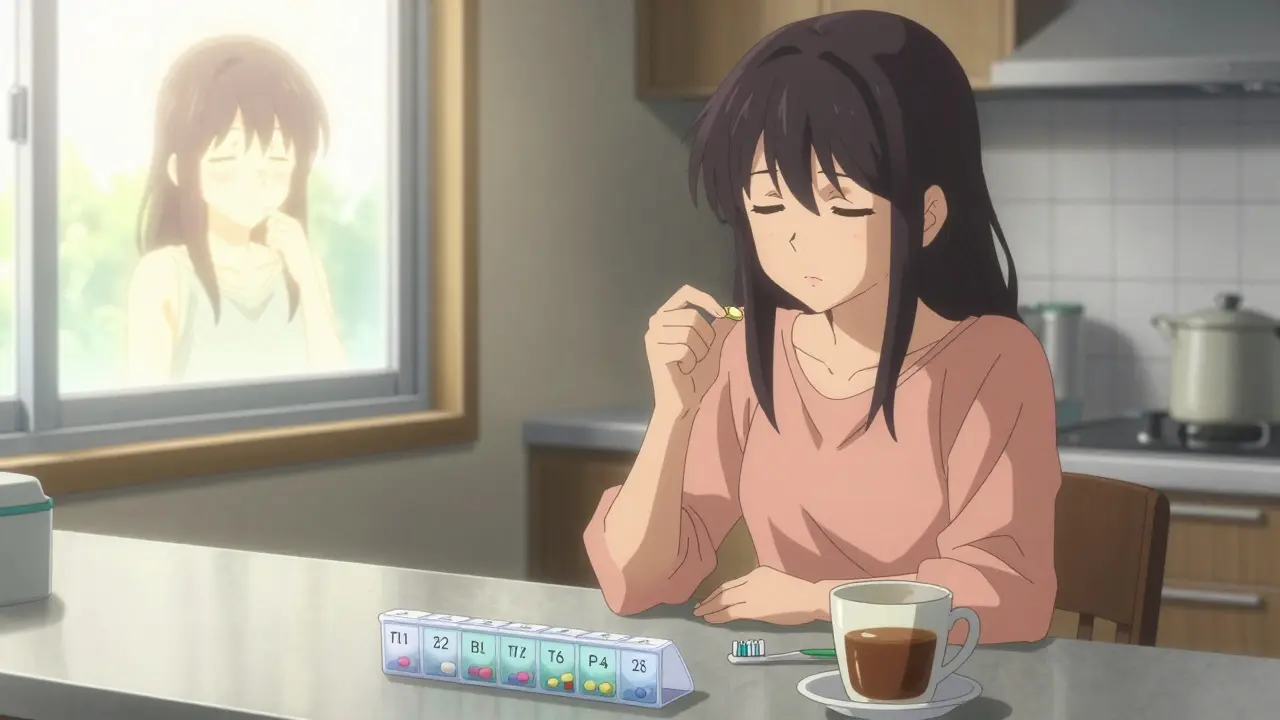
Taking a pill every day for years isn’t just a habit-it’s a full-time job. For people managing conditions like high blood pressure, diabetes, or rheumatoid arthritis, medication isn’t optional. Miss a dose, and the consequences can be serious: hospital visits, worsening symptoms, even life-threatening complications. Yet, medication adherence remains one of the biggest challenges in long-term care. Studies show that less than half of people with chronic conditions take their meds exactly as prescribed. Why? It’s not laziness. It’s not forgetfulness alone. It’s the weight of daily repetition, fear of side effects, confusing schedules, cost stress, and emotional burnout. The good news? There are proven ways to cope-and they’re not just about setting phone alarms.
What Makes Long-Term Medication Use So Hard?
Think about your own routine. You wake up, make coffee, check your phone, get dressed. Now imagine adding five or six pills to that morning, each with different instructions: take with food, take on an empty stomach, avoid grapefruit, don’t lie down for 30 minutes. Add in the anxiety of side effects-nausea, dizziness, fatigue-and the guilt when you skip one because you’re feeling fine. Then there’s the cost. A $300 monthly prescription isn’t just expensive-it’s a daily reminder of how fragile your health feels.
It’s no surprise that adherence drops over time. The first month? Most people are motivated. By month six? Many start cutting corners. By year two? A third have stopped taking at least one medication. This isn’t about willpower. It’s about systems. And systems can be fixed.
Problem-Solving: The Most Effective Strategy
Among all coping strategies, one stands out: problem-solving or active coping. In a 2022 review of 15 studies across chronic illnesses, 78% of the research found this approach strongly linked to better medication use. What does it look like in real life?
- Instead of saying, “I keep forgetting,” you ask: “What’s making me forget?” Is it the time of day? The location? The number of pills?
- You try a pill organizer labeled with days and times. You put it next to your toothbrush. You link taking meds to brushing your teeth-something you already do without thinking.
- If cost is the issue, you talk to your pharmacist. Generic versions? Patient assistance programs? Mail-order options? These aren’t just options-they’re solutions you can act on.
- If side effects scare you, you don’t stop. You call your doctor. Maybe the dose can be lowered. Maybe a different drug works just as well with fewer side effects.
This isn’t about being positive. It’s about being practical. Problem-solving turns vague frustration into specific actions. And those actions build confidence. When you solve one problem, you start believing you can solve the next.
Emotion-Focused Coping: Managing the Mental Load
Chronic illness doesn’t just affect your body. It affects your mood. Depression, anxiety, and feeling overwhelmed are common-and they directly impact whether you take your pills. That’s where emotion-focused coping comes in. This isn’t about ignoring your feelings. It’s about managing them so they don’t sabotage your health.
People who use this strategy might:
- Journal about how they feel when they take their meds-what emotions come up, what memories they trigger.
- Practice mindfulness or breathing exercises before taking pills to reduce anxiety.
- Use self-encouragement: “I’m doing this because I want to be here for my family,” or “This pill is keeping me out of the hospital.”
- Listen to music or podcasts while taking meds to make the routine feel less like a chore.
A 2019 study of rheumatoid arthritis patients found that those who used self-encouragement and diversion techniques (like listening to music or watching TV while taking pills) were significantly more likely to stay on track. These weren’t big changes. Just small moments of comfort woven into the routine.
Support Seeking: You’re Not Alone
One of the biggest myths about chronic illness is that you have to handle it alone. You don’t. Seeking support isn’t weakness-it’s strategy. Research shows that people who talk openly about their medication routine with family, friends, or healthcare providers are more likely to stick with it.
How to do it right:
- Ask a family member to check in once a week: “Did you take your blood pressure pill today?” Not to nag-to connect.
- Join a patient group. Online or in person. Sharing stories with others who get it reduces isolation.
- Work with a pharmacist. Many pharmacies now offer free medication reviews. They’ll look at your entire list, spot interactions, simplify your regimen, and even call you when refills are due.
One patient in Manchester told me she started bringing her pillbox to her weekly coffee with her sister. They’d talk about how she was feeling, and her sister would help her refill the box. Simple. But it worked.

What Doesn’t Work: Avoidance and Denial
Not all coping strategies help. In fact, one of the most common-problem avoidance-often backfires. That’s when you ignore the problem instead of facing it: “I’ll take it tomorrow,” “I feel fine, so I don’t need it,” “I’ll just skip a few days.”
Studies show this approach leads to worse outcomes. In half of the research that looked at avoidance, it was linked to lower adherence. And in some cases, it even made people feel worse physically because their condition worsened.
Why? Because avoidance doesn’t solve anything. It just delays the consequences. And when the consequences hit-like a heart attack or a flare-up-it’s harder to recover.
Team-Based Care: The System That Works
The best results come when patients aren’t left to figure it out alone. Team-based care-where pharmacists, nurses, doctors, and social workers work together-has shown dramatic improvements. One CDC study found that patients who got this kind of support had 89% adherence after a year. Those who didn’t? Only 74%.
What does team-based care look like in practice?
- A pharmacist reviews all your meds and simplifies your schedule-maybe switching from three daily pills to one combination pill.
- A nurse calls every few weeks to ask how you’re doing-not just about your numbers, but about your life. Are you working? Sleeping? Eating?
- A social worker helps with transportation, insurance, or medication costs. They know about RxAssist.org and other programs that cut costs by 50% or more.
This isn’t luxury care. It’s smart care. And it’s becoming more common in UK clinics and community pharmacies.
Real Barriers, Real Solutions
Here’s what actually gets in the way-and how to fix it:
- Too many pills → Ask about combination medications. Many drugs now come in one pill (like a blood pressure + cholesterol combo).
- Cost → Ask your pharmacist about generics. Use RxAssist.org or Patient Assistance Programs. Some drugs cost $5/month instead of $300.
- Confusing instructions → Request written instructions. Ask for a pill organizer with clear labels. Use a medication app that sends reminders.
- Side effects → Don’t quit. Talk to your doctor. There’s often another option.
- Feeling fine → Remember: chronic meds work when you take them. If you feel good, it’s because the pills are working.

What About Age and Gender?
Research shows some patterns. Older adults and women tend to adhere better. Why? Older adults often have more routines and fewer distractions. Women are more likely to seek help and talk about their health. But that doesn’t mean men or younger people can’t succeed. It just means they might need different support.
One study found women with rheumatoid arthritis were nearly five times more likely to stick with their meds than men. That’s not because women are “better patients.” It’s because they’re more likely to ask questions, reach out for help, and use emotional coping strategies. Men aren’t less capable-they’re just less likely to be asked, or to think they need help.
What You Can Do Today
You don’t need a perfect system. You need a starting point. Here’s what to do this week:
- Write down every medication you take, including dose and time.
- Check if any can be combined or switched to generics.
- Set one daily reminder on your phone-right after a habit you already do (like brushing your teeth).
- Call your pharmacist. Ask if they offer free medication reviews.
- Find one person you can talk to about your meds-no judgment, just support.
Improvement doesn’t come from willpower. It comes from small, consistent changes. And if you’ve been struggling for years? That’s okay. It’s never too late to start building a system that works for you.
Why do I still forget to take my pills even though I set reminders?
Reminders help, but they don’t fix the deeper issue: whether taking your pill feels meaningful. If you don’t connect the action to a personal reason-like staying independent, playing with your grandkids, or avoiding a hospital trip-you’re more likely to ignore it. Try linking your pill to a daily ritual you enjoy, like your morning coffee. Say out loud: “This is what lets me keep my life.” That emotional connection makes the habit stick.
Can coping strategies replace medication?
No. Coping strategies help you take your medication consistently-they don’t replace it. Medications for chronic conditions like hypertension, diabetes, or heart disease work because they change your body’s chemistry. Skipping them can lead to serious damage, even if you feel fine. Coping strategies are the bridge between knowing what to do and actually doing it.
What if my doctor won’t simplify my medication schedule?
Ask for a referral to a clinical pharmacist. Many clinics now have pharmacists who specialize in medication management. They can review your entire list, spot unnecessary drugs, suggest combinations, and even contact your doctor on your behalf. In the UK, NHS pharmacies often offer this service for free. You don’t need permission-you just need to ask.
Are there free tools to help track my meds?
Yes. Apps like Medisafe, MyTherapy, and even Google Calendar with recurring reminders work well. Some NHS pharmacies also offer free pill organizers with labels. If cost is an issue, ask at your local pharmacy-they often have them available at no charge. Don’t overcomplicate it. A simple paper chart taped to your fridge can be just as effective as a high-tech app.
How do I know if I’m really adhering?
Count your refills. If you refill your prescription every month without fail, you’re likely doing well. But if you’re running out early or skipping refills, it’s a red flag. You can also ask your pharmacist-they can tell you how often you refill and if there are gaps. Some clinics use pill counts or electronic monitors. But the easiest way? Be honest with yourself. If you’ve skipped a dose this week, don’t feel guilty. Just ask: “What changed? What can I adjust?”
Final Thought: It’s Not About Perfection
You don’t have to take every pill, every day, perfectly. That’s impossible for most people. The goal isn’t flawless adherence. It’s sustainable adherence. Some days, you’ll forget. Some weeks, you’ll struggle. That’s normal. What matters is that you keep trying. That you talk about it. That you adjust. That you don’t give up because you made one mistake. Chronic illness is a marathon, not a sprint. And the best strategy? The one you can live with-for years.
Robert Petersen
February 10, 2026 AT 10:29Love this breakdown. Seriously. Taking meds daily feels like a second job sometimes, and no one talks about the emotional toll. I’ve been on blood pressure meds for 8 years, and the turning point for me was linking it to my morning coffee. I say out loud: 'This is what lets me play with my niece without getting winded.' Small thing. Huge difference.
Craig Staszak
February 10, 2026 AT 20:44Team-based care is the real MVP here. My pharmacist in Manchester started calling me every 3 weeks just to check in. Not about numbers. About sleep. About whether I was still walking the dog. That’s care. Not just pills. That’s humanity.
Alyssa Williams
February 11, 2026 AT 22:21So many people think adherence is about willpower. Nope. It’s about making it effortless. I use a pillbox from my pharmacy, put it next to my keys, and take it right before I leave for work. No thinking. Just doing. Works like magic.
Reggie McIntyre
February 13, 2026 AT 07:44There’s something wild about how our brains treat medication. It’s not just a chemical. It’s a symbol. For some, it’s a reminder of brokenness. For others, it’s armor. The magic isn’t in the pill. It’s in the ritual you build around it. I started playing my favorite album while taking my meds. Now, that song means 'I’m still here.'
Ojus Save
February 14, 2026 AT 06:55took my bp pill today. forgot the other one. oh well. maybe tomorrow. dont feel bad. just keep going.
Ernie Simsek
February 15, 2026 AT 11:45Let’s be real. 89% adherence? That’s a miracle. 😏 Who’s lying? The CDC? The pharma reps? The ‘team-based care’ folks? Someone’s selling something. And it’s not just pills. It’s hope. And hope? That’s the most profitable drug of all. 💊🧠
Carla McKinney
February 17, 2026 AT 02:59Problem-solving? Emotion-focused coping? These are just buzzwords for 'try harder.' The real issue is systemic. People can’t afford meds. Doctors don’t have time. Pharmacies are profit-driven. No amount of journaling fixes a $400 monthly bill. Stop romanticizing personal responsibility. Fix the system.
Neha Motiwala
February 18, 2026 AT 21:44I’ve been on six pills a day for seven years. I’ve cried. I’ve thrown them out. I’ve pretended I took them. I’ve lied to my doctor. I’ve felt like a failure. But then I started bringing my pillbox to my sister’s coffee. She doesn’t ask if I took them. She asks how I’m feeling. And that’s enough. I’m not fixed. I’m just not alone anymore.
Robert Petersen
February 20, 2026 AT 04:42That’s beautiful. And honestly? That’s the kind of support that lasts. Not apps. Not alarms. Just someone who shows up. I’m going to start doing that with my cousin. She’s on diabetes meds. I’ll bring her coffee. No lecture. Just presence.
Joanne Tan
February 20, 2026 AT 17:49My doctor said 'just take it' and left. Then I found a free med review at my local pharmacy. They cut my regimen from 8 pills to 3. One of them was a combo. I cried. Not because I was sad. Because for the first time, I felt like they saw me.
Jack Havard
February 21, 2026 AT 11:53Adherence rates are manipulated. You think 89% is real? Try living in a rural area with no pharmacy access. Try being undocumented. Try being a single parent working two jobs. The data doesn’t reflect reality. It reflects who gets to be counted.
athmaja biju
February 22, 2026 AT 19:50India has the highest number of chronic disease patients in the world. Yet we have zero public health infrastructure for medication support. We rely on family. On faith. On luck. This post is beautiful. But it’s written for people who have access. What about the millions who don’t? No one talks about that.
Gloria Ricky
February 24, 2026 AT 01:58I used to skip my meds when I felt fine. Then I got hospitalized. Twice. Now I have a sticky note on my mirror: 'I’m not fine because I skipped. I’m fine BECAUSE I took it.' Simple. But it sticks.