Drug Causality Estimator
This tool helps assess whether a drug reaction is likely to be caused by the medication using clinical dechallenge and rechallenge principles. Enter your scenario details to receive a causality assessment.
When a patient develops an unexpected reaction after taking a medication, doctors face a tough question: Is this drug really to blame? It’s not enough to say, "It happened after the drug started." That’s just coincidence. To know for sure, doctors use two powerful but rarely discussed tools: dechallenge and rechallenge. These aren’t lab tests or scans-they’re real-world clinical moves that help cut through the noise and prove whether a drug caused the problem.
What Is Dechallenge?
- You stop the drug.
- You watch what happens to the side effect.
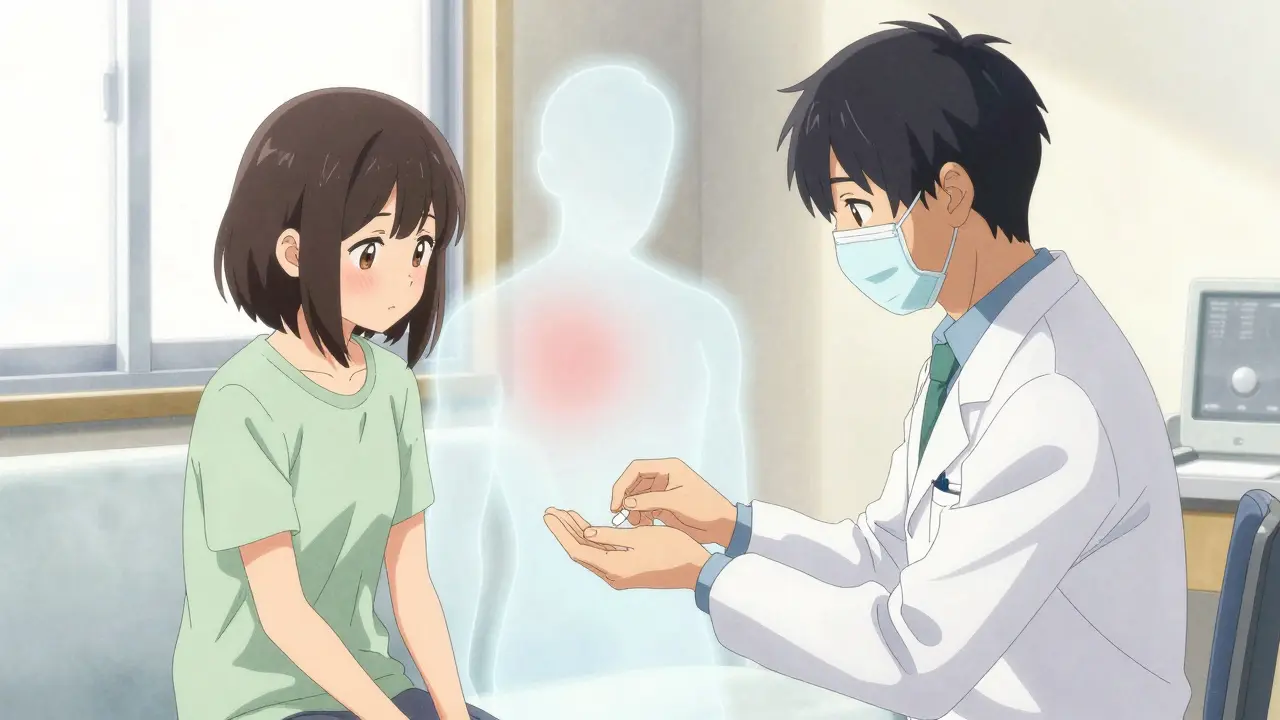
- If the symptom gets better or disappears-congratulations, you just had a positive dechallenge.
That’s the whole idea. Dechallenge is the first, most common, and safest step in figuring out if a drug caused an adverse reaction. For example, if someone develops a rash after starting a new antibiotic, and the rash fades within a week of stopping the drug, that’s a strong clue the antibiotic was the culprit. The timing matters. If the reaction clears within a timeframe that matches how long the drug stays in the body-say, 2 to 5 days for most antibiotics-it adds weight to the connection.
But not all dechallenge results are clear. Sometimes, symptoms don’t fully go away. Maybe the rash leaves behind dark spots, or nerve pain lingers. That’s a negative dechallenge. It doesn’t mean the drug was harmless-it could mean the damage was permanent, or another factor (like an infection or autoimmune issue) was involved. A negative dechallenge doesn’t rule out the drug; it just means you need more evidence.
What Is Rechallenge?
Rechallenge is the next, riskier step. It means giving the drug back-on purpose-to see if the same reaction happens again.
Imagine this: A patient gets a severe skin reaction after taking metronidazole. The drug is stopped. The rash clears over two weeks. Then, under strict medical supervision, the patient is given the same drug again. Within 48 hours, the exact same rash appears in the same spot. That’s a positive rechallenge. It’s not just correlation anymore. It’s proof.
Rechallenge is the gold standard for proving drug causality. According to the World Health Organization’s pharmacovigilance system, a confirmed rechallenge moves the likelihood of drug involvement from "probable" to "definite" in 97% of cases. No algorithm, no statistical model, no expert opinion beats this kind of direct evidence.
But here’s the catch: Rechallenge is rarely done. Why? Because it’s dangerous. If the reaction was life-threatening-like liver failure, Stevens-Johnson syndrome, or anaphylaxis-reintroducing the drug could kill the patient. The FDA estimates that deliberate rechallenge is approved in only 0.3% of serious adverse event investigations. Even in dermatology, where reactions are often visible and less immediately deadly, rechallenge is avoided in over 85% of cases.
When Do Doctors Use These Tools?
Dechallenge is routine. In dermatology, it’s used in 87% of suspected drug rash cases. In liver injury, it’s used in 79%. In psychiatry? Only 43%. Why the difference? Because stopping an antidepressant or antipsychotic can trigger withdrawal, relapse, or even suicide risk. The danger of stopping the drug sometimes outweighs the benefit of proving causality.
Rechallenge? It’s mostly reserved for:
- Mild reactions: like a minor rash or headache that didn’t require hospitalization.
- Research settings: where patients are fully informed and monitored in controlled environments.
- When no other options exist: if a patient needs a drug with no alternatives-like certain antibiotics for resistant infections-and the only way to confirm safety is to test it directly.
In all cases, rechallenge requires:
- Written informed consent from the patient.
- Approval from an ethics committee.
- Immediate access to emergency care.

Why This Matters in Real Life
Most patients don’t realize how often they’re part of a hidden clinical experiment. If you’ve ever had a side effect, been told to stop a drug, and then felt better-you’ve undergone a dechallenge. If you’ve ever been told, "We can’t give you that drug again," even if you needed it, you’ve been protected from a rechallenge.
But here’s the problem: many patients stop drugs on their own. They read online that a medication causes side effects and quit without telling their doctor. That makes dechallenge useless. The doctor can’t tell if the improvement was from stopping the drug-or from a cold, stress, or coincidence.
And what about polypharmacy? If someone is on seven medications and one causes a reaction, which one is it? Stopping them all at once makes dechallenge impossible. That’s why pharmacovigilance teams now use electronic health record alerts and structured reporting forms that ask: "When did the reaction start? When did you stop each drug? Did symptoms improve?"
What’s New in 2026?
Technology is trying to reduce the need for rechallenge. In 2024, researchers at the NIH developed a blood test that analyzes a patient’s immune cells to predict whether they’ll react to a specific drug. It’s 89% accurate. That’s huge. If this becomes routine, we might avoid rechallenges entirely.
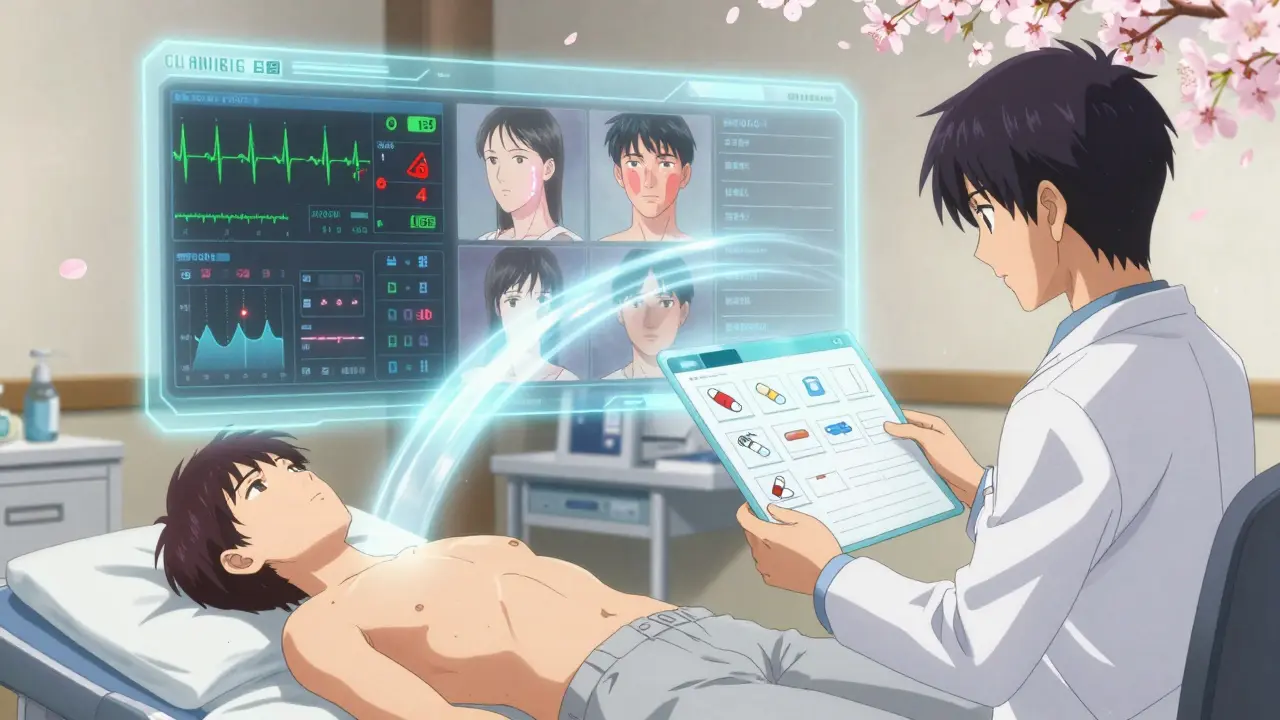
Wearable sensors are also helping with dechallenge. Instead of asking patients to describe how they feel, devices now track heart rate, skin temperature, and inflammation markers in real time. A 2023 study showed these sensors caught symptom resolution 78% of the time-compared to just 52% with patient reports.
Still, experts agree: no algorithm can replace the human experience. As Dr. Elena Rodriguez of the WHO said in 2024: "No algorithm can substitute for the clinical reality of symptom resolution after drug discontinuation-dechallenge remains the cornerstone of causality assessment that all emerging technologies must validate against."
How This Affects You
If you’ve had a strange side effect:
- Don’t stop your medication without talking to your doctor.
- Write down exactly when the symptom started and what drugs you were taking.
- Report it-even if you think it’s "not that bad."
- If your doctor suggests stopping a drug to see what happens, trust the process. That’s dechallenge-and it’s science in action.
If you’re prescribed a drug that caused a reaction before, your doctor should know. Even if you didn’t think it was serious. That history matters. It could save your life next time.
Final Thought
Dechallenge and rechallenge aren’t fancy terms. They’re simple, practical tools: stop the drug and see if it gets better. Give it back and see if it comes back. They’re the difference between guessing and knowing. And in medicine, knowing matters more than ever.
Can dechallenge prove a drug caused a side effect on its own?
Yes, but with limits. A positive dechallenge-where symptoms clearly improve after stopping the drug-is strong evidence, especially when combined with timing and biological plausibility. It’s often enough for doctors to avoid the drug in the future. However, without rechallenge, it’s usually classified as "probable" rather than "definite" causality. Rechallenge is the only way to reach "definite."
Is rechallenge ever done without patient consent?
Never. Rechallenge requires full, informed consent, approval from an ethics board, and emergency protocols in place. It’s not done in routine care. Even in clinical trials, patients must understand the risks and agree in writing. The FDA and WHO treat this as a non-negotiable ethical boundary.
Why don’t all doctors use dechallenge and rechallenge?
Many don’t know how to apply them properly. Others avoid rechallenge due to fear of harm. Some patients refuse to rechallenge, even when safe. And in busy clinics, time and documentation are limited. That’s why structured tools and electronic health record prompts are now being rolled out-so every clinician has a clear path to use these methods correctly.
Can you have a positive rechallenge with a different drug?
No. Rechallenge means giving back the exact same drug. If a reaction happens after taking a different drug, it’s likely a new reaction-not proof of causality for the original one. Cross-reactivity can happen (like between penicillin and cephalosporins), but that’s a separate issue. Rechallenge only confirms causality for the specific drug given.
How long should you wait before rechallenging?
There’s no fixed rule, but most protocols wait at least 4 to 6 weeks after full symptom resolution. This gives the body time to clear any lingering immune response. In severe cases, doctors may wait months or avoid rechallenge entirely. The key is ensuring the reaction is truly gone-not just suppressed.
Morgan Dodgen
March 8, 2026 AT 14:36Jazminn Jones
March 9, 2026 AT 22:42rafeq khlo
March 10, 2026 AT 21:23Erica Santos
March 12, 2026 AT 02:43Scott Easterling
March 12, 2026 AT 02:43Tom Sanders
March 13, 2026 AT 19:34Stephen Rudd
March 14, 2026 AT 01:40Melba Miller
March 14, 2026 AT 05:15George Vou
March 15, 2026 AT 08:45Philip Mattawashish
March 17, 2026 AT 03:55Mantooth Lehto
March 18, 2026 AT 10:52APRIL HARRINGTON
March 19, 2026 AT 20:24