When a generic drug company submits an Abbreviated New Drug Application (ANDA) to the FDA, they’re not just asking for permission to sell a cheaper version of a brand-name drug. They’re asking the FDA to confirm that their product is therapeutically equivalent to the original. But too often, that request hits a wall: a deficiency letter. These aren’t just polite requests for more info. They’re formal roadblocks that can delay approval by over a year - and cost millions.
According to FDA data from 2023 and 2024, over 70% of major deficiencies in generic drug applications are quality-related. That means the problem isn’t usually about marketing or pricing. It’s about science, manufacturing, and documentation. And the most common issues? They’re predictable. If you know what the FDA is looking for, you can avoid the trap.
Top Deficiencies in Generic Drug Applications
The FDA doesn’t leave companies guessing. Their deficiency letters are detailed, specific, and often repeat the same problems across dozens of applications. Based on FY2023 data and analysis of submissions from 2018-2023, the most frequent issues fall into three buckets: drug substance, drug product, and bioequivalence.
For drug substance (DS) deficiencies, 82% of problems trace back to issues in the Drug Master File (DMF) referenced by the applicant. That’s a critical point: if the supplier’s DMF is incomplete or outdated, your entire application suffers. Common DS flaws include:
- Inadequate characterization of impurities - especially those flagged under ICH M7 for mutagenicity
- Lack of data on physical properties like particle size, polymorph form, or solubility
- Missing toxicological studies for unqualified impurities
- Insufficient evidence that the starting materials match the reference listed drug (RLD)
For drug product (DP) deficiencies, the biggest offenders are:
- Unqualified impurities (20% of cases)
- DS sameness issues (19%) - meaning the generic doesn’t match the original in chemical or physical behavior
- Problems with Critical Quality Attributes (CQAs) - the key features that affect safety and efficacy
- Toxicology-exposure (Tox-E/L) limits not properly addressed
And then there’s bioequivalence. This is where most applications stumble. Dissolution testing - the method used to prove the generic releases the drug at the same rate as the brand - is the #1 cause of deficiency letters. In 2023, 23.3% of applications failed here. Why? Because many companies still use outdated apparatuses (like Apparatus 1 or 2) without validating them under biorelevant conditions. The FDA expects dissolution methods to reflect real human digestion, not just lab convenience.
Why Complex Drugs Fail More Often
Not all generic drugs are created equal. A simple immediate-release tablet of amoxicillin has a low risk of deficiency. But a modified-release tablet, a topical cream, or a peptide-based injectable? Those are high-risk. Data from the FDA shows complex generics - like extended-release formulations, inhalers, or biologics - face deficiency rates 40% to 65% higher than standard small-molecule drugs.
Why? Because they’re harder to replicate. Take modified-release tablets. They’re designed to release the drug slowly over hours. To do that, manufacturers use coatings, matrices, or osmotic systems. But if your coating is 5% thicker than the original, or your particle size distribution differs by 10 microns, the release profile changes. The FDA can detect that. And they will call it out.
Peptide drugs are even trickier. The FDA now requires circular dichroism, Fourier-transform infrared spectroscopy, and size-exclusion chromatography to prove that the secondary structure and aggregation profile of your peptide matches the reference. If you don’t have that data, your application won’t pass.
Companies with fewer than 10 approved ANDAs in their portfolio see deficiency rates 22% higher than those with 50 or more. Experience matters. And so does investment.
What the FDA Really Wants: Documentation and Evidence
It’s not enough to say, “We followed the guidelines.” The FDA wants proof. And that proof has to be detailed, consistent, and traceable.
One major red flag? Poor documentation. Applications with minimal development reports are 27% more likely to get a deficiency letter than those with thorough, clear explanations. The FDA reviewer has to understand not just what you did, but why you did it - and how you know it’s right.
For example, if you change the dissolution apparatus from Apparatus 2 to Apparatus 4 because your product is modified-release, you must justify it. You need data showing that Apparatus 2 couldn’t discriminate between your product and the RLD. You need validation across pH conditions (1.2, 4.5, 6.8). You need to prove your method is robust.
And then there’s the issue of “stock deficiencies.” A 2023 survey by the Association for Accessible Medicines found that 63% of companies received vague feedback on elemental impurities - like “control strategy insufficient” - without clear guidance on what the FDA expected. That’s frustrating. But it’s also preventable. Companies that request pre-submission meetings with the FDA cut their deficiency rates by 32%.
How to Avoid Deficiency Letters
You can’t eliminate all risk. But you can drastically reduce it.
- Use pre-submission meetings. The FDA offers these for free. Use them. Ask for feedback on your dissolution method, impurity profile, and DS sameness strategy before you submit. Early feedback saves months.
- Match the RLD exactly. Don’t assume your supplier’s DMF is good enough. Audit it. If the DMF doesn’t have full characterization data, don’t use it. Find a better source.
- Validate your dissolution method. Test it under biorelevant conditions. Don’t just copy an old method from a 2005 FDA guidance. Use Apparatus 2 for immediate-release, Apparatus 3 or 4 for modified-release. Show discrimination across pH levels.
- Address impurities early. Use (Q)SAR modeling for mutagenicity. Conduct toxicology studies for unqualified impurities before submission. Don’t wait for the FDA to ask.
- Invest in quality documentation. Your development report should read like a story: problem, solution, data, conclusion. Include raw data references. Link your methods to your specifications.
- Know your product complexity. If you’re making a peptide, a topical, or a modified-release product, assume you’ll face extra scrutiny. Build in extra time and budget for testing.
Companies that follow these steps see first-cycle approval rates jump from the industry average of 52% to over 70%. That’s not luck. That’s preparation.
The Cost of Getting It Wrong
Every deficiency letter adds 14 to 18 months to approval timelines. For a high-revenue generic drug - one that could bring in $100 million annually - that delay costs roughly $1.2 million in lost revenue and added development expenses. Small companies? They can’t afford that. Many never recover.
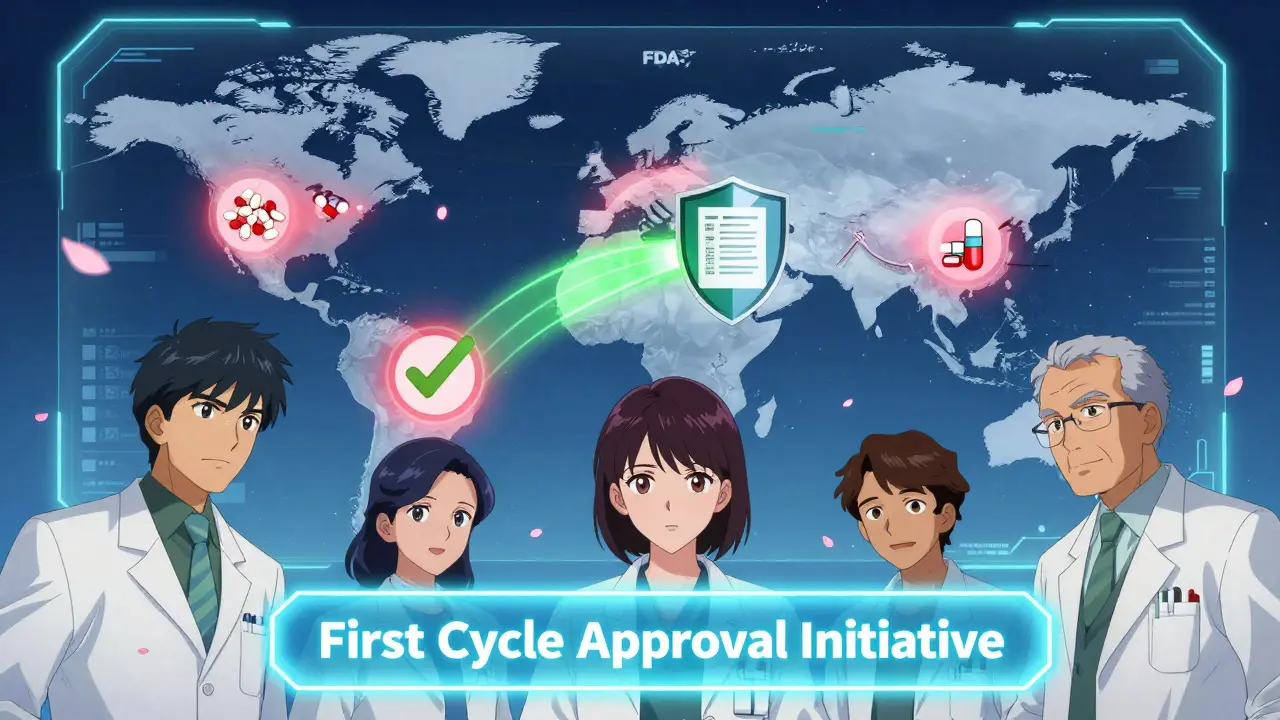
But here’s the good news: the FDA is trying to help. In 2023, they launched the First Cycle Generic Drug Approval Initiative, which includes new templates for common deficiencies and specialized review teams for complex products. By April 2025, they rolled out template responses for the 10 most frequent deficiency categories. And by Q3 2026, they plan to launch AI-assisted pre-submission screening - software that flags common errors before you even submit.
These changes aren’t just bureaucratic. They’re strategic. The FDA wants more generics on the market, faster. But they won’t compromise on safety. If you do the work upfront, you won’t get stuck in review limbo.
Final Thought: Deficiencies Are Preventable
Dr. David Rope, former Director of the FDA’s Office of Generic Drugs, said it plainly: “About 65% of major deficiencies could be avoided through better understanding of FDA expectations.”
It’s not about having the biggest lab or the most PhDs. It’s about knowing what the FDA looks for - and delivering exactly that. The data is public. The guidance is clear. The tools are available. The only thing missing is the discipline to use them.
What is a deficiency letter from the FDA?
A deficiency letter is a formal notice from the FDA’s Center for Drug Evaluation and Research (CDER) that identifies specific issues in an Abbreviated New Drug Application (ANDA) that prevent approval. It details what’s missing or incorrect - such as inadequate dissolution data, unqualified impurities, or failure to prove drug substance sameness - and requires the applicant to respond with additional information before the application can move forward.
What percentage of generic drug applications receive deficiency letters?
Approximately 48% of ANDA submissions receive at least one deficiency letter on first review, according to FDA FY2023 data. Of those, over 70% are due to quality-related issues, with dissolution and impurity-related problems being the most common.
Which types of generic drugs have the highest deficiency rates?
Complex generics - such as modified-release tablets, topical dermatologicals, peptides, and inhalers - have deficiency rates 40% to 65% higher than standard immediate-release small-molecule drugs. These products require advanced characterization and manufacturing controls that many applicants overlook.
How long does it take to resolve a deficiency letter?
Resolving a deficiency typically adds 14 to 18 months to the approval timeline, especially when toxicology studies or new manufacturing data are required. For unqualified impurities or DS sameness issues, the delay can be even longer if the applicant must source new materials or redevelop the formulation.
Can pre-submission meetings with the FDA reduce deficiency rates?
Yes. Companies that request and participate in pre-submission meetings with the FDA see deficiency rates that are 32% lower than those who submit without prior feedback. These meetings allow applicants to clarify expectations, validate methods, and avoid common pitfalls before the formal review begins.
What is the FDA doing to reduce deficiency letters?
The FDA has launched several initiatives to reduce deficiencies, including the First Cycle Generic Drug Approval Initiative, specialized review teams for complex products, and template responses for the 10 most common deficiency categories. By Q3 2026, the agency plans to implement AI-assisted pre-submission screening to automatically flag errors before formal review, potentially reducing preventable deficiencies by 35%.
Deficiency letters aren’t punishment. They’re feedback. And if you treat them as a guide - not a setback - you’ll get your drug approved faster, cheaper, and with far less stress.
Johny Prayogi
March 22, 2026 AT 11:32Man, this post is spot on. I’ve been in the trenches with ANDA submissions for 8 years now, and 70% of our deficiencies were due to DMF gaps. We lost a $40M launch because our supplier’s impurity profile was outdated. Now we audit DMFs like they’re bank accounts. If your supplier doesn’t give you raw chromatograms? Walk away. 🚫
Nishan Basnet
March 23, 2026 AT 16:59Brilliant breakdown. The emphasis on biorelevant dissolution is particularly critical. Too many firms still cling to Apparatus 1 and 2 like relics from the 90s. The FDA’s expectation isn’t mere compliance-it’s *contextual fidelity*. A tablet that dissolves perfectly in pH 6.8 but fails in simulated intestinal fluid? That’s not a generic. It’s a placebo with a label. 🧪
Allison Priole
March 25, 2026 AT 04:31Okay I just read this whole thing and I’m kinda emotional?? Like… I work at a small generics firm and we got hit with a deficiency letter last year over peptide aggregation. We didn’t even know we needed circular dichroism. 😭 But then we reached out to the FDA for a pre-sub meeting and they sent us a 3-page email that literally saved us. Now we’re prepping for submission again and I’m actually kinda excited? Who knew regulatory stuff could feel like a roadmap instead of a wall?? 🤗
Casey Tenney
March 25, 2026 AT 22:01Companies that don’t audit DMFs deserve to fail. No excuses. This isn’t rocket science-it’s basic due diligence. If you’re cutting corners on impurity data, you’re gambling with patient safety. And that’s not innovation. That’s negligence.
Sandy Wells
March 26, 2026 AT 00:23Deficiency letters are just the FDA’s way of saying you didn’t do your homework. Stop complaining. The guidelines are public. The templates exist. If you can’t follow a 50-page guidance doc, maybe you shouldn’t be in pharma.
Bryan Woody
March 26, 2026 AT 09:48Let me guess-you’re one of those companies that thinks ‘we followed the 2012 guidance’ is enough? LOL. The FDA updated dissolution requirements in 2020. Your method from 2015? It’s obsolete. Your ‘validated’ apparatus? Probably unvalidated. And your ‘sufficient’ impurity control? Not even close. You’re not getting approved until you stop treating regulatory science like a suggestion box. 🤦♂️
Chris Dwyer
March 26, 2026 AT 23:57Hey everyone-this is gold. Seriously. If you’re a small player, don’t panic. The FDA isn’t your enemy. They want you to succeed. I’ve helped three startups get through first-cycle approval by just doing three things: 1) Pre-sub meeting (free!), 2) Match the RLD like your life depends on it (it does), and 3) Document everything like you’re writing a novel. Your development report should tell a story. Not a spreadsheet. If you do that? You’re not just avoiding deficiency letters. You’re building a legacy. 🙌
Timothy Olcott
March 28, 2026 AT 01:49USA first. Why are we letting foreign suppliers mess with our drug supply? If your DMF is from India or China, you’re asking for trouble. FDA knows this. We need domestic manufacturing. Period. 🇺🇸