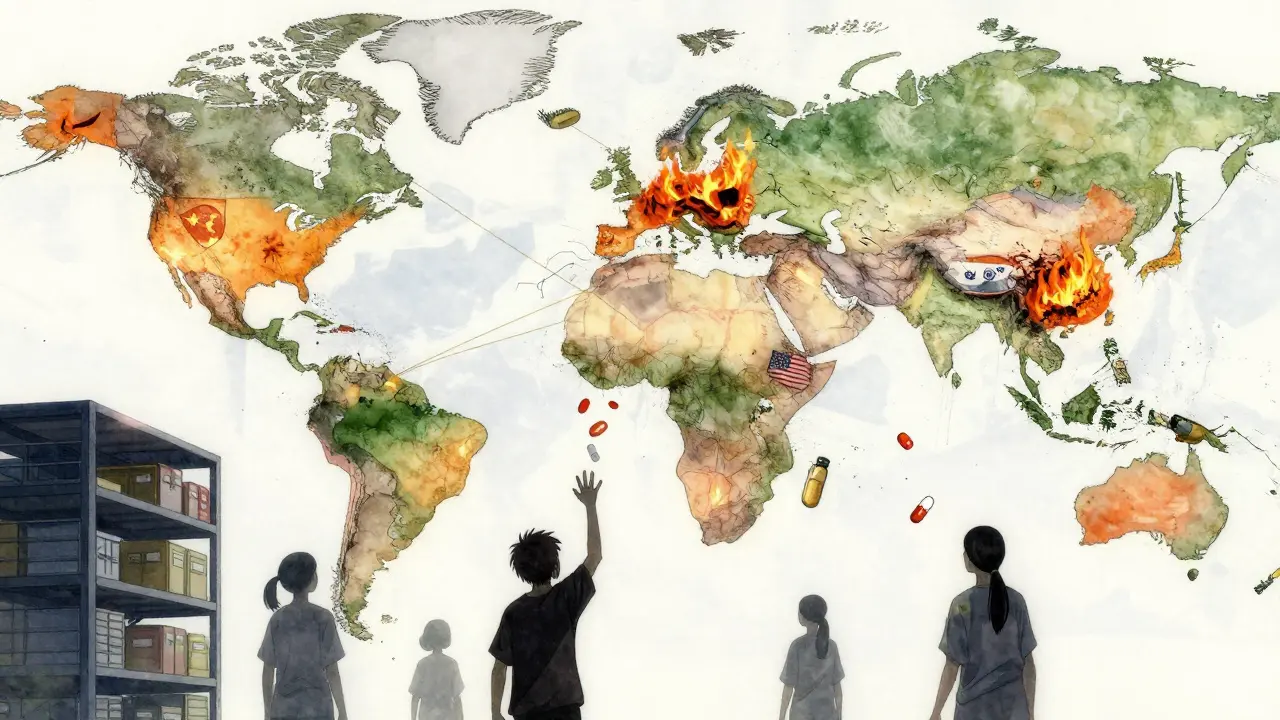
By 2026, one in five commonly prescribed medications in the UK and US could be hard to find. It’s not just a rumor - it’s a forecast backed by real data. Drug shortages aren’t random glitches anymore. They’re the result of deep, interconnected systems under strain. And the next five years will make today’s supply issues look mild.
Why drug shortages are getting worse, not better
The old way of thinking about drug shortages was simple: a factory broke down, or a raw material got delayed. That still happens. But now, the root causes are systemic. Climate change is disrupting the farms that grow key plant-based ingredients. Geopolitical tensions are cutting off supply lines from India and China, where 80% of active pharmaceutical ingredients are made. And labor shortages in manufacturing are slowing production just when demand is rising. The World Health Organization estimates that over 120 essential medicines faced global shortages in 2024. That number is expected to climb to 180 by 2027. It’s not just antibiotics or cancer drugs. Even common pills like metformin for diabetes or levothyroxine for thyroid issues are hitting supply walls. Why? Because no one’s building new factories to replace aging ones. And when a single plant makes 70% of a drug’s global supply, one fire or inspection shutdown can ripple across continents.The three big drivers of future drug scarcity
There are three forces pushing drug shortages into crisis territory. None of them are going away soon. 1. Fragmented global supply chainsMost drugs today are made in a chain that crosses three or four countries. The raw chemical might come from China, the capsule from Germany, the final packaging from Mexico. If any link breaks - say, due to a trade ban, a port strike, or a new environmental rule - the whole thing stalls. The U.S. Food and Drug Administration found that 75% of drug manufacturing facilities now rely on just one supplier for critical components. That’s not resilience. That’s a single point of failure. 2. Aging infrastructure and lack of investment
Many pharmaceutical plants in the U.S. and Europe were built in the 1980s and 90s. They’re outdated, inefficient, and expensive to upgrade. Meanwhile, new facilities are being built in Southeast Asia and India, but they’re still scaling up. The gap? About 5-7 years. That’s five to seven years where demand keeps growing - thanks to aging populations and new treatments - but supply can’t keep pace. 3. Economic pressure killing low-margin drugs Generic drugs are the backbone of global healthcare. But they’re cheap. A single tablet of amoxicillin might cost 2 cents to make. If the price is pushed down by bulk buyers or insurance companies, manufacturers stop making it. Why make pennies when you can make dollars on a new cancer drug? The result? Over 30% of generic drugs have been discontinued since 2018 because they’re no longer profitable. And when a generic disappears, there’s often no backup.
How forecasting works - and why it’s failing
Companies and governments do try to predict shortages. The FDA tracks inventory levels, hospital orders, and production delays. The European Medicines Agency runs similar systems. But these tools are reactive, not proactive. They see a drop in stock and then scramble to find alternatives. The real breakthroughs are happening in predictive modeling. One UK-based analytics firm, PharmForecast, uses AI to combine 14 data streams: weather patterns affecting crop yields, shipping delays from major ports, political instability in supplier countries, raw material prices, even social media chatter from pharmacists reporting out-of-stocks. Their model predicted the 2025 metformin shortage six months before it hit. But only 12% of NHS trusts use this kind of tool. Most still rely on spreadsheets and phone calls. The problem? Data isn’t shared. Drugmakers don’t want to reveal how much they’re producing. Hospitals don’t want to admit they’re running low. Regulators don’t have the authority to force transparency. So forecasts are built on guesswork.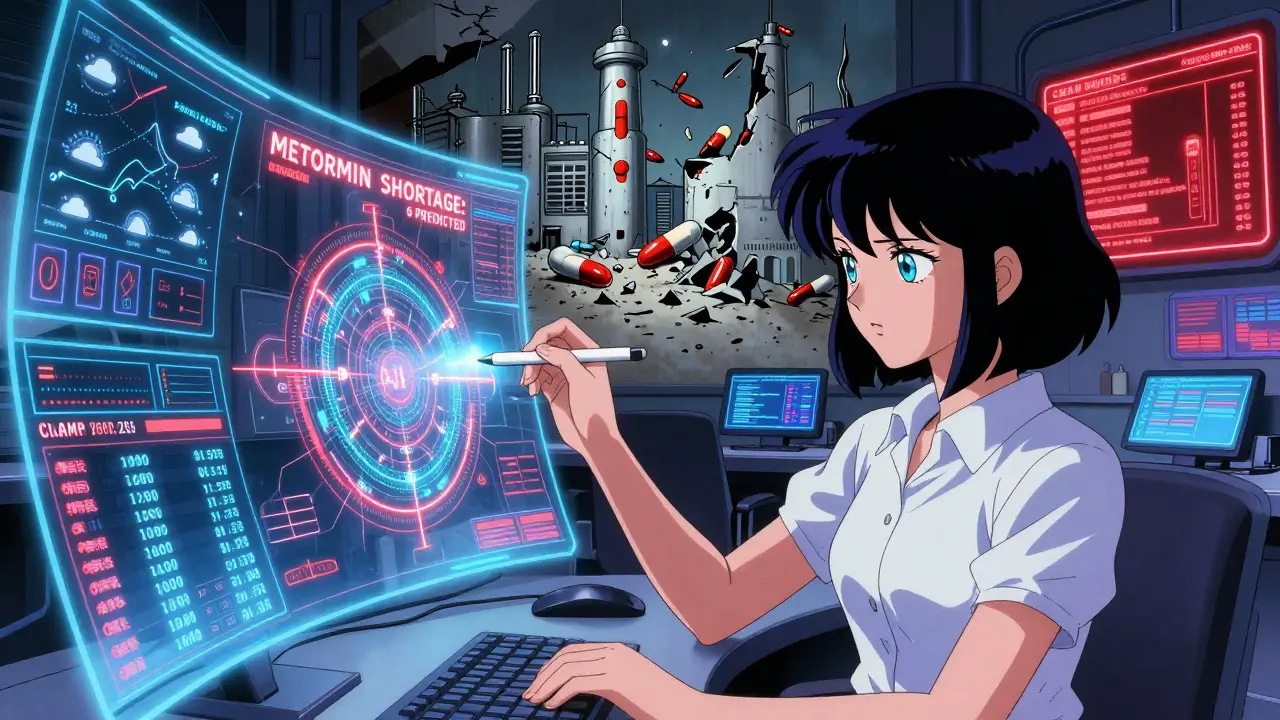
What’s already breaking - and what’s coming next
Some shortages are already here. In 2025, the UK saw its worst insulin supply crisis in a decade. Hospitals rationed doses. Patients switched to less effective alternatives. Why? Because one plant in the U.S. that made the active ingredient shut down for safety upgrades - and no other facility could ramp up fast enough. Next up? Antibiotics. The WHO lists 12 antibiotics as critically important. Four of them are already in short supply. By 2028, that could rise to eight. Why? Because no major company is investing in new antibiotics. The return on investment is too low. They’re used for short courses, not lifelong treatment. And resistance is rising, meaning higher doses are needed - which strains supply even more. Cancer drugs are another ticking bomb. The global demand for chemotherapy agents is expected to rise 40% by 2030. But production capacity is flat. One reason: many of these drugs require rare isotopes made in aging nuclear reactors. Only three reactors in the world produce enough. One of them is scheduled for shutdown in 2027.What’s being done - and why it’s not enough
Governments are trying. The U.S. passed the Drug Supply Chain Security Act in 2013. The EU launched its Pharmaceutical Strategy in 2020. The UK’s NHS has a national stockpile of 50 critical drugs. But these efforts are fragmented. The U.S. stockpile holds enough for 30 days. The UK’s lasts 45. In a true crisis, that’s not enough. Some companies are moving toward dual sourcing - making the same drug in two different countries. But it’s expensive. And it takes years to get regulatory approval for a second plant. The World Economic Forum found that only 27% of pharmaceutical firms have fully implemented dual sourcing. Most are still in pilot stages. There’s also talk of government subsidies to keep low-margin drugs alive. The U.S. is testing a program that pays manufacturers a fixed fee to keep producing essential generics. Early results show a 22% drop in shortages for covered drugs. But the program only covers 17 medications. There are over 3,000 generics on the market.
What you can do - as a patient, provider, or policymaker
If you’re a patient: Don’t wait until your prescription runs out. Talk to your pharmacist early. Ask if there’s an alternative. Keep a 30-day backup supply if possible. If you’re a clinician: Document every shortage you encounter. Report it to your regional health authority. Data from frontline staff is the most accurate early warning system we have. If you’re a policymaker: Push for mandatory transparency. Require drugmakers to report production volumes, inventory levels, and backup plans. Fund R&D for alternative manufacturing - like continuous flow production, which is faster and more resilient than batch methods. And invest in local production of critical drugs. The UK could produce 80% of its essential medicines domestically with the right incentives.The bottom line
Drug shortages aren’t going away. They’re becoming a permanent feature of modern healthcare. But they don’t have to be chaotic. With better forecasting, shared data, and smarter investment, we can avoid the worst-case scenarios. The technology exists. The data is there. What’s missing is the will to act before the next crisis hits.By 2030, we could have a system where shortages are rare, predictable, and managed - or we could be stuck in a cycle of panic, rationing, and delayed care. The choice isn’t about money. It’s about priorities.
Why are generic drugs so often in short supply?
Generic drugs make little profit - sometimes just pennies per pill. Manufacturers stop making them when prices drop too low or when production costs rise. With no financial incentive, companies focus on newer, more profitable drugs. There’s also no backup supplier for many generics - one factory makes nearly all of it globally. If that factory shuts down, the drug vanishes.
Can we make drugs locally in the UK to avoid shortages?
Yes, but it’s expensive and slow. The UK used to make most of its medicines domestically. Now, only 20% is produced here. Rebuilding capacity would require £1-2 billion in investment and 5-7 years to get regulatory approvals for new plants. It’s doable, but only if the government guarantees long-term contracts and subsidies for essential drugs.
How far ahead can we predict drug shortages?
With current tools, most forecasts are accurate 3-6 months out. Advanced AI models using global data (weather, shipping, politics) can spot risks up to 12 months in advance. But without mandatory reporting from drugmakers, even the best models are guessing. Real accuracy requires transparency - and that’s still missing.
Are there any drugs that will always be in short supply?
Yes - drugs that are cheap, complex to make, or rely on rare ingredients. Antibiotics, chemotherapy agents, insulin, and certain hormones fall into this category. They’re not profitable enough to attract investment, and their production requires specialized equipment or rare materials like isotopes or plant extracts that are hard to scale.
What role does climate change play in drug shortages?
Climate change affects the crops used to make many drugs. For example, the bark of the Pacific yew tree is used in cancer drugs. Droughts and wildfires in the Pacific Northwest have reduced harvests. Even basic ingredients like aspirin’s original source - willow bark - are harder to grow as temperatures rise. Water shortages in India and China also disrupt chemical production.
Next steps: If you’re a pharmacist, start tracking your top 10 most frequently out-of-stock drugs. If you’re a patient, keep a list of your essential meds and ask your doctor about alternatives now. If you’re a policymaker - demand data. Without visibility, we’re flying blind.
Haley Graves
January 17, 2026 AT 01:03These shortages aren’t just inconvenient-they’re life-threatening. I’ve seen patients skip doses of metformin because the pharmacy ran out. No one talks about how this erodes trust in the system. We need real-time tracking, not spreadsheets. Pharmacies should be mandated to report stock levels daily. It’s not that hard. We do it with vaccines.
And yes, the government needs to step in with subsidies for generics. If we can fund fighter jets, we can fund insulin.
Diane Hendriks
January 17, 2026 AT 19:59The entire pharmaceutical supply chain is a foreign-controlled vulnerability. China manufactures 80% of our active ingredients. India packages half of our prescriptions. This isn’t capitalism-it’s national surrender. We outsource our health to authoritarian regimes and then wonder why we’re vulnerable. The U.S. used to be the world’s pharmacy. Now we’re a customer. And customers get ignored when the supplier has leverage.
Rebuild domestic production. Nationalize critical manufacturing. End the outsourcing of our survival to foreign labs. This isn’t a policy debate. It’s a security emergency.
Sohan Jindal
January 18, 2026 AT 13:13They’re doing this on purpose. The pharmaceutical companies and the government are in cahoots. Why? So they can force you to buy expensive new drugs instead of generics. They let the cheap stuff run out so you have no choice. That’s why metformin disappeared right after the new diabetes drug got approved. Coincidence? No. It’s a scam. They’re killing people so they can profit. The FDA is complicit. The WHO is a puppet. Wake up.
They’re also using climate change as an excuse. The weather hasn’t changed that much. This is all planned. They want you dependent on their expensive pills. And they’re using your fear to push it.
Frank Geurts
January 19, 2026 AT 22:17While the systemic vulnerabilities outlined in this analysis are undeniably profound, I must emphasize the criticality of multilateral coordination. The fragmentation of regulatory frameworks across jurisdictions-particularly between the FDA, EMA, and MHRA-creates a labyrinthine impediment to supply chain resilience.
Moreover, the absence of harmonized reporting standards for active pharmaceutical ingredient (API) inventory levels constitutes a fundamental data deficit. Until such transparency is institutionalized, predictive models, no matter how sophisticated, remain speculative constructs. The World Health Organization must be granted binding authority to mandate disclosure, with non-compliance resulting in trade sanctions. This is not merely a healthcare issue-it is a global public goods challenge.
Annie Choi
January 20, 2026 AT 21:46Let’s be real-this is a supply chain crisis wrapped in a profit motive. We’ve optimized for cheap, not resilient. We’ve outsourced everything and called it efficiency. But when your insulin depends on a single factory in a region prone to floods and political unrest, you’re not efficient-you’re fragile.
We need to treat essential medicines like critical infrastructure. Think power grids. Think water systems. We don’t outsource those. Why do we outsource our health? We need federal investment in domestic continuous-flow manufacturing. It’s faster, cheaper, and way more adaptable. Let’s stop talking and start building.
Mike Berrange
January 22, 2026 AT 01:21You’re all missing the point. This isn’t about factories or trade deals. It’s about people not taking their meds. You think the system’s broken? No. People are lazy. They don’t refill early. They wait until the last day. Then they panic. Then they blame the pharmacy. I’ve worked in retail for 18 years. Half the shortages are caused by patients not being responsible. Stop blaming corporations. Start blaming the people who treat their prescriptions like optional snacks.
Dan Mack
January 23, 2026 AT 21:58They’re lying. The shortages aren’t real. They’re manufactured. The government and Big Pharma are working together to create artificial scarcity so they can raise prices. You think insulin is expensive now? Wait until they cut supply even more. They’ve already done it with epinephrine. They’ll do it with everything. This isn’t a crisis-it’s a playbook. They want you dependent. They want you scared. And they want you to pay more.
They’re using climate change as a cover. There’s no drought in India. It’s all staged. Watch the news. They’ll say it’s ‘global instability’-but it’s all scripted.
Amy Vickberg
January 24, 2026 AT 14:37I’ve been a nurse for 22 years. I’ve watched this unfold. The worst part isn’t the shortages-it’s the silence. Patients don’t know they’re being rationed. Clinicians are too tired to fight. We need to stop treating this like a supply problem and start treating it like a moral one.
Let’s start with the basics: every hospital should have a public shortage dashboard. Every pharmacist should get a stipend to report stockouts. Every generic drug with under 3 suppliers should get automatic federal backup funding.
We can fix this. But only if we stop pretending it’s someone else’s problem.
Nishant Garg
January 25, 2026 AT 16:24As someone who grew up in a small town in India where my father worked in a pharma plant, I’ve seen both sides. Yes, the West blames us for shortages-but we’re just the middleman. The real problem? Western companies design the drugs, own the patents, and dictate the prices. They outsource the hard work to us, then act shocked when something breaks.
And yet-we’re the ones who keep the lights on. We make 40% of the world’s generics. But we’re not paid enough to upgrade. We’re not protected from climate disasters. We’re not given the tools to scale.
It’s not a supply chain issue. It’s a justice issue. If you want stability, invest in the people who actually make your pills-not just the CEOs who profit from them.
Nicholas Urmaza
January 25, 2026 AT 16:52The data is clear and the solution is simple. Stop treating medicine like a commodity. Treat it like a public utility. Build domestic production. Fund continuous manufacturing. Mandate transparency. No more delays. No more excuses. We have the technology. We have the capital. What we lack is the political courage to act.
It’s not rocket science. It’s basic governance. If we can bail out banks, we can bail out insulin. Period.
Sarah Mailloux
January 27, 2026 AT 15:15My grandma’s thyroid med ran out last year. Took her three weeks to get a refill. She cried. She didn’t say anything, but I saw it. We need to stop acting like this is normal. It’s not. Talk to your pharmacist. Ask your doctor about alternatives. Don’t wait. And if you’re lucky enough to have insurance, use it to push for better coverage on generics. We can’t fix this alone-but we can start by refusing to stay quiet.
Nilesh Khedekar
January 29, 2026 AT 09:42Oh, so now we’re all supposed to be heroes? Patients should keep 30-day backups? Clinicians should report shortages? Policymakers should demand transparency? Wow. What a revolutionary idea. Meanwhile, the same people who wrote this post are probably sipping lattes in their 7th-floor offices, talking about ‘resilience’ while their stock options keep rising.
Let’s be real: no one in power cares until their kid can’t get their ADHD med. Until then, it’s just another spreadsheet. And guess what? The system works perfectly-for them.