
Most people think earwax is something to clean out - but the truth is, your ears are designed to clean themselves. When earwax builds up too much and hardens, it becomes a problem called earwax impaction. This isn’t just a minor annoyance. It can block your hearing, cause pain, make you dizzy, or even trigger a cough. And the worst part? Many of the things people do to fix it - like cotton swabs or ear candles - actually make it worse.
What Exactly Is Earwax Impaction?
Earwax, or cerumen, is a natural substance made by glands in your ear canal. It traps dust, bacteria, and tiny particles before they reach your eardrum. Normally, it slowly moves out on its own, carried along by jaw movements like chewing. But sometimes, it gets stuck. When that happens, it hardens and forms a plug - often blocking the ear canal from the eardrum all the way to the opening. This is earwax impaction. It’s not rare. About 6% of adults deal with it, but the numbers jump to 12% in people over 65 and up to 30% in those with developmental disabilities. You’re more likely to have it if you wear hearing aids, have a lot of ear hair, or have an oddly shaped ear canal. And if you use cotton swabs? You’re part of the 60-70% of people whose attempts to clean their ears actually pushed wax deeper in.How Do You Know If You Have It?
Symptoms don’t always show up right away. They usually build over a week or two. The most common signs include:- Hearing loss - often the first thing people notice, affecting 65% of cases
- A feeling of fullness or pressure in the ear - reported by 58%
- Earache or discomfort - present in 42%
- Ringing in the ears (tinnitus) - affects nearly 3 in 10 people
- Dizziness or balance issues - happens in about 18%
- Itching inside the ear - 33% of cases
- Drainage or bad smell from the ear - seen in 22%
- A persistent cough - yes, really. This happens because the ear and throat nerves are connected
What Makes It Worse?
You’d think cleaning your ears helps. But here’s what actually happens:- Cotton swabs: Push wax deeper. NHS England data shows they’re behind 60-70% of iatrogenic (doctor-caused) impactions.
- Ear candling: Totally useless and dangerous. The FDA says it causes around 12,500 ear injuries a year - including 3,000 perforated eardrums - between 2018 and 2022.
- Home suction devices: Sold online as quick fixes, but they’re not regulated. Many users report pain, bleeding, or worse.
- “Ear scoops” on TikTok: Over 1.2 billion views show people poking around their ears with metal tools. These videos are a public health risk.
How Doctors Diagnose It
Your GP or an ENT specialist won’t guess. They’ll use an otoscope - a small lighted tool - to look inside your ear. This isn’t just a quick peek. A pneumatic otoscope checks if your eardrum moves normally. If wax is blocking it, the drum won’t bounce back when air is gently puffed in. Diagnosis requires two things: visible wax blocking the canal and symptoms. No symptoms? No treatment needed. That’s the rule from the American Academy of Family Physicians. But here’s the catch: about 22% of people who think they have earwax impaction actually have something else - like an ear infection, cholesteatoma, or jaw joint problem. That’s why self-diagnosis is risky.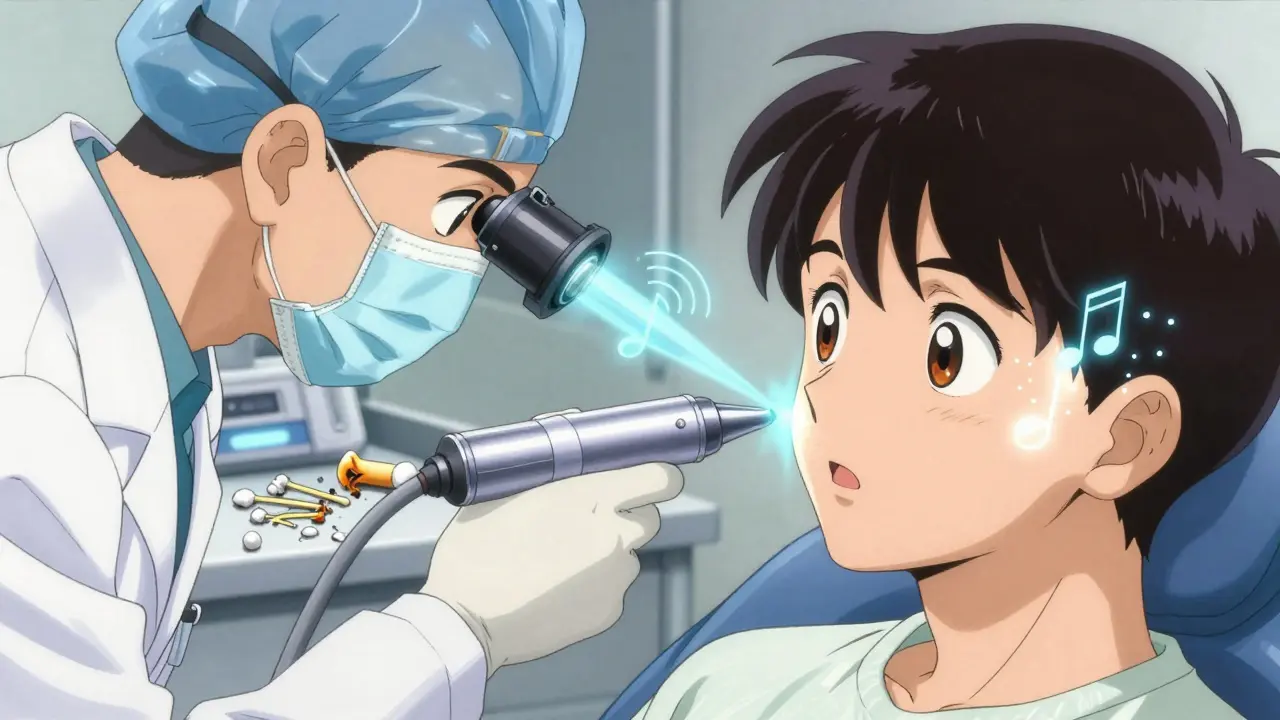
Safe Ways to Remove Earwax
There are three proven methods - and only one should ever be done at home.1. Softening at Home (First-Line)
If you’re not in pain and your hearing is just muffled, try this NHS-recommended approach:- Lie on your side with the affected ear facing up.
- Put 2-3 drops of olive oil, almond oil (if you’re not allergic), or mineral oil into the ear.
- Stay in that position for 5-10 minutes so the oil soaks in.
- Repeat 3-4 times a day for 3-5 days.
- After that, gently wipe the outside of your ear with a damp cloth. Don’t stick anything inside.
2. Professional Removal (Second-Line)
If home oil doesn’t help, see a professional. Here’s what they do:- Manual removal: A doctor uses a tiny curette or forceps to gently scoop out the wax. It’s quick, painless, and 92% effective in one visit.
- Ear irrigation: Warm water or saline is gently flushed into the ear. Works 85% of the time, but not safe if you’ve ever had a perforated eardrum or ear surgery.
- Microsuction: A small vacuum removes wax under direct vision. It’s the gold standard - 96% effective, no water involved, and safest for people with past ear issues. Most clinics now prefer this.
3. Advanced Cases
For stubborn or complex blockages - like wax packed tightly around scar tissue or after ear surgery - endoscopic removal is used. Cedars-Sinai reports a 99.2% success rate with this method. It’s done under magnification with a tiny camera, so nothing is missed.What NOT to Do
Stop these practices immediately:- No cotton swabs: Even “just cleaning the outside” can push wax inward.
- No ear candles: They don’t work. They’re a fire hazard. The FDA banned them as misbranded medical devices in 2010.
- No suction tools: Those “ear vacuums” sold online aren’t regulated. They can rupture your eardrum.
- No metal tools: TikTok influencers show “ear scoops” - but real doctors use precision instruments under controlled conditions. You don’t.
When to See a Doctor
You don’t need to wait until you’re in pain. See a professional if:- Your hearing has gotten noticeably worse over a few days
- You feel pressure or fullness that won’t go away
- You have dizziness, ringing, or drainage
- You’ve had ear surgery, a perforated eardrum, or tubes in the past
- You use hearing aids or earplugs daily - these block natural wax movement

Prevention Tips
You can reduce your risk:- Use earplugs sparingly - they trap wax inside
- If you wear hearing aids, get your ears checked every 6 months
- After swimming or showering, tilt your head to let water drain
- Use oil drops once a week if you’re prone to buildup - but only if you don’t have a history of ear problems
- Never insert anything smaller than your elbow - a phrase repeated across dozens of patient forums for good reason
What’s New in 2025?
The field is evolving. In 2023, the FDA cleared the Eareto OtoSonic - the first prescription-only home ultrasonic device shown to soften wax in 78% of users. It’s not a cure-all, but it’s a step toward safer home management. New guidelines from the American Academy of Otolaryngology (coming June 2025) will include telehealth triage. A 2023 JAMA study found remote video assessments were 89% accurate at spotting true impaction - meaning you might not need an in-person visit just to confirm it. But the biggest threat? Social media. TikTok and YouTube are flooded with videos of people digging into their ears. That’s not education - it’s dangerous misinformation.Final Takeaway
Your ears don’t need cleaning. They clean themselves. Earwax impaction isn’t caused by dirt - it’s caused by interference. Every time you stick something in your ear, you’re disrupting nature’s design. If you have symptoms, don’t try to fix it yourself. Use oil drops for a few days, then see a professional. Microsuction is fast, safe, and often life-changing - people describe it as “hearing again for the first time in years.” And remember: if you’ve ever had ear surgery, use hearing aids, or feel sudden hearing loss - skip the home remedies. Your ears are delicate. Treat them that way.Can earwax impaction cause permanent hearing loss?
No, earwax impaction doesn’t cause permanent hearing loss. The hearing loss it causes is temporary and fully reversible once the wax is removed. However, if left untreated for a long time, it can lead to infections or damage to the eardrum - which, in rare cases, might cause lasting issues. That’s why prompt, safe removal matters.
Is it safe to use hydrogen peroxide to remove earwax?
Hydrogen peroxide can help soften wax - about 52% effective - but it’s not ideal. It can irritate the skin inside the ear canal, especially if used too often or in high concentrations. Some people get itching, redness, or even temporary dizziness. If you use it, stick to over-the-counter drops with 3% hydrogen peroxide and only for a few days. Olive oil or mineral oil are gentler and just as effective for most people.
Why do some people get earwax buildup more than others?
Several factors increase risk. Age is a big one - older adults produce drier, harder wax. People who wear hearing aids or earplugs regularly are more likely to get impacted wax because these devices block the natural exit path. Those with narrow or oddly shaped ear canals, excessive ear hair, or certain skin conditions like eczema are also at higher risk. And yes, using cotton swabs is the #1 preventable cause.
Can I use baby oil to remove earwax?
Yes, baby oil is a safe and effective option. It’s a type of mineral oil, which helps soften wax without irritating the ear canal. Use 2-3 drops twice a day for 3-5 days, then let gravity and natural movement do the rest. Avoid it if you’re allergic to petroleum products. Don’t use it if you have a perforated eardrum or drainage from the ear - see a doctor instead.
How long does professional earwax removal take?
A typical appointment lasts 15-20 minutes per ear. Most people get complete relief in one visit - especially with microsuction. The procedure is quick, usually painless, and doesn’t require recovery time. You can drive, work, or go about your day right after.
Do earwax removal services cost a lot?
In the UK, NHS earwax removal is free if referred by your GP. Private clinics charge between £40 and £80 per ear, depending on location and method. Microsuction tends to be on the higher end but is often worth the cost for safety and effectiveness. Compare that to the $116 million spent annually in the U.S. on impaction-related visits - it’s a small price to avoid complications.
Should I clean my ears regularly?
No. Your ears are self-cleaning. Wiping the outer ear with a washcloth after a shower is enough. Don’t insert anything. If you’re prone to buildup, using oil drops once a week may help - but only if you don’t have ear surgery history or drainage. Over-cleaning can dry out the skin, cause irritation, and actually increase wax production.
Is microsuction better than irrigation?
Yes, for most people. Microsuction is more effective (96% success rate vs. 85% for irrigation) and safer. It doesn’t use water, so it’s ideal if you’ve had ear surgery, a perforated eardrum, or a history of infections. It’s also faster and quieter. Irrigation can be effective too, but it’s riskier for certain groups. Most clinics now offer microsuction as the first choice.
Mike Rengifo
December 19, 2025 AT 04:40Just used olive oil for 4 days after my ear felt plugged. Felt like a dam broke when I woke up. No doctor needed. Your ears are not a toilet you need to scrub.
Stop putting things in there.
shivam seo
December 20, 2025 AT 03:08Of course the FDA bans ear candles but lets TikTok influencers sell metal ear scoops for $12.99. Capitalism is a joke. We’re all just guinea pigs for algorithms now. Also Australia has better healthcare than you guys. Just saying.
Ashley Bliss
December 20, 2025 AT 09:17You think this is about earwax? No. This is about control. We’ve been taught to fear our own bodies. To distrust nature. To buy solutions. The wax isn’t the problem. The system is. We’ve been conditioned to see ourselves as broken machines needing constant repair. Your ear canal is sacred. Don’t violate it. Ever.
Wake up.
Tim Goodfellow
December 21, 2025 AT 13:52I’ve had microsuction twice. First time felt like a magician pulled a rabbit out of my head. Instant clarity. Like someone turned up the volume on the world. My dog barked and I cried. Not because it hurt - because I’d forgotten what real sound sounded like.
Doctors aren’t magicians. But microsuction? That’s alchemy.
Monte Pareek
December 22, 2025 AT 10:57Listen up people. If you're over 50 or wear hearing aids you're basically on a timer for wax buildup. Don't wait until you're dizzy or your grandkid has to yell at you. Do the oil drops once a week. Just 2 drops. No cotton swabs. No fancy gadgets. Olive oil is cheaper than your coffee habit.
And if it doesn't work in 5 days? Go see a professional. Not a pharmacy tech with a syringe. A real ENT. Microsuction is worth every penny. I've had it done 3 times. Never had a problem. You think $80 is expensive? Try paying for a ruptured eardrum. Or an infection that turns into a hospital stay. Your ears are not a DIY project. Treat them like your eyes. You wouldn't stick a Q-tip in your eyeball. So why in your ear?
Stop being cheap with your hearing. It's the one sense you can't replace.
Kelly Mulder
December 23, 2025 AT 01:41While I appreciate the empirical data presented, I must express my profound concern regarding the casual dismissal of hydrogen peroxide as a viable option. The biochemical properties of 3% H2O2, when applied in controlled dosages, demonstrate a marked efficacy in lipid solubilization - a process that, contrary to popular belief, does not inherently induce epithelial irritation when administered correctly. One must question the editorial bias toward mineral oils, which, while less reactive, lack the oxidative catalytic action necessary for deep cerumen disruption. Furthermore, the normalization of ‘oil drops’ as a panacea reveals a troubling trend toward pseudo-scientific folk remedies masquerading as medical advice. I urge the medical community to enforce stricter evidence-based protocols before endorsing such practices.
Elaine Douglass
December 23, 2025 AT 11:14I used to use swabs all the time then I got dizzy one day and panicked
went to the doc and they just sucked it out in 5 minutes
now I just wipe the outside and feel so much better
thank you for this post really helped me stop being dumb
Glen Arreglo
December 23, 2025 AT 19:08My dad’s a retired ENT. He always said if you can hear your own fingers moving in your ear, you’re doing it wrong.
He never used swabs. Never. Even at 82 he hears better than most 30-year-olds.
Just let it be. Nature got this.
Takeysha Turnquest
December 24, 2025 AT 21:52They told us to clean our ears since we were kids
and now we’re told not to
who do we believe
the doctors
or the lies we were raised on
the truth is we were never taught to listen to our bodies
we were taught to fix them
and that’s the real impaction