Imagine you walk into a pharmacy with a prescription for a brand-name medication. The pharmacist hands you a box that looks completely different, costs significantly less, and bears a different name. Is it safe? Does it work the same way? For decades, this question has been central to pharmaceutical care. The answer lies in a rigorous verification process that pharmacists perform daily, ensuring that generic drugs are not just cheaper copies, but therapeutically identical alternatives.
This process isn't based on guesswork or simple visual inspection. It relies on a complex web of federal regulations, statistical data, and specific practice standards established over forty years ago. When a pharmacist substitutes a generic for a brand-name drug, they are legally and professionally verifying three critical dimensions: pharmaceutical equivalence, bioequivalence, and therapeutic equivalence. Understanding how this works reveals why the system is both highly reliable and strictly regulated.
The Foundation: Hatch-Waxman and the ANDA Process
To understand current practice standards, we have to look back at the Drug Price Competition and Patent Term Restoration Act of 1984, commonly known as the Hatch-Waxman Act. This legislation revolutionized the industry by granting the U.S. Food and Drug Administration (FDA) the authority to approve generic versions of drugs without requiring manufacturers to repeat expensive and time-consuming clinical trials. Instead, these companies file an Abbreviated New Drug Application (ANDA).
The key word here is "abbreviated." A generic manufacturer doesn't need to prove their drug works in humans through large-scale studies like the original brand-name developer did. They only need to prove that their product is equivalent to the already-approved Reference Listed Drug (RLD). This creates a streamlined pathway that brings affordable medications to market faster while maintaining safety standards. As of fiscal year 2023, the FDA's Office of Generic Drugs processed over 1,000 of these applications, demonstrating the high volume of generics entering the supply chain annually.
The Gold Standard: The FDA Orange Book
If there is one tool every pharmacist relies on, it is the FDA Orange Book. Officially titled "Approved Drug Products with Therapeutic Equivalence Evaluations," this publication is the legal backbone of generic substitution in the United States. First published in 1980, it serves as the primary reference for determining whether a generic can be swapped for a brand-name drug.
The Orange Book uses a two-character coding system to rate therapeutic equivalence. The first letter indicates the status:
- A Rating: The product is considered therapeutically equivalent to other pharmaceutically equivalent products. This means it can be substituted safely.
- B Rating: The product is not considered therapeutically equivalent at the time of publication, often due to insufficient data or pending litigation.
The second character provides more detail about the basis for the rating. The most common designation is AB, which accounts for nearly 99% of rated products. An AB rating confirms that the generic has been found both pharmaceutically equivalent and bioequivalent to the reference listed drug through adequate human studies. Other codes exist for specific delivery methods, such as AN for aerosolized nasal products or AO for oral solutions.
In all 50 states, state laws mandate using the Orange Book as the primary verification tool. For example, Texas Administrative Code explicitly requires pharmacists to use this publication to determine generic equivalency. If a pharmacist substitutes a drug based on an 'A' rating from the Orange Book, they are protected from liability under state substitution laws. Deviating from this standard can lead to serious professional sanctions, as seen in cases where pharmacists substituted non-listed products without proper justification.
Decoding Bioequivalence: The 80-125% Rule
When people ask if generics are "just as strong" as brands, they are asking about Bioequivalence. This is the scientific core of the verification process. Bioequivalence ensures that the generic drug enters your bloodstream at the same rate and to the same extent as the brand-name drug.
The FDA sets strict statistical thresholds for this. In a bioequivalence study, researchers measure two key pharmacokinetic parameters:
- Cmax: The maximum concentration of the drug in the blood.
- AUC: The area under the curve, representing the total exposure to the drug over time.
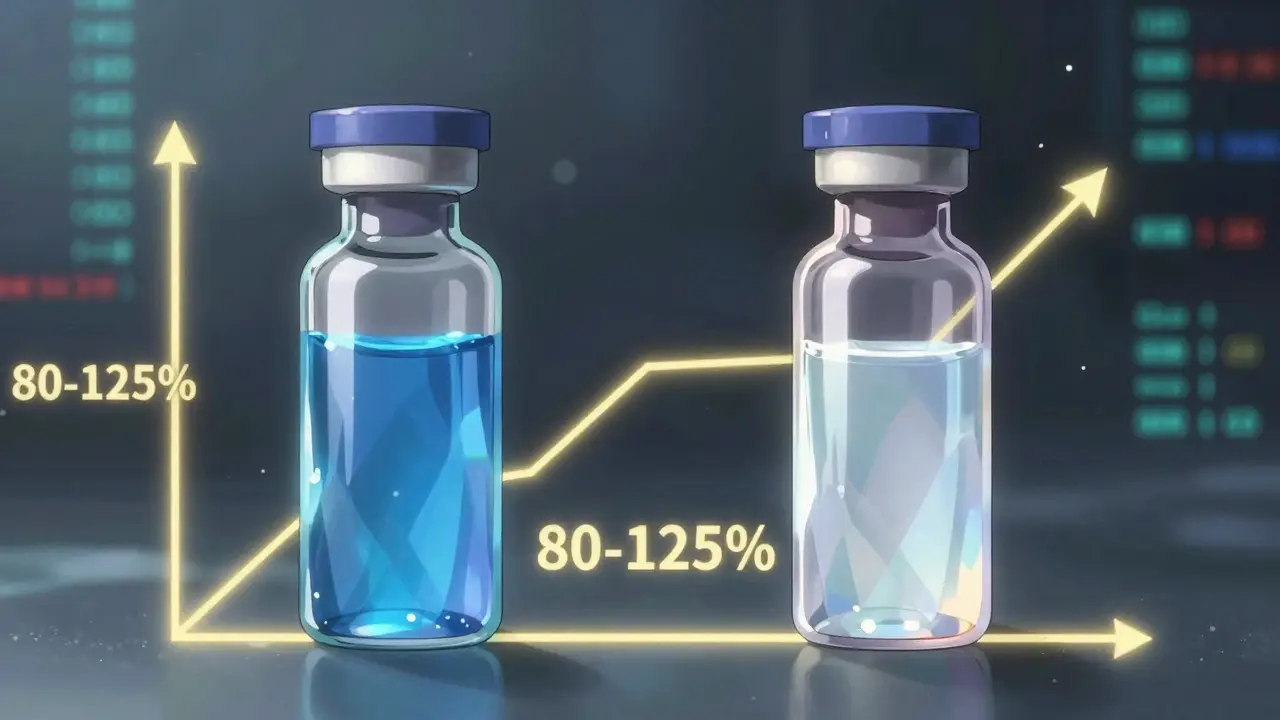
For a generic to be approved, the 90% confidence interval for the ratio of the generic's Cmax and AUC compared to the brand must fall within 80% to 125%. This might sound like a wide range, but it is statistically derived to ensure no more than a 10% difference in therapeutic effect. Dr. Lawrence Yu, former Deputy Director of the FDA's Office of Pharmaceutical Quality, explained that this window is not arbitrary but designed to guarantee clinical similarity.
Research supports the rigor of this standard. A 2023 analysis of over 2,000 bioequivalence studies found that 97.8% of approved generics showed less than a 5% difference in AUC from their reference products. For narrow therapeutic index drugs-medications like levothyroxine or warfarin where small changes in dose can be dangerous-the FDA applies even tighter criteria, often requiring ratios between 90% and 111%.

Pharmaceutical vs. Therapeutic Equivalence
While bioequivalence deals with how the body processes the drug, Pharmaceutical Equivalence deals with what is actually in the bottle. For a generic to be considered pharmaceutically equivalent, it must contain the exact same active ingredient, dosage form, strength, and route of administration as the brand-name drug. The inactive ingredients-such as fillers, binders, or dyes-may differ, but they cannot affect the drug's performance.
Therapeutic Equivalence is the final determination. It combines pharmaceutical equivalence and bioequivalence to conclude that the generic will produce the same clinical effect and safety profile when administered to patients according to labeled directions. This is the ultimate goal of the verification process: ensuring that switching from brand to generic has no negative impact on patient health.
| Type | Key Criteria | Verification Method |
|---|---|---|
| Pharmaceutical | Identical active ingredient, strength, dosage form | Label inspection, chemical analysis |
| Bioequivalence | 80-125% CI for Cmax and AUC ratios | Pharmacokinetic studies in humans |
| Therapeutic | Same clinical effect and safety profile | Orange Book TE Rating ('A') |
Daily Practice: How Pharmacists Verify Substitutions
In a busy community pharmacy, verification happens in seconds, but the protocol is precise. According to time-motion studies, the average verification takes 8 to 12 seconds per prescription. Here is the typical workflow a pharmacist follows:
- Identify the RLD: Using the Orange Book, the pharmacist locates the Reference Listed Drug associated with the prescribed brand name.
- Confirm Active Ingredients: They verify that the generic product matches the brand in active ingredient, strength, and dosage form.
- Check TE Rating: They ensure the generic has an 'A' therapeutic equivalence rating, specifically looking for 'AB' codes.
- Review Restrictions: They check for any "Do Not Substitute" designations or prescriber notes indicating "Dispense as Written."
Most pharmacists access the Orange Book digitally. Many use the free FDA Orange Book mobile app, which has been downloaded hundreds of thousands of times, while others rely on integrated pharmacy management systems like PioneerRx or QS/1 that pull this data automatically. Despite the automation, the pharmacist remains responsible for the final check. Commercial databases like Micromedex or Lexicomp are often used as secondary checks, but the Orange Book remains the legal standard.
Challenges with Complex Generics
While the system works flawlessly for simple pills, challenges arise with complex drug products. Inhalers, topical creams, and ophthalmic solutions do not always fit neatly into the traditional bioequivalence model. Measuring plasma concentration (Cmax/AUC) is difficult or impossible for drugs that act locally rather than systemically.
Critics, including experts like Dr. Randall Stafford from Stanford University, have noted that the current system may not fully capture clinical performance for these complex generics. In response, the FDA has developed product-specific guidances for nearly 2,000 complex drug products. These guidances introduce new metrics, such as aerodynamic particle size distribution for inhalers, to ensure equivalence. The Generic Drug User Fee Amendments (GDUFA) III, implemented in 2023, introduced stricter requirements for these complex generics, allocating millions of dollars to research new bioequivalence methodologies.
Another emerging challenge is the rise of biosimilars. Unlike small-molecule generics, biosimilars are large, complex proteins made in living cells. They are listed in the "Purple Book," not the Orange Book. As of mid-2024, only a fraction of approved biosimilars were listed, creating verification gaps for pharmacists handling these advanced therapies. This highlights that while the generic equivalence system is robust, it continues to evolve to meet the demands of modern medicine.
Legal and Professional Safeguards
The stakes for accurate verification are high. Generic drugs now account for over 90% of all prescriptions dispensed in the U.S., representing billions of dollars in healthcare savings. However, this scale also means that errors could affect millions of patients. To mitigate risk, state boards of pharmacy enforce strict adherence to the Orange Book.
In 49 states, pharmacists are permitted to automatically substitute an 'A'-rated generic for a brand-name drug unless the prescriber specifies otherwise. Massachusetts is the notable exception, requiring prescriber authorization for substitution. This legal framework protects both the patient and the pharmacist. By following the Orange Book, pharmacists operate within a defensible standard of care. Studies show that when properly implemented, the substitution error rate is incredibly low, at just 0.03%. Furthermore, meta-analyses have found that adverse event rates after switching to generics are statistically indistinguishable from those staying on brand-name drugs.
Can a pharmacist substitute any generic for a brand-name drug?
No. A pharmacist can only substitute a generic if it is listed in the FDA Orange Book with an 'A' therapeutic equivalence rating (typically 'AB'). Additionally, the prescriber must not have indicated "Dispense as Written" or "Brand Medically Necessary" on the prescription. State laws vary, but most allow automatic substitution for 'A'-rated generics.
What does the 80-125% bioequivalence range mean?
This range refers to the statistical confidence interval for the ratio of the generic drug's absorption (AUC) and peak concentration (Cmax) compared to the brand-name drug. If the 90% confidence interval falls between 80% and 125%, the FDA considers the two drugs bioequivalent, meaning they perform similarly in the body.
Why are some generics rated 'B' in the Orange Book?
A 'B' rating indicates that the FDA has not determined the product to be therapeutically equivalent to the reference listed drug. This can happen due to insufficient data, pending patent litigation, or issues with the manufacturing process. Pharmacists generally should not substitute 'B'-rated products for brand-name drugs without consulting the prescriber.
Are biosimilars verified using the Orange Book?
No. Biosimilars are large biological products and are listed in the FDA's "Purple Book," not the Orange Book. The verification process for biosimilars is different and involves demonstrating high similarity to the reference biologic rather than strict chemical equivalence.
Is it safe to switch between different generic manufacturers?
Yes, as long as both generics hold an 'A' rating in the Orange Book for the same reference listed drug. The FDA ensures that all 'A'-rated generics meet the same bioequivalence standards. However, for narrow therapeutic index drugs, some clinicians prefer keeping patients on the same manufacturer to minimize variability.
Daniel Tremblay
June 2, 2026 AT 12:48You are dramatically overstating the case here. The Hatch-Waxman act was a compromise, yes, but it saved billions for patients who otherwise couldn't afford insulin or statins. Calling it 'rigged' ignores the reality of healthcare economics. You want free drugs? Fine. But you can't have quality control without regulation. Stop being so dramatic and look at the data.
Jerry Mathews
June 2, 2026 AT 17:23I actually found this really interesting! I never knew there was such a specific process behind generic substitution. It's good to know that pharmacists are checking those AB ratings. Makes me feel a bit more confident when I pick up my meds. Thanks for sharing this info!
Lenny Cruz
June 3, 2026 AT 23:50The 80-125% rule is frankly absurd if you understand basic statistics. A 25% increase in Cmax is not 'clinically similar' for many sensitive individuals. The fact that they allow this margin suggests a lack of rigor that would be unacceptable in any other scientific field. It's convenient for manufacturers, obviously. The elite in pharma care little about your individual variance; they care about population averages. Typical mass-market thinking.
Aswin Narayan J
June 5, 2026 AT 10:56Bro, stop complaining. The generics work fine for 99% of people. If you have issues, talk to your doctor. Don't blame the FDA for your own body being weird. It's not that deep. Just take the pill and move on with your life.
Jennifer Legore
June 6, 2026 AT 02:29This is such an important topic! :) I am always happy to see discussions that clarify medical processes for the public. The Orange Book is truly a marvel of organization. It gives me great peace of mind knowing that there are strict legal safeguards in place. Pharmacists are heroes for ensuring these standards are met daily! Keep spreading this knowledge! :)
Alyssa Zucker
June 7, 2026 AT 23:30I used to worry about switching brands too. Reading this helps quiet that anxiety. It's comforting to know someone is double-checking everything before it gets to me.
Francis Saul
June 8, 2026 AT 06:24hey guys just wanted to say thanks for explaining this. i always wondered why my pills looked different sometimes. glad to hear its safe. no need to stress about it really. just trust the pros.
Dave Villeneue
June 9, 2026 AT 09:39Your understanding of bioequivalence is superficial. The confidence interval is a statistical construct, not a guarantee of individual outcome. You are ignoring the biological variability inherent in human metabolism. This article presents a sanitized view of pharmaceutical regulation. It fails to address the systemic biases in clinical trial design that favor large cohorts over individual patient needs. Wake up.
Rachel Harrypersad
June 11, 2026 AT 01:38its all about control really. they tell us what to believe about our own bodies. the orange book is just another tool of oppression disguised as science. do you really think they care about your health or just their liability? think about it. the truth is hidden in plain sight
Brian Irwin
June 12, 2026 AT 04:56i get where you are coming from but i think most people just want their meds to work without breaking the bank. the system has flaws sure but its better than nothing. we should focus on improving access rather than tearing down the current framework. everyone deserves affordable healthcare
Nicholas Bowling
June 12, 2026 AT 23:50Boring. Everyone thinks they know everything now because they read one article. The real issue is that doctors don't listen to patients when we say the generic doesn't work. They just push it anyway. It's a conspiracy of convenience. I've been burned twice and no one cares.
Jay Foreman
June 13, 2026 AT 02:07I mean, yeah, if you're having side effects you should definitely tell your doctor. But expecting them to prescribe brand name just because you 'feel' different is unrealistic. The placebo effect is powerful. Maybe you're just imagining things. But hey, if paying extra makes you feel better, go for it. Just don't expect sympathy when your insurance denies coverage.
Cathy N
June 13, 2026 AT 17:43I appreciate the detailed breakdown of the TE ratings. It's helpful to know what to look for if I ever need to advocate for myself. Thanks for posting this.
Adelaide Motata
June 13, 2026 AT 21:23oh please. you americans are so naive. in australia we have much stricter controls on biosimilars. your orange book is outdated garbage. dont trust anything written by fda employees. they are corrupt. wake up sheeple