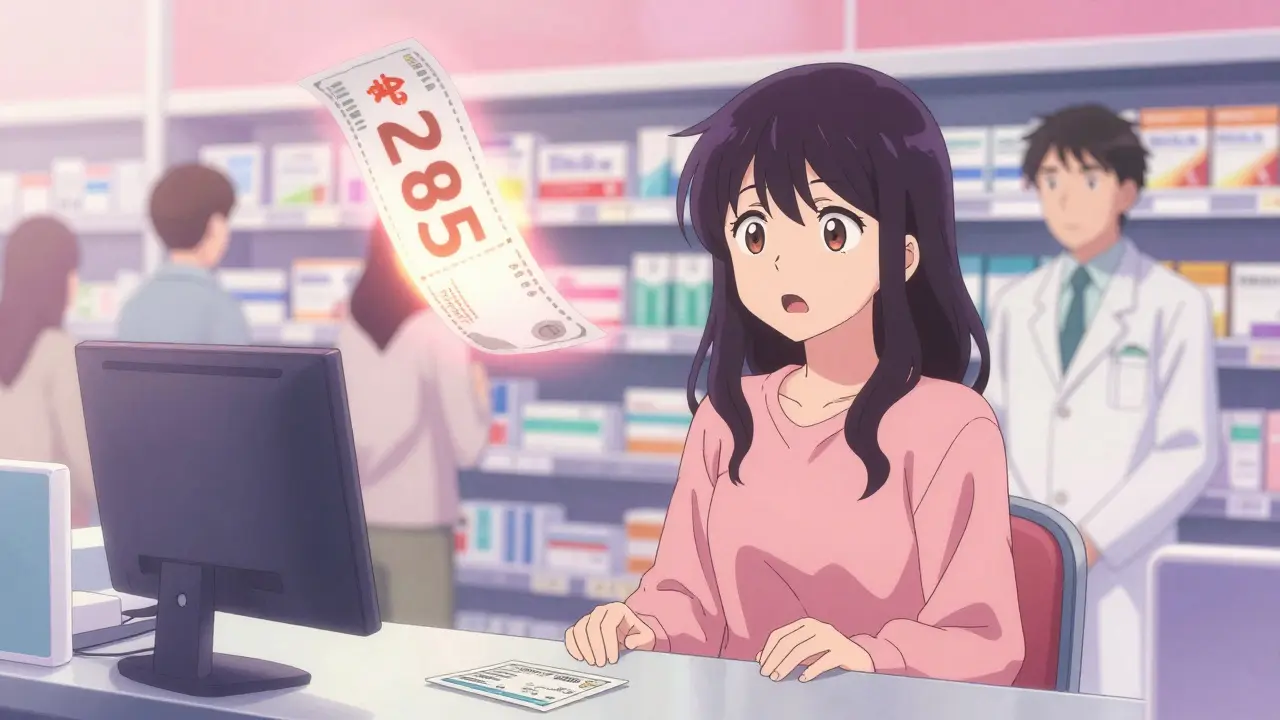
You fill your prescription at the pharmacy, hand over your card, and expect to pay your usual $20 copay. Instead, the cashier says, "That’ll be $285." You didn’t change plans. You didn’t switch pharmacies. You didn’t even know your pharmacy was out-of-network. This isn’t a glitch-it’s a common trap. And the out-of-network pharmacy surprise isn’t covered by the No Surprises Act, even though it leaves you with the same shock as a surprise hospital bill.
The No Surprises Act, which took effect in January 2022, protects you from unexpected medical bills for emergency care, air ambulances, and certain non-emergency services at in-network hospitals. But it says nothing about prescriptions. Pharmacy benefits are handled by separate companies called pharmacy benefit managers (PBMs)-like CVS Caremark, Express Scripts, or OptumRx. These PBMs run their own networks, completely separate from your medical insurance network. You could be covered at your doctor’s office and still get hit with a massive pharmacy bill because the local pharmacy you’ve used for years isn’t on their list.
Why Your Pharmacy Might Be Out-of-Network
It’s not random. PBMs negotiate deals with pharmacies to get lower prices on drugs. In return, they put those pharmacies on their in-network list. But they also cut deals with specialty pharmacies for high-cost medications like cancer drugs or injectables. If your plan requires you to use one of those specialty pharmacies-and you walk into your local CVS instead-you’re automatically out-of-network.
Even if you’re not on a specialty drug, your PBM might have dropped your neighborhood pharmacy from its network. You won’t get a letter. You won’t get a text. The only sign is when you’re charged full retail price at the register. A Kaiser Family Foundation survey found that 28% of commercially insured adults faced unexpected pharmacy costs in 2022. Nearly one in five of those bills were over $500.
How to Check Your Pharmacy Network Before You Fill a Prescription
You can’t rely on your insurance card or your doctor’s office. You need to check two things: your plan’s pharmacy network and your drug’s formulary.
- Go to your health plan’s website and look for the “pharmacy network directory.” Don’t settle for the general provider directory-that’s for doctors, not pharmacies.
- Search for your pharmacy by name and zip code. If it doesn’t show up, it’s out-of-network.
- Check your drug’s tier. Some plans put certain medications on higher tiers, meaning higher costs even at in-network pharmacies.
- If you’re on Medicare Part D, use the Medicare Plan Finder tool. It separates medical and pharmacy networks, so you can see exactly what’s covered.
Specialty drugs are the biggest risk. About 78% of Medicare Part D plans and 65% of commercial plans require you to use specific specialty pharmacies for drugs like Humira, Enbrel, or Orencia. If you don’t, you’ll pay the full price-sometimes over $10,000 a month. Always ask your doctor or pharmacist: “Is this drug restricted to a specialty pharmacy?”
What to Do If You’re Already at the Pharmacy
If you’re already at the counter and the price is way higher than expected, don’t just pay it. You have options.
- Ask the pharmacist: “Is this pharmacy in my plan’s network?” They can often check in real time.
- Ask if they can transfer your prescription to an in-network pharmacy. Many will do it for free.
- Call your PBM’s customer service number-usually on the back of your card. Ask: “What’s the lowest cost pharmacy for this drug near me?” They’re required to give you that info.
- Ask if your drug has a generic version or a lower-cost alternative. Sometimes switching brands cuts the cost by 80%.
Don’t assume the pharmacist knows your plan. Many don’t. They’re trained to process transactions, not explain coverage. If they say, “It’s just how your plan works,” push back. You have rights.
Real People, Real Bills
Reddit threads are full of stories like this: “I’ve been going to my local Walgreens for 10 years. One day, my $45 copay became $310. I called my insurer. Turns out, they switched to a new PBM and dropped Walgreens last month. No notice.”
Another person wrote: “My son needs a $1,200 monthly injection. We used a local pharmacy. The bill came back $12,000. We had to appeal. Took six weeks. We almost lost his coverage.”
These aren’t rare cases. The Patient Advocate Foundation documented over 12,000 pharmacy billing disputes in 2022. Eighty-nine percent were caused by out-of-network charges that patients thought were covered.
What’s Being Done About It?
There’s growing pressure to fix this. The Consolidated Appropriations Act of 2023 required insurers to offer real-time benefit tools that show pharmacy network status at checkout. But the deadline keeps getting pushed-now it’s 2025.
States are stepping in. California and New York have introduced bills to extend surprise billing protections to pharmacy costs. The Biden administration’s 2024 budget includes $25 million to study how to protect patients from these hidden costs.
But until federal or state laws change, the responsibility falls on you. The No Surprises Act doesn’t cover you here. No one else will check for you.
Pro Tips to Stay Protected
- Keep a printed copy of your pharmacy network list. Update it every time you renew your plan.
- Use mail-order pharmacies if your plan offers them. They’re almost always in-network and often cheaper.
- Set up alerts with your PBM. Some let you sign up for notifications if your pharmacy changes.
- If you’re switching plans, check the pharmacy network before you enroll. Don’t wait until you need your medication.
- For expensive drugs, always ask your doctor to write a prior authorization request. It forces the plan to confirm coverage before you fill it.
There’s no law that stops a pharmacy from charging you full price if they’re out-of-network. But there’s a simple habit that can save you hundreds-or thousands-every year: Always check your pharmacy network before you fill a prescription.
Frequently Asked Questions
Is the No Surprises Act supposed to cover pharmacy bills?
No. The No Surprises Act protects you from surprise medical bills for emergency care, air ambulances, and certain non-emergency services at in-network hospitals. It does not cover prescription drugs or pharmacy networks. Pharmacy benefits are managed separately by pharmacy benefit managers (PBMs), and federal law does not require them to limit out-of-network costs.
Why does my pharmacy say it’s in-network, but my bill says it’s out-of-network?
Your pharmacy might be in-network for your medical insurance, but not for your pharmacy benefit manager (PBM). Medical networks and pharmacy networks are completely separate. A pharmacy can be in-network for your doctor visits but out-of-network for your prescriptions. Always check the pharmacy directory provided by your PBM, not your insurer’s general provider list.
Can I switch pharmacies if mine is out-of-network?
Yes. Most pharmacies will transfer your prescription for free. Call your PBM’s customer service and ask for a list of in-network pharmacies near you. Then call the new pharmacy and ask them to transfer your prescription. You can also use mail-order services, which are often cheaper and always in-network.
What if I need a specialty drug and the only in-network pharmacy is far away?
Many specialty drugs require you to use a specific pharmacy, often one that ships directly to your home. If the in-network pharmacy is inconvenient, ask your doctor to help you get a prior authorization to use a different one. Some plans allow exceptions for hardship, distance, or medical need. Don’t assume you’re stuck-ask.
Are there apps or tools to check pharmacy networks in real time?
Some plans offer real-time benefit tools through their apps or websites. These show your copay before you pay. Ask your insurer or PBM if they have one. In 2025, federal rules will require all plans to offer these tools, but they’re not fully rolled out yet. Until then, always call your PBM directly to confirm your pharmacy’s network status.
What to Do Next
If you take even one prescription, you need to act now. Don’t wait until you’re hit with a $500 bill. Open your plan’s website and look for the pharmacy network directory. Print it or save it on your phone. Keep it with your insurance card. Every time you get a new prescription, check that pharmacy before you walk in. If you’re on Medicare, use the Medicare Plan Finder. If you’re on an employer plan, call your PBM and ask for their current pharmacy list.
Pharmacy network surprises are preventable. But they won’t fix themselves. You have to be your own advocate. The system isn’t designed to protect you here. So protect yourself-before it’s too late.
Cara Hritz
December 21, 2025 AT 16:07Ajay Brahmandam
December 23, 2025 AT 04:20Jim Brown
December 24, 2025 AT 15:40Jeremy Hendriks
December 25, 2025 AT 09:38Tarun Sharma
December 25, 2025 AT 10:31jenny guachamboza
December 25, 2025 AT 14:01Aliyu Sani
December 27, 2025 AT 00:39Julie Chavassieux
December 28, 2025 AT 20:23Nader Bsyouni
December 30, 2025 AT 01:13Kiranjit Kaur
December 31, 2025 AT 01:54Jamison Kissh
December 31, 2025 AT 06:58Gabriella da Silva Mendes
December 31, 2025 AT 16:03