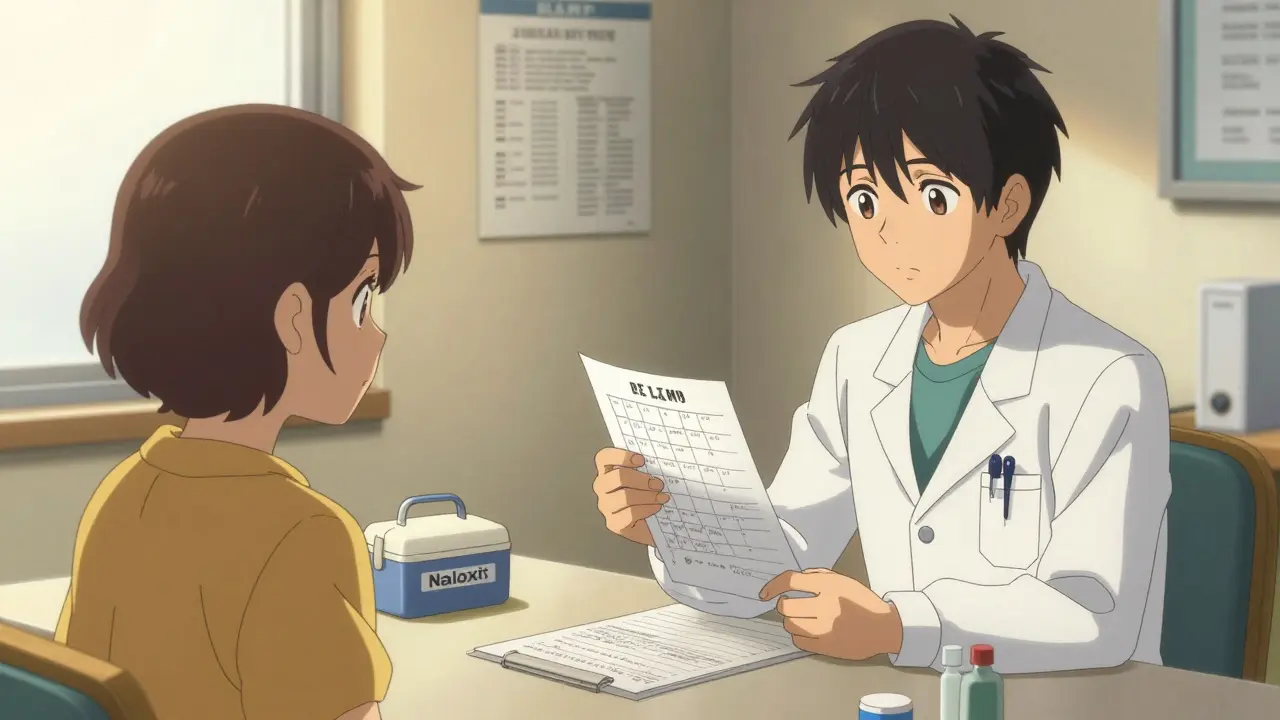
When you’re taking medication for chronic pain, or if you’ve ever used substances to cope with stress, trauma, or mental health struggles, talking to your doctor about overdose risk can feel terrifying. You might worry they’ll judge you, assume the worst, or dismiss you as someone who’s "just looking for drugs." But here’s the truth: overdose risk isn’t about morality - it’s about medicine. Just like checking your blood pressure or screening for diabetes, assessing your risk for overdose should be a routine part of care.
Why This Conversation Matters
Every day in the U.S., 78 people die from opioid overdoses - including prescription painkillers and heroin. Many of these deaths happen to people who were taking their medication exactly as prescribed. Others involve mixing medications with alcohol or benzodiazepines. The problem isn’t always misuse - it’s lack of awareness. Your doctor doesn’t know you’re taking extra pills when you’re in pain, or that you’ve been using Xanax to sleep, unless you tell them. And if you don’t know how to say it without shame, you might stay silent.Studies show that when patients use clear, factual language, they’re 4.2 times more likely to get help - like a naloxone prescription - than those who speak vaguely or emotionally. Naloxone isn’t a reward for "bad behavior." It’s like an EpiPen for allergies. You don’t need to earn it. You just need to need it.
What to Say - And How to Say It
The key is to shift from fear-based language to safety-based language. Instead of saying, "I’m scared I might overdose," try this:- "I’d like to discuss overdose prevention as part of my overall health plan."
- "Can we go over my current medications and make sure I’m not at risk?"
- "I’d like to have naloxone on hand - just like I keep an inhaler for my asthma."
These phrases work because they frame the conversation as routine, not exceptional. They match how doctors talk about other chronic conditions. You wouldn’t feel embarrassed asking for a flu shot or a mammogram. Overdose prevention should be the same.
According to a 2021 JAMA Internal Medicine study, patients who used this exact language were 62% more likely to receive naloxone than those who said things like, "I think I’m at risk." Vague statements invite judgment. Specific ones invite action.
Prepare Before Your Appointment
Don’t walk in cold. Spend 15 minutes before your visit writing down:- All prescription medications you take - including dosages and how often
- Any non-prescribed substances - alcohol, marijuana, benzodiazepines, street drugs
- Any times you’ve felt dizzy, passed out, or had trouble breathing after taking meds
- Any recent changes - increased stress, loss of sleep, new mental health symptoms
This "medication timeline" isn’t about confession - it’s about clarity. A 2021 study in the Journal of General Internal Medicine found that patients who brought this written list were 53% more likely to have a productive conversation. Doctors aren’t mind readers. They need facts, not feelings.
What If They React Poorly?
Not every provider is trained to talk about substance use without stigma. In fact, a 2019 study found that 43% of healthcare workers still hold negative attitudes toward people with substance use disorder. You might hear things like:- "Are you using heroin?"
- "You’re just looking for drugs."
- "Why would you need naloxone?"
If this happens, you have options. First, don’t panic. You’re not wrong. You’re not broken. You’re simply trying to protect your life.
Try this response: "I’m concerned about being judged. That’s why I’m asking - I want to make sure I’m safe. Is there a way we can talk about this without stigma?"
If they still shut you down, ask for a referral. Say: "Can you connect me with someone who specializes in substance use and overdose prevention?"
Many clinics now have integrated care teams. Federally qualified health centers - which serve over 29 million Americans - have adopted stigma-reduction protocols since the 2020 SUPPORT Act. If you’re in a rural area, you might have to travel farther. But you deserve care.
What Is Naloxone? And Why Should You Ask For It?
Naloxone (brand name Narcan) reverses opioid overdoses. It’s safe, easy to use, and doesn’t work on non-opioid drugs like cocaine or meth. But if you’re taking opioids - even legally - and you use alcohol, benzodiazepines, or sleep aids, your risk goes up.Since July 2023, generic naloxone nasal spray costs as little as $25 per kit. That’s down from $130. Many pharmacies now sell it over the counter without a prescription. But if your doctor writes one, insurance usually covers it for free.
As Dr. Sarah Wakeman of Massachusetts General Hospital says: "Think of naloxone like a fire extinguisher. You don’t wait until the house is burning to buy one. You keep it handy because you care about safety."
Stigma Isn’t Just in the Room - It’s in the System
Yes, language matters. But so does access. In rural areas, only 28% of primary care providers are trained to prescribe buprenorphine - a medication that helps treat opioid use disorder. In cities, that number is 56%. And even if your doctor wants to help, they might be blocked by insurance.A 2022 survey found that 41% of people trying to get treatment for substance use disorder faced insurance denials. That’s not stigma in the moment - that’s stigma built into policy. You can’t fix the system alone. But you can protect yourself.
Use the SAMHSA National Helpline (1-800-662-4357). It’s free, confidential, and available 24/7. They can help you prepare for your appointment, find local providers, and even practice what to say. In 2022 alone, they answered nearly 290,000 calls - a 22% jump from the year before.
You’re Not Alone
Thousands of people have walked into their doctor’s office with this exact fear. Some left with a prescription. Others left feeling shattered. The difference? Preparation. Clarity. Confidence.You’re not asking for permission to be safe. You’re exercising your right to care. You’re not a "junkie." You’re not a "drug seeker." You’re a person managing complex health needs - just like someone with heart disease or diabetes.
And if your doctor doesn’t treat you that way? Find another one. Your life is worth more than their bias.
What if my doctor refuses to prescribe naloxone?
If your doctor refuses, ask why. If they say "you don’t need it," ask for a referral to a specialist or a clinic that offers overdose prevention services. You can also get naloxone directly from many pharmacies without a prescription - and at low cost. The CDC recommends everyone who uses opioids - even as prescribed - carry naloxone. It’s not a judgment; it’s a safety tool.
Can I bring someone with me to the appointment?
Yes. Bringing a trusted friend or family member can help you feel less alone and give you someone to remember what was said. Many people find it easier to speak up when they have support. Your doctor should welcome this - it’s part of patient-centered care.
Is it okay to talk about past drug use even if I stopped years ago?
Absolutely. Past substance use can still affect how your body responds to medications today. Even if you haven’t used in years, telling your doctor helps them make safer decisions about pain management, anesthesia, or mental health drugs. Your history isn’t a mark against you - it’s information that keeps you alive.
What if I’m on long-term opioids for pain?
You’re not alone. Millions of people take opioids for chronic pain. The CDC now says that assessing overdose risk should be routine for all patients on opioids - no matter how long they’ve been taking them. Ask your doctor to review your dose, check for interactions with other medications, and offer naloxone. This isn’t about suspicion - it’s about prevention.
How do I know if I’m at risk for overdose?
You’re at higher risk if you: take opioids, use alcohol or benzodiazepines (like Xanax or Valium), have a history of overdose, have depression or anxiety, use drugs alone, or have recently been released from jail or a treatment program. The CDC says anyone on opioids should be offered naloxone - regardless of perceived risk. If you’re unsure, ask: "Based on what I’ve told you, am I at risk?"
Oliver Calvert
February 18, 2026 AT 01:37Finally someone says it plainly: overdose risk isn't about morality, it's about pharmacology. Doctors treat hypertension without asking if you 'deserve' it. Why should opioids be different? I've seen too many patients get dismissed because they used the word 'scared' instead of 'risk assessment.' The language shift you're advocating? Pure clinical logic.
Also-naloxone at $25? That's a win. Pharmacies should stock it next to aspirin. No prescription needed. No judgment required. Just common sense.
Logan Hawker
February 19, 2026 AT 20:10Brilliantly articulated, though I must say-the entire framework rests on a foundation of neoliberal medicalization. You're essentially asking people to perform health literacy like a corporate compliance module. 'I'd like to discuss overdose prevention as part of my overall health plan'-how quaint. As if the system isn't designed to extract, not heal. The fact that we need to script our suffering into palatable corporate-speak to get basic safety tools… that’s the real tragedy.
Also, 'naloxone like an EpiPen'? No. EpiPens don't come with a 37-page consent form and a mandatory mental health screening. This isn't prevention-it's triage with a side of surveillance.
Carrie Schluckbier
February 21, 2026 AT 10:32Did you know the CDC got pressured into this by Big Pharma? They quietly funded the 'naloxone as routine' campaign while pushing more opioids into circulation. The same companies that made fentanyl-laced pills now sell the antidote. It's a profit loop. You think they care about you? They care about your insurance bill.
And don't get me started on SAMHSA-funded by HHS, which is run by people who voted against Medicaid expansion. They want you to call a helpline while the system burns. Wake up. This isn't help. It's damage control with a smiley face.
Haley DeWitt
February 23, 2026 AT 03:08This made me cry a little 😭 I’ve been on long-term opioids for 8 years after a car crash. My doctor never brought up naloxone until I asked. I used the exact phrase from the article: 'Can we go over my meds and make sure I’m not at risk?' He looked at me like I’d just asked for a hug. Then he handed me a free kit. I didn’t feel judged. I felt seen.
Thank you for writing this. I’m printing it out for my next appointment 💛
Digital Raju Yadav
February 23, 2026 AT 08:22USA is collapsing under this woke medical nonsense. You want naloxone? Fine. But don't pretend this is about 'health equity.' It's about enabling addiction. In India, we don't hand out antidotes to people who keep jumping off cliffs. We tell them to stop jumping. Simple.
Why not just say: 'Stop using opioids if you're scared of overdosing'? Why the whole theater? This isn't medicine. It's social engineering with a stethoscope.
Kancharla Pavan
February 25, 2026 AT 06:52You speak of 'safety-based language' as if it's a magic incantation. But language is not the issue. The issue is systemic abandonment. People who take opioids for chronic pain are often elderly, poor, or disabled. They don't have 15 minutes to write a 'medication timeline.' They don't have transportation to a clinic that 'specializes.' They don't have insurance that covers naloxone without prior authorization.
This article reads like a glossy brochure from a pharmaceutical lobby. Real people aren't scripting conversations. They're choosing between rent and refills. And you're telling them to be articulate? That's not compassion. That's cruelty dressed in clinical jargon.
Dennis Santarinala
February 26, 2026 AT 03:48I’ve been in recovery for 11 years. I used to think asking for naloxone meant I was a failure. Then I realized: it’s like carrying a spare tire. You don’t wait until you’re stranded to get one.
My doctor didn’t know I was mixing sleep meds with my painkillers. I didn’t say 'I’m scared.' I said: 'I want to make sure I’m not at risk.' He didn’t blink. Gave me two kits. One for me. One for my sister.
It’s not about being brave. It’s about being smart. And smart people don’t wait for a crisis to prepare for it.
guy greenfeld
February 26, 2026 AT 16:27There’s a deeper metaphysical question here: if the body is a site of suffering, and medicine is the institution that both alleviates and administers that suffering-then who are we really asking for permission from? The doctor? The system? The state?
Naloxone doesn’t restore life. It delays death. And in a world where the cost of care exceeds the value of human life, is delaying death the same as affirming it?
I carry naloxone. But I also carry grief. Because I know: the system that gives me this tool will never give me the dignity to not need it.
Adam Short
February 28, 2026 AT 09:53My mate in Manchester got handed naloxone after a hospital stay. He said the nurse laughed and said 'you'll need this if you keep doing what you're doing.' He didn't feel supported. He felt labeled.
This article is too polished. Real people don't speak in bullet points. They mumble. They cry. They say 'I don't know how to say it.' And when they do, they get told 'you're not ready for this conversation.'
Stop scripting. Start listening.
John Haberstroh
March 2, 2026 AT 02:04Let’s be real: the reason this works is because it removes the emotional weight from the conversation. Saying 'I’d like to discuss overdose prevention as part of my overall health plan' is like saying 'I’d like to get my cholesterol checked.' No drama. No guilt. Just data.
Doctors are humans too. They don’t want to be villains. They want to help. But they’re drowning in paperwork and time constraints. Give them a clear, clean opening-and they’ll meet you halfway.
And yeah, naloxone costs less than a Starbucks latte now. If you’re on opioids? Get it. Even if you think you’re 'fine.' You’re not. None of us are.
Tony Shuman
March 3, 2026 AT 15:50Interesting how this ignores the elephant in the room: the opioid epidemic was manufactured. Purdue Pharma. The Sacklers. The FDA. The DEA. All of them. Now we're told to 'talk to your doctor' like it's a customer service hotline.
They sold the poison. They sold the antidote. And now they want you to thank them for the 'safe' way to ask for help.
Don't be fooled. This isn't progress. It's PR with a stethoscope.
James Lloyd
March 3, 2026 AT 17:54One sentence: Get naloxone. It’s cheap. It’s safe. It’s lifesaving. No script needed. No shame required. Just do it.