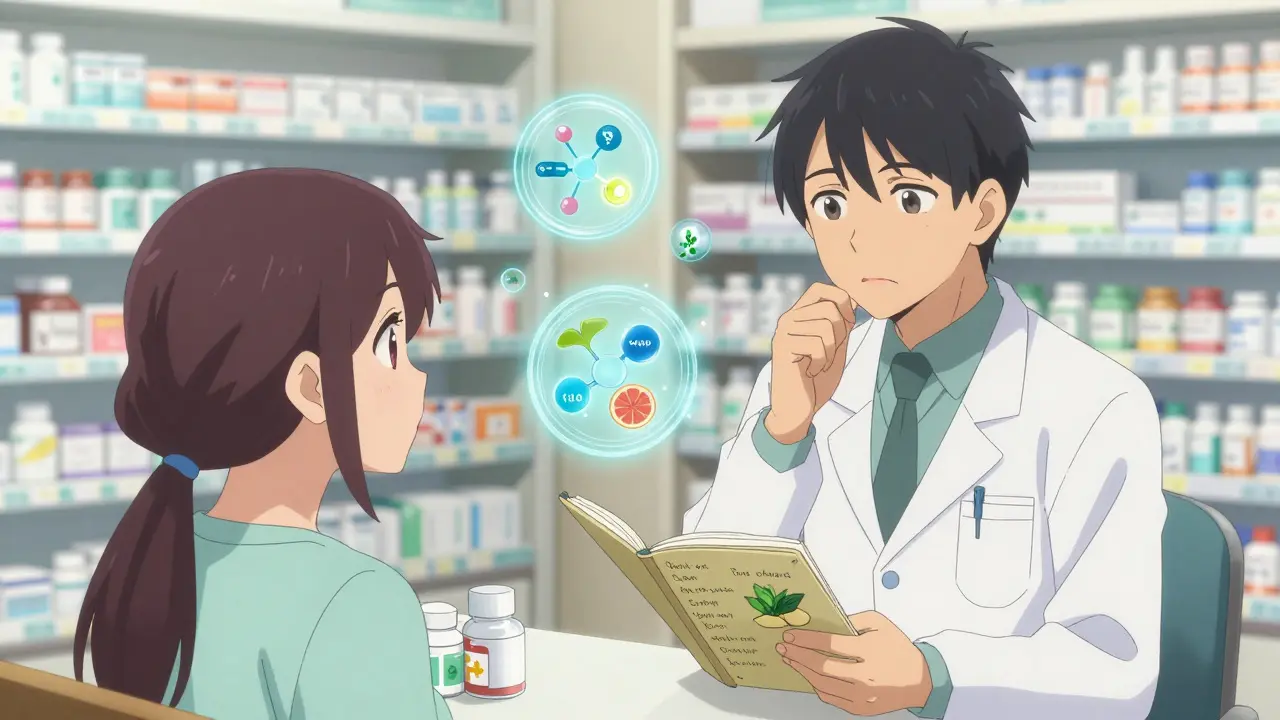
Many people take supplements-vitamins, herbs, fish oil, probiotics-thinking they’re harmless. But here’s the truth: supplements aren’t harmless. They can react with your prescriptions in ways that are dangerous, even life-threatening. And most people don’t tell their pharmacist about them. That’s a problem.
Imagine you’re on warfarin, a blood thinner. You start taking ginkgo biloba because you heard it helps memory. Sounds safe, right? Wrong. Ginkgo can make your blood too thin, increasing your risk of internal bleeding. Or maybe you’re on statins for cholesterol and you’re popping coenzyme Q10 to fight muscle pain. That might seem smart, but it could cancel out the statin’s effect. Even foods like grapefruit, dairy, or avocado can interfere with how your meds work.
Pharmacists are the hidden experts in this space. They’re not just the people who hand out pills. They’re trained to spot interactions between drugs, supplements, and food. But they can’t help if you don’t tell them everything.
Why Your Pharmacist Needs to Know Everything You Take
A 2025 study showed that when pharmacists asked patients detailed questions about supplements, they caught dangerous interactions that had been missed before. Before the full history, only 3 out of every 100 pharmacists spotted a serious interaction between warfarin and avocado-soybean supplements. After asking the right questions, that number jumped to 13 out of 100. That’s a fourfold increase.
Why? Because most patients don’t think of supplements as medicine. They say, “I just take a multivitamin.” But multivitamins can contain vitamin K, which directly opposes warfarin. Or they take St. John’s wort for low mood-thinking it’s natural, so it’s safe. But St. John’s wort can cause serotonin syndrome when mixed with antidepressants. It can also make birth control fail. It’s not just about pills. It’s about what you put in your body.
And it’s not just supplements. Foods matter too. Dairy products and calcium supplements can block absorption of antibiotics like tetracycline and ciprofloxacin. Grapefruit can raise the level of certain heart meds in your blood to toxic levels. Even leafy greens like spinach and kale can interfere with blood thinners if your intake suddenly changes.
What Supplements Are Most Dangerous?
Not all supplements are equal when it comes to risk. Some are low-risk. Others? High-risk.
- St. John’s wort: This one’s a big red flag. It interacts with antidepressants, birth control, blood thinners, and even some cancer drugs. It can make your meds stop working-or cause dangerous side effects.
- Goldenseal: Often used for colds, it can interfere with liver enzymes that break down drugs. This can make your medications build up to toxic levels.
- Ginkgo biloba: Can increase bleeding risk with warfarin, aspirin, or NSAIDs like ibuprofen.
- Milk thistle: Generally low risk, but can interfere with some cancer drugs and statins.
- Black cohosh: Used for menopause, but can affect liver function in rare cases.
Even supplements labeled “natural” or “organic” can be risky. The FDA doesn’t test them before they hit shelves. That means what’s on the label might not match what’s inside. Some products contain hidden drugs, contaminants, or wrong dosages.
Medications That Drain Your Nutrients
It’s not just about what you take-it’s what your meds take from you.
- Proton pump inhibitors (PPIs) like omeprazole: These reduce stomach acid, which helps you absorb vitamin B12, magnesium, and calcium. Long-term use can lead to nerve damage, muscle cramps, or osteoporosis.
- Metformin (for diabetes): Lowers B12 and folate levels. This can cause fatigue, brain fog, and even nerve damage over time.
- Statins: These drugs lower cholesterol but also reduce coenzyme Q10, which your muscles need. That’s why many people on statins feel tired or get muscle pain.
- Diuretics: These flush out water, but also potassium and magnesium. Low levels can cause irregular heartbeat or cramps.
- Oral contraceptives: Can lower B6, B12, folate, and magnesium. This may contribute to mood swings or headaches.
That’s why talking to your pharmacist isn’t just about avoiding bad interactions-it’s also about replacing what your meds are stealing from your body.
How to Prepare for Your Visit
Don’t walk in blind. Bring a list. Not just a mental note. Write it down.
- Write down every supplement: Include brand name, dose, and how often you take it. Example: “Nature Made Omega-3, 1000mg, once daily.”
- Include every prescription and OTC med: Even aspirin, antacids, or sleep aids.
- Track your diet: Do you eat grapefruit every morning? Drink milk with your meds? Eat a lot of spinach? Note it.
- Bring the bottles: If you can’t remember names, bring the actual containers. Pharmacists can read the labels and spot red flags.
- Be specific: Don’t say “I take vitamins.” Say “I take vitamin D 5000 IU daily and magnesium glycinate 200mg at night.”
Also, don’t assume your pharmacist will ask. Many still don’t. A 2025 study found that only 6% of pharmacists asked patients if they were taking supplements for someone else. That’s not a mistake-it’s a gap in training. So lead the conversation.
What to Ask Your Pharmacist
Don’t just listen. Ask questions. Here are five smart ones:
- “Could any of these interact with my medications?”-This opens the door for a full review.
- “Should I take this supplement at a different time than my pills?”-For example, take calcium 4 hours apart from thyroid meds.
- “Is there a better supplement for my condition?”-Sometimes, there’s a safer or more effective option.
- “Could this be causing my side effects?”-If you’ve had new nausea, dizziness, or fatigue, this could be why.
- “Should I get my nutrient levels checked?”-Especially if you’re on long-term meds like metformin or PPIs.
Pharmacists aren’t doctors. But they know how drugs move through your body. They know which supplements block absorption. They know which foods change drug levels. They’re your best ally if you’re taking more than one thing.
What’s Changing in 2026
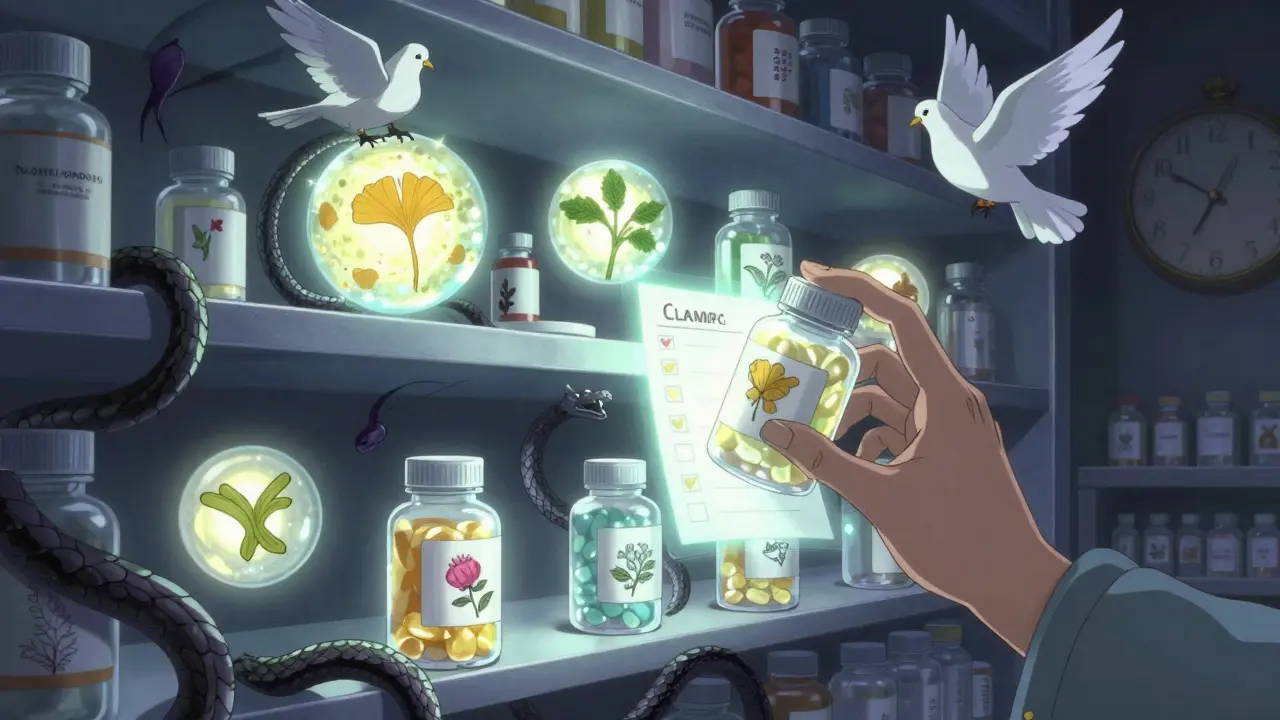
The rules are shifting. In 2023, pharmacy schools started requiring full training on supplement interactions. By 2025, CVS and Walgreens added supplement interaction checkers into their pharmacy systems. In early 2026, the FDA proposed a new law requiring supplement makers to list products before selling them-meaning more transparency.
By 2027, 85% of community pharmacies are expected to offer formal supplement counseling. That means you’ll be able to book a 15-minute appointment just to review what you’re taking. No appointment needed? Ask anyway. Most pharmacists will still do it.
And don’t wait for your annual checkup. If you start a new supplement, call your pharmacist the same day. If you switch medications, review your list again. It’s not a one-time thing. It’s ongoing.
Final Tip: Don’t Stop Without Talking
Sometimes, people stop taking a supplement because they heard it “interacts.” But quitting suddenly can be risky too. If you’re on a statin and you stop coenzyme Q10, your muscle pain might get worse. If you stop a B vitamin after being on metformin for years, you could feel more tired or confused.
Your pharmacist can help you adjust safely. Maybe you need a different form. Maybe you need a blood test. Maybe you just need to time it differently. But you’ll never know unless you ask.
Do I really need to tell my pharmacist about vitamins and herbs?
Yes. Even if you think it’s harmless, vitamins and herbs can interact with your prescriptions. For example, vitamin K in multivitamins can reduce the effect of blood thinners like warfarin. St. John’s wort can make antidepressants or birth control pills less effective. Pharmacists need the full picture to keep you safe.
Can food really interfere with my medications?
Absolutely. Grapefruit can raise levels of certain heart and cholesterol drugs to dangerous levels. Dairy and calcium can block absorption of antibiotics like tetracycline and thyroid meds. Even leafy greens can affect blood thinners if your intake changes suddenly. Always mention your regular eating habits.
What if I don’t know the brand name of my supplement?
Bring the bottle. If you can’t find it, write down what it says on the label-ingredients, dose, how often you take it. Even partial info helps. Pharmacists can look up ingredients and find potential interactions. Don’t say “I take a fish oil pill.” Say “I take one softgel with 1000mg omega-3 daily.” Specifics save lives.
Are supplements regulated like drugs?
No. Unlike prescription drugs, supplements don’t need FDA approval before being sold. Manufacturers aren’t required to prove they’re safe or effective. That’s why some products contain hidden drugs, too much of an ingredient, or none of what’s listed. That’s why your pharmacist’s advice matters more than the label.
I’ve been taking the same supplement for years. Do I still need to mention it?
Yes. Your body changes. Your medications change. A supplement that was safe last year might not be safe now if you started a new drug, changed doses, or developed a new condition. Even if nothing changed, it’s still worth a quick check. It takes two minutes-and could prevent a serious problem.
If you’re on more than one medication and take any supplement-even a daily multivitamin-your pharmacist is your most accessible safety net. They’re in your neighborhood, they’re trained for this, and they’re ready to help. All you have to do is speak up.
rafeq khlo
March 8, 2026 AT 17:14The systemic disregard for pharmacological precision in the general populace is nothing short of catastrophic. Supplements are not benign. They are pharmacologically active compounds with half-lives, metabolic pathways, and receptor affinities. To treat them as dietary accessories is not ignorance-it is negligence. The FDA’s regulatory gap is not a loophole-it is a chasm through which lethal interactions slip daily. Your multivitamin contains vitamin K1. Warfarin’s INR is a tightrope. One gram of spinach at dinner can destabilize it. This is not opinion. This is pharmacokinetics.
Morgan Dodgen
March 10, 2026 AT 13:34lol so the FDA is just letting Big Pharma control everything?? 😈
St. John’s Wort? Yeah it interferes-but so do 80% of prescription drugs. The real scam? They don’t test drug interactions either. Pharma just wants you addicted to $500/month pills while you’re ‘supplementing’ with ‘toxic’ herbs. Meanwhile, your doctor won’t even ask about your turmeric. 💥
And grapefruit? That’s just science being ‘too complicated’ for the masses. Classic.
Philip Mattawashish
March 11, 2026 AT 05:39You people are pathetic. You think a pharmacist is going to save you? They’re paid by the chain pharmacy to push their own branded supplements. The ‘interaction checker’? A marketing tool. The real danger isn’t ginkgo-it’s the fact that you’ve outsourced your health to a guy in a white coat who’s never read a peer-reviewed paper on CYP450 polymorphisms.
And don’t get me started on ‘natural’-that word is a death sentence wrapped in a hemp bag. Your body doesn’t care if it’s from a tree or a lab. It cares about molecular structure. You’re not a customer. You’re a metabolic experiment.
Tom Sanders
March 11, 2026 AT 21:29bro i just take fish oil and a multivitamin. why is this so complicated? i dont wanna write a novel just to get my blood pressure meds.
Erica Santos
March 12, 2026 AT 18:41Oh wow, a 2025 study? That’s practically ancient history. I bet the ‘fourfold increase’ was just a PR stunt by the American Pharmacists Association to get more funding. Meanwhile, the real problem? People think ‘I take supplements’ means ‘I’m healthy.’ Nope. You’re just another data point in Big Supplement’s marketing funnel. 🤡
And don’t even get me started on ‘natural’-if it’s from a tree, why does it come in a plastic bottle with a barcode?
Scott Easterling
March 14, 2026 AT 15:40Wait. Wait. Wait. So… you’re telling me… that I need to bring my supplement bottles… to the pharmacy… like… every time? And write down the brand? And the dose? And the time? And the food I eat? And the weather? And my zodiac sign? 😭
Can I just… not? I have a cat. I have a job. I have a Netflix queue. I can’t be a full-time biochemist. This is too much. I’m done.
Melba Miller
March 15, 2026 AT 00:42Let me tell you something. I’ve been on blood pressure meds for 12 years. I take a calcium supplement because my doctor said so. I eat spinach every morning. I never told anyone. I thought it was ‘natural’ so it was fine. Then I got dizzy. Went to the ER. Turns out my calcium was blocking my med. My pharmacist said, ‘Why didn’t you say anything?’
I didn’t know. I’m not a doctor. I’m not a scientist. I’m a mom who just wants to live long enough to see her grandkids. Don’t shame us. Educate us. Gently.
Katy Shamitz
March 16, 2026 AT 16:44I love this so much. Seriously. I’ve been taking St. John’s wort for years because my cousin swore by it. Then I started on antidepressants and didn’t connect the dots. My pharmacist pulled me aside last month and said, ‘You’re lucky you’re still here.’ I cried. I didn’t know. No one told me. Thank you for writing this. I’m bringing my whole medicine cabinet next time. 💕
Nicholas Gama
March 18, 2026 AT 07:38Supplements are unregulated. Ergo, they’re dangerous. Ergo, avoid them. End of story. If you need vitamins, eat food. If you need medicine, get a prescription. Anything else is self-delusion wrapped in a capsule. The science is clear. The evidence is overwhelming. You’re not special. You’re not immune. Stop.
Mary Beth Brook
March 19, 2026 AT 15:13Pharmacists are the last line of defense in a broken system. CYP450 enzyme inhibition isn’t a buzzword-it’s a clinical reality. When CoQ10 competes with statins for HMG-CoA reductase modulation, you’re not ‘helping’ your muscles-you’re creating a pharmacokinetic bottleneck. This isn’t anecdotal. It’s biochemistry. And if you’re not tracking your dosing intervals, you’re playing Russian roulette with your hepatocytes.
Dan Mayer
March 21, 2026 AT 01:45im not saying this is wrong but i think you overstat the risk. like i take magnesium and its fine. also why do you say ‘avocado-soybean supplements’? that sounds like a made up thing. maybe you meant avocado oil? lol
Samantha Fierro
March 22, 2026 AT 15:28This is the kind of information that saves lives. I’ve worked in healthcare for 18 years. I’ve seen patients who didn’t tell their pharmacist about their herbal tea because ‘it’s just chamomile.’ Then they had a stroke. Or their blood sugar crashed. Or their heart skipped.
Don’t wait for a crisis. Bring your list. Bring your bottles. Ask the questions. Your pharmacist isn’t judging you. They’re your ally. And they’re waiting to help you. You just have to show up. I’m proud of you for caring enough to read this. Keep going.
Robert Bliss
March 22, 2026 AT 20:06thanks for this. i always thought supplements were ‘safe’ because they’re ‘natural.’ now i know better. i’m gonna bring my stuff to my pharmacist next week. no more guessing. 🙏
APRIL HARRINGTON
March 24, 2026 AT 04:05OMG I JUST REALIZED I’VE BEEN TAKING GINKGO WITH MY BLOOD THINNER FOR 3 YEARS 😭 I’M CALLING MY PHARMACY RIGHT NOW I’M SO SCARED BUT ALSO SO GRATEFUL FOR THIS POST I’M CRYING RIGHT NOW