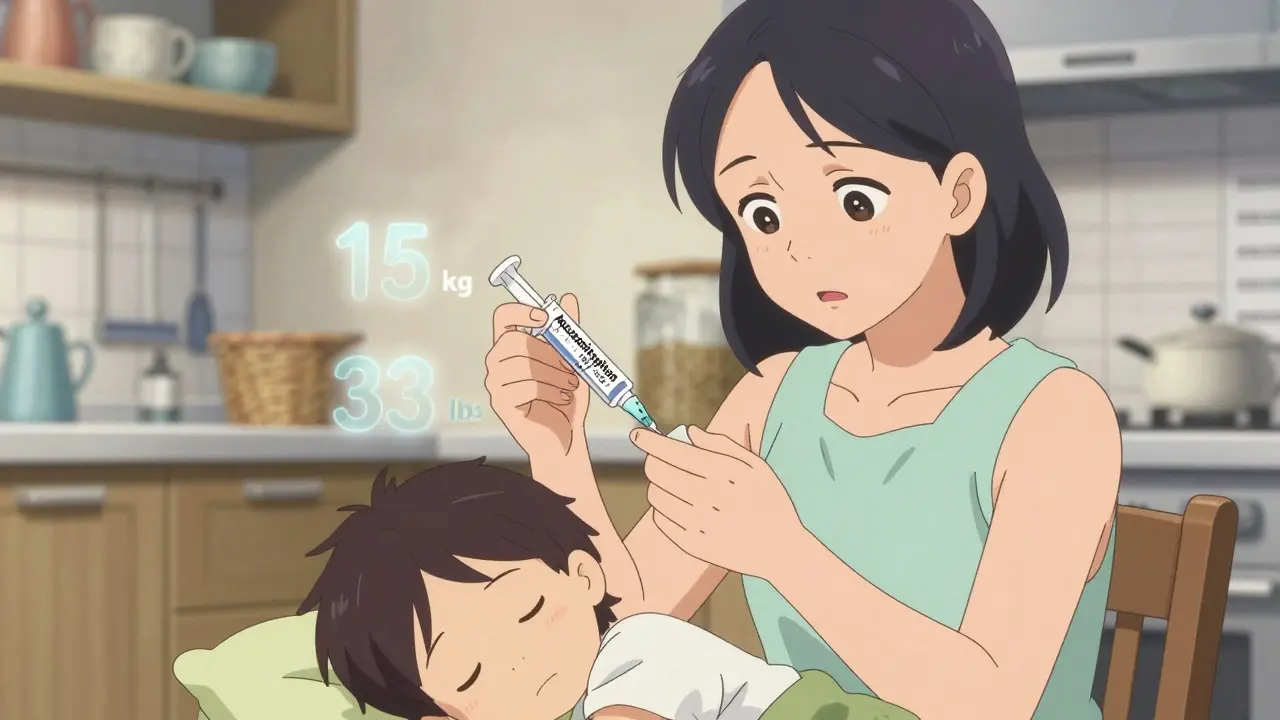
Why Reading Medicine Labels by Age and Weight Saves Lives
Every year, tens of thousands of children end up in emergency rooms because someone gave them the wrong dose of medicine. Not because the medicine was bad, but because the label wasn’t read correctly. The most common mistake? Using age alone to decide how much to give. But a 3-year-old who weighs 25 pounds needs a different dose than a 3-year-old who weighs 40 pounds. Age is a rough guide. Weight is the real key.
The Centers for Disease Control and Prevention (CDC) reports that about 70,000 emergency visits each year for kids under 12 are tied to medication errors. And the biggest culprit? Acetaminophen - the active ingredient in Tylenol®. Too little won’t help the fever. Too much can damage the liver. The fix isn’t complicated: learn how to read the label using your child’s weight.
The Seven Parts of a Children’s Medicine Label (And What They Mean)
Every OTC children’s medicine in the U.S. must follow the FDA’s Drug Facts label. It’s not just text - it’s a safety map. Here’s what to look for:
- Active ingredient: This tells you what the medicine actually is. Look for the amount per milliliter (mL). Example: acetaminophen 160 mg/5 mL. That means every 5 mL has 160 mg of acetaminophen. If you see 80 mg/1 mL, that’s infant drops - a much stronger concentration.
- Uses: What the medicine treats. Fever? Pain? Cough? Don’t use it for something it’s not meant for.
- Warnings: This section tells you when NOT to give the medicine. Look for age restrictions, allergy alerts, and signs of overdose (like nausea, vomiting, or yellowing skin).
- Directions: The most important part. This gives you dosing by weight AND age. Always check both. If your child’s weight falls between two ranges, round up to the next dose - never down.
- Inactive ingredients: These don’t treat symptoms, but they can cause reactions. Watch for dyes, alcohol, or high-fructose corn syrup if your child has allergies or sensitivities.
- Purpose: Explains what the active ingredient does. For example, analgesic means pain reliever.
- Other information: Storage tips, expiration date, and manufacturer details. Never use expired medicine.
Prescription labels add more: your child’s name, the doctor’s name, the pharmacy’s phone number, and how often to give it (like TID = three times daily). Always double-check the name on the bottle. Mistakes happen - and they’re dangerous.
Weight-Based Dosing: The Gold Standard
Doctors and pharmacists agree: weight is the most accurate way to dose children. Why? Because a child’s body processes medicine based on how much they weigh, not how old they are. A 2021 study from Penn State found weight-based dosing cuts errors by nearly 38% compared to age-only dosing.
For acetaminophen, the standard dose is 10-15 mg per kilogram of body weight, every 4 to 6 hours. Don’t exceed 75 mg per kg in 24 hours. For ibuprofen, it’s 5-10 mg per kg, every 6 to 8 hours, with a max of 40 mg per kg per day.
Need to convert pounds to kilograms? Divide by 2.2. So a 33-pound child is 15 kg (33 ÷ 2.2 = 15). If the label says 10 mg/kg, that’s 150 mg total. Since the liquid is 160 mg/5 mL, you’d give about 4.7 mL - close enough to 5 mL if your syringe doesn’t go below 0.5 mL increments.
Here’s a quick reference:
| Weight (kg) | Weight (lbs) | Acetaminophen (160 mg/5 mL) | Ibuprofen (100 mg/5 mL) |
|---|---|---|---|
| 5 kg | 11 lbs | 1.5-2.5 mL | 0.75-1.5 mL |
| 10 kg | 22 lbs | 3-5 mL | 1.5-3 mL |
| 15 kg | 33 lbs | 4.7-7 mL | 2.25-4.5 mL |
| 20 kg | 44 lbs | 6-9 mL | 3-6 mL |
| 25 kg | 55 lbs | 7.5-11 mL | 3.75-7.5 mL |
These are general guidelines. Always check your specific product’s label. Some brands use slightly different concentrations.
Age-Based Dosing: When Weight Isn’t Available
Not every parent has a scale that measures to 0.1 kg. If you don’t know your child’s exact weight, use age ranges - but treat them as a backup, not a rule.
Most labels break children into these groups:
- Under 2 years: Always talk to a doctor first. Their liver and kidneys are still developing. Never guess a dose.
- 2-3 years: Usually 5-10 mL of acetaminophen (160 mg/5 mL)
- 4-5 years: Usually 7.5-10 mL
- 6-11 years: Usually 10-15 mL
- 12+ years: Adult dose, but check the label. Some products cap at 12 years.
Here’s the catch: a 5-year-old weighing 50 pounds (22.7 kg) needs more than a 5-year-old weighing 30 pounds (13.6 kg). If you only use age, you’re risking underdosing or overdosing. That’s why the American Academy of Pediatrics says: “Use weight when possible. Use age only when weight is unknown.”

Measuring Devices: Never Use a Kitchen Spoon
One of the most dangerous habits? Using a regular spoon. A teaspoon from your kitchen might hold 3 mL. Or 7 mL. Or 10 mL. It’s unpredictable. The FDA says 68% of dosing errors happen because parents use household spoons.
Use what comes with the medicine:
- Oral syringe: Best for babies and toddlers. Look for one marked in 0.1 mL or 0.5 mL increments. Draw up the dose, hold it at eye level, and read the bottom of the liquid curve.
- Dosing cup: Good for older kids. Make sure it has clear markings. Don’t fill it to the top - read the line.
- Plastic dosing spoon: Only if it’s clearly marked in mL. Avoid metal spoons - they’re hard to read.
Never use a tablespoon unless the label says “tablespoon.” One tablespoon = 15 mL. One teaspoon = 5 mL. Confusing them means a 300% overdose. That’s not a typo - that’s a hospital trip.
What to Do When You’re Confused
It’s okay to be unsure. Almost every parent has been there. One Reddit user wrote: “My 6-year-old weighs 55 pounds. The age chart says 5 mL. The weight chart says 11 mL. I called my pediatrician. He said go by weight.”
Here’s your action plan:
- Find your child’s current weight in kilograms. Weigh them on a digital scale, or ask your pediatrician for their last recorded weight.
- Check the label for both age and weight ranges.
- If they conflict, choose the weight-based dose.
- Use the measuring tool that came with the medicine.
- Write down the dose before you give it. Double-check it.
- If you’re still unsure, call your pharmacist. They’re trained for this. Most will walk you through it over the phone.
Pharmacists gave counseling to 93% of new pediatric prescriptions in 2023. Don’t be shy - ask. It’s part of their job.
Red Flags: When to Stop and Call a Doctor
Some labels are confusing, outdated, or missing key info. Watch for these warning signs:
- The label only lists age, not weight.
- It doesn’t say the concentration (e.g., “acetaminophen” without “160 mg/5 mL”).
- It says “infant drops” but you don’t have infant drops - you have children’s liquid. The old infant drops were 80 mg/mL. The new ones are 160 mg/5 mL. Mixing them up kills.
- The bottle says “Tylenol®” but doesn’t say “Children’s” or “Infant.” Older bottles might be unsafe.
- The expiration date is past.
If you see any of these, don’t guess. Call your pediatrician or pharmacist. They’ll tell you what to do.

Tools and Resources to Help You
You don’t have to memorize everything. Use free tools:
- FDA’s “Medicine: Play It Safe” toolkit - downloadable charts and videos.
- AAP’s Safe Dosage Calculator app - enter your child’s weight and the medicine, and it tells you the dose.
- Children’s Hospital of Philadelphia (CHOP) dosing charts - available online with precise weight ranges.
- HealthyChildren.org - the American Academy of Pediatrics’ parent site. Updated monthly.
Walmart and other pharmacies are now testing QR codes on labels that link to short videos showing how to use the syringe. Early results show 87% of parents found them helpful.
Final Safety Checklist Before Giving Any Medicine
Before you pour, pause. Ask yourself:
- Is this medicine for my child? (Check the name on the bottle.)
- Is this the right medicine? (Brand and generic names can differ.)
- Is the dose based on weight or age? (Use weight if possible.)
- Am I using the correct measuring tool? (Syringe or dosing cup - never a spoon.)
- Is the medicine expired? (Check the date.)
If you answer yes to all five, you’re safe to give it. If even one is a no - stop. Call someone.
What’s Changing in 2025
By the end of 2024, the FDA required all children’s OTC medicines to include both age and weight dosing on the label. Products without it are being pulled from shelves. That means fewer confusing labels.
Smart bottle caps that record when a dose was given are in final testing. They’ll alert you if you give a dose too soon - or too late. In 2025, expect more of these tools to hit pharmacies.
The goal? To cut pediatric medication errors by 70%. That’s 100,000 emergency visits avoided every year. You’re part of that solution - just by reading the label the right way.
Bryan Woods
December 28, 2025 AT 07:46Really appreciate the breakdown of the Drug Facts label. I never realized how much variation there is between infant drops and children’s liquid-scary stuff. I always assumed 'Tylenol' was 'Tylenol' until my kid had a reaction last year. Now I triple-check the concentration. This should be mandatory reading for every new parent.
Ryan Cheng
December 29, 2025 AT 14:46Weight-based dosing is the gold standard, no question. I used to go by age until my daughter was 22 lbs and the chart said 5 mL, but her weight said 7 mL. I went with weight. She didn’t get sick longer, and I didn’t panic. Always use the syringe that comes with it-no kitchen spoons. Ever. I’ve seen too many parents wing it with teaspoons. Don’t be that person.
wendy parrales fong
December 30, 2025 AT 08:50It’s wild how something so simple can be so dangerous. I used to just guess based on how big my kid looked. Now I keep a sticky note on the fridge with the conversion: divide pounds by 2.2. It’s not perfect, but it’s safer than guessing. Also, I take a picture of the dose before I give it. My phone’s camera is my second brain now.
Jeanette Jeffrey
December 30, 2025 AT 10:12Wow. Another ‘parenting guide’ that treats us like idiots. Of course weight matters. But let’s be real-most parents don’t have a digital scale under the sink. You think the average person knows how to convert pounds to kg? This feels like guilt-tripping instead of helping. Also, why is the FDA just now requiring both age and weight? Should’ve been decades ago.
Shreyash Gupta
January 1, 2026 AT 09:36bro i just use the cap and shake it like 3 times 😅 my kid never died yet 🤷♂️ also why are we all so scared of tylenol? i gave my niece 10ml once and she slept for 12 hours 😴
Ellie Stretshberry
January 2, 2026 AT 09:48i never knew about the concentration difference between infant and childrens tylenol until last year when i almost gave my son the wrong one 😳 i thought they were the same. now i always check the mg/ml and write it down. also the syringe thing is a game changer. no more guessing. thank you for this
Zina Constantin
January 3, 2026 AT 21:31As a nurse and mom of three, I’ve seen the aftermath of dosing errors. This post is a lifesaver. I’ve handed out printed copies of this checklist to every new parent I know. And yes-the QR codes on bottles? Genius. My sister in Nigeria just told me her pharmacy started using them too. Global change starts with a label.
Dan Alatepe
January 4, 2026 AT 06:26Man... I used to give my baby medicine with a dropper from a shampoo bottle. No joke. I thought ‘close enough’. Then he threw up for 12 hours straight. I cried. I felt like the worst dad alive. Now I carry a syringe in my diaper bag like it’s my weapon. This post? It’s not just advice-it’s redemption.
Angela Spagnolo
January 4, 2026 AT 15:47I... I didn’t realize how many things I was doing wrong... The inactive ingredients... I didn’t know high-fructose corn syrup was even in kids’ medicine... And I’ve been using the dosing cup wrong... I’ve been filling it to the top... Oh my gosh... I’m so sorry, baby... I’m going to call the pharmacist right now...
Sarah Holmes
January 6, 2026 AT 04:46This is a textbook example of performative safety culture. You’re not ‘saving lives’ by memorizing mg/kg ratios-you’re enabling a pharmaceutical-industrial complex that profits from parental anxiety. Why can’t we just trust our instincts? I’ve raised three children without ever reading a label. They’re all healthy. Your fear is not your child’s reality.
Jay Ara
January 6, 2026 AT 07:24good post. i used to use a spoon till my kid got sick. now i use the syringe. weight over age. simple. no need to overthink. just check the bottle and measure right. also call the pharmacist. they dont bite. trust me