
Every year, over 130,000 people in the U.S. die from lung cancer - more than colon, breast, and prostate cancers combined. But here’s the thing: if caught early, most of those cases can be cured. The key? A simple, low-radiation scan called low-dose CT (LDCT). It’s not for everyone. But if you’re in the right group, it could save your life.
Who Should Get a Low-Dose CT Scan?
The guidelines changed in 2021, and now more people qualify than ever before. You’re eligible if you’re between 50 and 80 years old, have smoked at least 20 pack-years (that’s one pack a day for 20 years, or two packs a day for 10 years), and either still smoke or quit within the last 15 years.
That’s a big shift from the old rules, which only covered people 55 and older with 30 pack-years. Now, someone who started smoking at 18 and quit at 35 - if they smoked a pack a day for 20 years - still qualifies. The science shows their risk doesn’t drop off after 15 years. In fact, about one-third of lung cancers happen in people who quit more than 15 years ago.
Some groups, like the National Comprehensive Cancer Network (NCCN), go even further. They recommend screening for people up to age 85, and they add other risk factors: family history of lung cancer, exposure to asbestos or radon, or conditions like pulmonary fibrosis. If you’ve been around those risks, talk to your doctor - even if you never smoked.
How Does a Low-Dose CT Work?
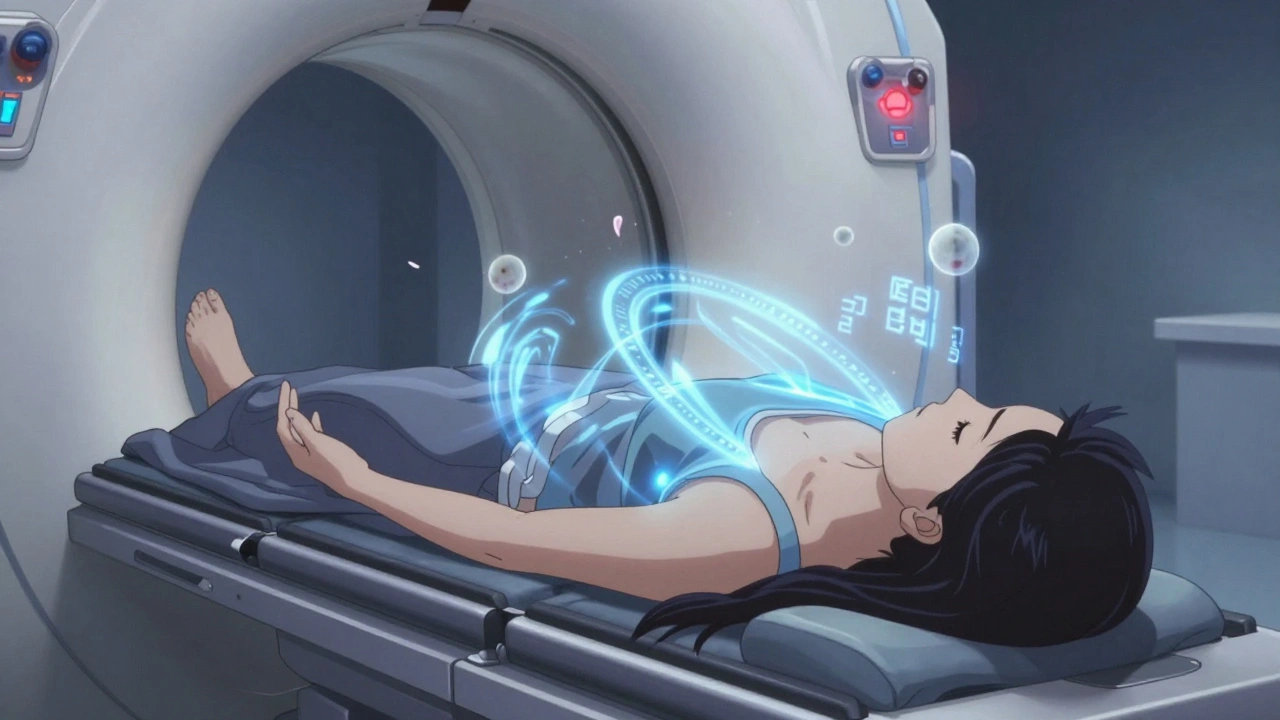
It’s quick. You lie on a table, raise your arms, and hold your breath for about 10 seconds. No needles. No fasting. No prep. The machine takes detailed pictures of your lungs using just a fraction of the radiation of a regular CT scan - about 1.2 millisieverts on average. That’s less than half the radiation you get from natural background sources in a year.
The scan picks up tiny nodules - spots smaller than a grain of rice. Most are harmless. But some can be early-stage cancer. The goal isn’t to find every spot. It’s to catch the dangerous ones before they spread.
Modern scanners use AI to help radiologists. Tools like LungPoint® can flag suspicious areas in seconds, cutting reading time by 30% without missing anything. In studies, AI catches 97% of nodules 6 mm or larger - the size most likely to matter.
What Do the Results Mean?
Most people - about 85% - get a clean result. No nodules. No follow-up needed. You’ll be asked to come back in a year.
If something shows up, don’t panic. A positive result doesn’t mean cancer. It just means there’s something that needs watching. The most common finding is a nodule under 6 mm. These are almost never cancer. The standard is to repeat the scan in 6 to 12 months to see if it grows.
Only about 1 in 10 positive scans turns out to be cancer. The rest? Scar tissue from old infections, inflammation, or just normal variations. But even if it’s not cancer, the wait is stressful. One study found 42% of people felt anxious during the follow-up period. That’s normal. But knowing what to expect helps.
Real stories show the stakes. Mary Johnson, 58, from Ohio, had a 6 mm nodule found on her LDCT. It was Stage 1 adenocarcinoma. She had surgery. No chemo. No radiation. She’s cancer-free now. James Wilson, 62, from Texas, got a false positive. He spent three months in worry, had two extra scans, and paid $450 out of pocket. He’s fine now - but he wishes he’d known how common false positives are.
What Happens If Cancer Is Found?
If a nodule grows or looks suspicious, the next step is usually a biopsy or a PET-CT scan. Most screen-detected cancers are caught at Stage I - the earliest stage. At that point, surgery alone can cure 80% or more of cases.
Today, most surgeries are done with VATS - video-assisted thoracoscopic surgery. That means small incisions, a camera, and a few days in the hospital instead of a week. Recovery is faster. Complication rates are under 1% in top programs.
The NLST study showed that for every 1,000 people screened annually for 3 years, 15 lung cancer deaths are prevented. The radiation risk? About 1 extra cancer death per 1,000 people - far outweighed by the lives saved.
Why Isn’t Everyone Getting Screened?
Only about 23% of eligible people in the U.S. have ever had an LDCT scan. That’s not because the test doesn’t work. It’s because access is uneven.
In rural areas, the average person lives 32 miles from a screening center. Transportation is a real barrier. In states that didn’t expand Medicaid, screening rates are nearly 40% lower than in states that did.
There’s also a racial gap. Black Americans have higher lung cancer rates, but they’re screened at 28% lower rates than White Americans. That’s not because they’re less at risk. It’s because they’re less likely to be offered the test.
Doctors sometimes assume patients won’t show up. Or they don’t know the guidelines. Or they’re worried about false positives. But the data is clear: if you’re eligible, screening saves lives.
What About Cost and Insurance?
Medicare and most private insurers cover LDCT screening with no out-of-pocket cost - as long as you meet the criteria and get a counseling visit first. That visit is required. It’s not a formality. It’s where you talk about your risks, your fears, and whether screening is right for you.
Some programs use decision aids - simple videos or pamphlets - to help you understand the benefits and the risks. The goal isn’t to push you into a scan. It’s to help you make an informed choice.
Even with insurance, follow-up tests can add up. A diagnostic CT after a positive screen might cost $200 or more. That’s why some people avoid screening altogether. But if you’re eligible, the cost of not screening - in lost time, lost health, or lost life - is far higher.
What’s Next for Lung Screening?
The conversation is changing. The FDA just released draft guidance for AI tools that analyze CT scans. Blood tests that detect early cancer signals - like the EarlyCDT-Lung test - are being tested in trials. One study showed a 94% accuracy rate in ruling out cancer.
The NELSON trial from Europe found that scanning every two years - not every year - also cuts deaths by 24%. That could mean less radiation and lower costs over time.
And the U.S. government is reviewing its rules again. In early 2024, CMS announced it’s considering dropping the 15-year quit limit entirely. That could open screening to millions more people - especially older adults who quit decades ago but still carry risk.
The bottom line? Low-dose CT isn’t perfect. But it’s the best tool we have. And for the right people, it’s life-saving.
Sheryl Lynn
December 3, 2025 AT 03:28Let’s be real-this isn’t just screening, it’s a cultural litmus test. We’ve turned preventive medicine into a neoliberal performance art where your worth is measured by your pack-years and your compliance. And yet, the system still ignores the fact that 30% of lung cancers occur in non-smokers, mostly women exposed to secondhand smoke or radon in poorly regulated housing. The guidelines are a joke dressed in clinical jargon. If you’re poor, brown, or lived near a coal plant? Good luck getting an appointment before your lungs turn to ash.
Paul Santos
December 3, 2025 AT 07:12AI-driven nodule detection is the new black, isn’t it? 🤖✨ We’ve outsourced diagnostic intuition to neural nets trained on datasets that barely include non-white phenotypes. It’s like giving a self-driving car a map of Manhattan and expecting it to navigate Mumbai. The 97% accuracy stat? Cute. But what about the 3% that slip through? Those are the ones who end up in obituaries with ‘unexplained respiratory decline’ on the death certificate. We’re optimizing for efficiency, not equity. And that’s… tragic.
Eddy Kimani
December 5, 2025 AT 06:17Just read the NLST data again-15 lives saved per 1,000 screened over 3 years is massive when you think about it. But what’s even more fascinating is how the radiation risk is so low: 1 extra cancer death per 1,000. That’s less than the risk from driving to the screening center. We’re terrified of a 0.1% statistical threat while ignoring the 12% mortality rate of untreated Stage III lung cancer. The math is screaming at us. Why are we still hesitating?
Chelsea Moore
December 6, 2025 AT 11:33WHAT ABOUT THE WOMEN WHO QUIT SMOKING AT 30??!? They’re STILL at risk!! And no one talks about it!! They’re told ‘you’re fine now’ and then-BAM-Stage 4 diagnosis at 52!! And now they’re dead and their kids are crying and the system just shrugs and says ‘well you didn’t qualify’-WHY IS THIS STILL HAPPENING??!!
John Biesecker
December 7, 2025 AT 14:19man i had a cousin who got screened last year after his dad died of lung cancer-he never smoked but grew up in a house with a dad who chain-smoked in the garage. found a 4mm nodule. turned out to be scar tissue. but dude was so scared he stopped sleeping. i told him: ‘you’re alive, you’re getting checked, that’s the win.’ the scan didn’t give him cancer, it gave him peace. kinda beautiful when you think about it 😊
Genesis Rubi
December 7, 2025 AT 15:32US has the best tech in the world but we still let rural folks drive 30 miles just to get a scan? That’s not healthcare, that’s a privilege. If you’re not rich enough to live near a hospital, you’re just supposed to die quietly? I’m not saying we need free yoga for everyone but maybe free CT scans for people who paid taxes for 40 years? Just a thought. #AmericaFirst #ScreeningIsAShame
Doug Hawk
December 8, 2025 AT 04:59One thing people don’t mention is how the counseling visit isn’t just paperwork-it’s a moment where someone actually listens to your fear. I had a patient who’d never talked about his 30-year smoking habit until the counselor asked him why he kept going. He said ‘I thought if I quit, I’d lose the only thing that made me feel normal.’ That’s the real cost of addiction. Screening isn’t just about machines. It’s about recognizing that people aren’t just risk factors.
John Morrow
December 8, 2025 AT 19:18The entire screening paradigm is predicated on the assumption that early detection equals survival, which is a fallacy rooted in selection bias. We observe the survivors-the ones who got caught early-and forget the thousands who were screened, received false positives, underwent unnecessary biopsies, and developed anxiety disorders or financial ruin. The mortality reduction is real, but the cost-benefit analysis is a statistical mirage designed to justify institutional inertia. We’re not saving lives-we’re prolonging a system that profits from fear and surveillance.
Saravanan Sathyanandha
December 10, 2025 AT 04:36In India, we don’t have widespread LDCT access-but we do have chai, community, and doctors who remember your name. My uncle, a retired teacher who smoked two packs a day for 35 years, was diagnosed with Stage 1 lung cancer after a routine chest X-ray in a village clinic. He had surgery, no fancy AI, just a skilled surgeon and a family that held his hand. Screening isn’t about technology-it’s about care. And care doesn’t need a barcode or an insurance code.
alaa ismail
December 12, 2025 AT 04:09just got my first ldct today. no big deal. held my breath for 10 sec. felt like a robot. hope i’m one of the 85%. if not, at least i’ll know. no drama. just science. peace.
ruiqing Jane
December 13, 2025 AT 10:15For those who think screening is unnecessary because ‘I’m healthy’-you’re not. You’re just unaware. The nodules don’t announce themselves. They don’t knock. They don’t ask permission. They grow in silence. And when they finally scream, it’s too late. I’ve seen too many people lose their parents to lung cancer because they ‘didn’t think it applied to them.’ Don’t be that person. Get screened. Your future self will thank you.
Chris Wallace
December 13, 2025 AT 20:41Reading this made me think about my dad. He quit smoking in ’98. Turned 70 last year. Never got screened. Said he didn’t want to ‘find something he couldn’t fix.’ I didn’t push it. But now I wonder-if he’d gotten the scan, would he still be here? The guilt isn’t loud. It’s quiet. Like a nodule you didn’t know was there.