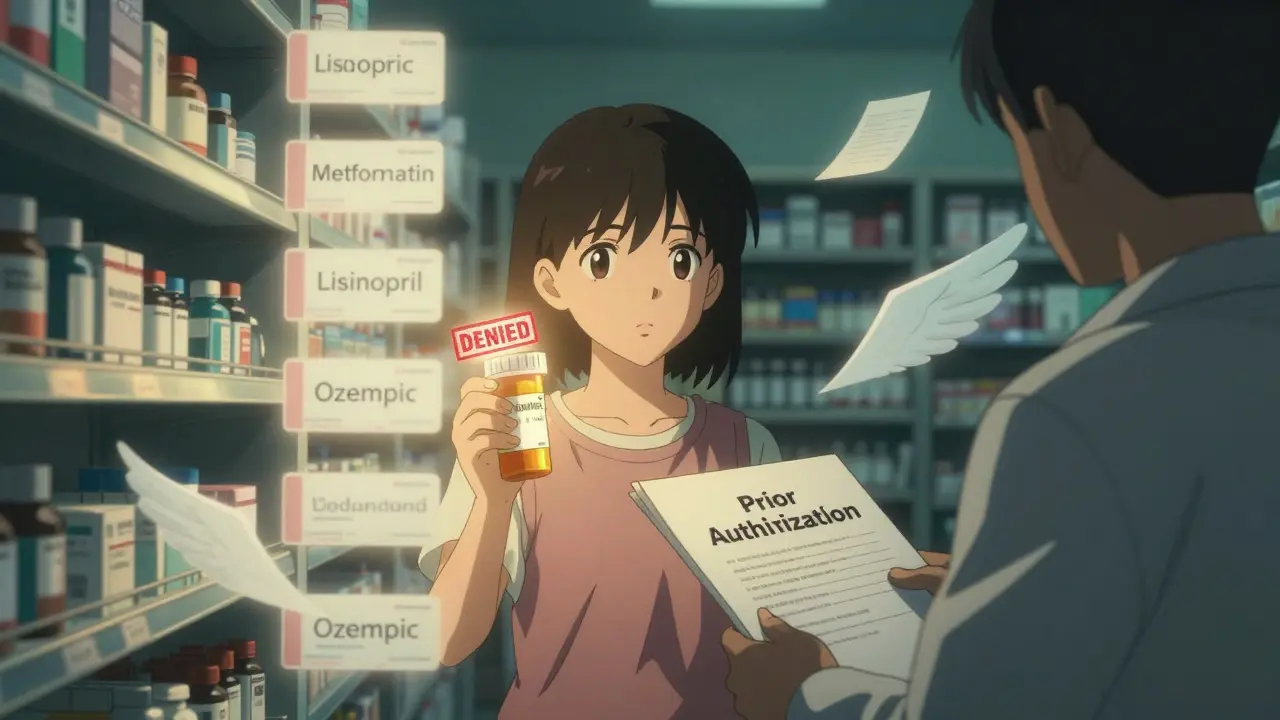
When you’re on Medicaid, getting your prescriptions shouldn’t mean choosing between medicine and rent. But knowing what’s actually covered - and what’s not - can feel like navigating a maze. In 2025, Medicaid covers prescription drugs for over 85 million Americans, but the rules vary wildly from state to state. What’s covered in North Carolina might be denied in Florida, even if you’re taking the same pill. So what does Medicaid really pay for? And why do some drugs require endless paperwork just to get approved?
Almost All States Cover Prescriptions - But Not the Same Ones
Federal law doesn’t require Medicaid to pay for prescription drugs. Yet every single state, including Washington D.C., does. Why? Because without drug coverage, people with chronic conditions like diabetes, asthma, or depression would end up in emergency rooms or hospitals - costing far more than the meds themselves. So states stepped in. But here’s the catch: while coverage is universal, the list of approved drugs isn’t. Each state builds its own Preferred Drug List (PDL), also called a formulary. This list sorts medications into tiers. Tier 1 usually includes generics - the cheapest, most common versions of a drug. Tier 2 has brand-name drugs. Tier 3 or 4? That’s where specialty drugs live: expensive treatments for cancer, hepatitis C, or rare autoimmune diseases. In North Carolina, for example, CVS Caremark manages the PDL as of October 2025. Generic drugs like metformin or lisinopril are in Tier 1, with copays as low as $1. Brand-name drugs like Lipitor or Humira land in Tier 2, with copays around $10-$25. But if your doctor prescribes a drug that’s not on the list at all? You’re out of luck - unless you jump through hoops.Step Therapy: You Have to Fail First
One of the biggest surprises for new Medicaid beneficiaries? You might not get the drug your doctor recommends right away. Many states enforce step therapy - also called “trial and failure.” This means you have to try two cheaper, preferred drugs first. Only if those don’t work (or cause side effects) will Medicaid approve the one your doctor actually wants. In North Carolina, this applies to most chronic conditions. If you have depression and your doctor wants to prescribe Wellbutrin XL, you might first need to try two SSRIs like sertraline or escitalopram. If those didn’t help - and your doctor documents why - then Medicaid will cover Wellbutrin. But if you skip the step therapy and just ask for the brand-name drug? The pharmacy will deny it. No exceptions. This rule exists to save money. According to the Medicaid and CHIP Payment and Access Commission, step therapy cuts state drug spending by 15-25%. North Carolina saved $127 million between 2010 and 2023 just by using this system. But for patients? It can mean weeks of trial, error, and frustration.Prior Authorization: The Paperwork Wall
Some drugs - especially high-cost ones - require prior authorization. That’s a formal request from your doctor to Medicaid, explaining why you need this specific drug. It’s not just a form. It’s a medical letter, often with lab results, previous treatment history, and proof that other drugs failed. For example, if you have Type 1 Diabetes and need premixed insulin, North Carolina allows prior authorization to last up to three years - if your doctor provides the right documentation. But if you’re on a new drug like Ozempic for weight loss or diabetes, you’ll likely need a fresh request every year. The process isn’t fast. The Medicare Rights Center found that 63% of Medicaid beneficiaries waited an average of 7.2 business days just to get a prior authorization approved. Appeals? That’s 14.5 days on average. And if your doctor’s paperwork is incomplete? The request gets denied. Then you start over. But here’s the good news: 78% of denied requests were overturned on appeal - if the doctor submitted full clinical notes. So if your request gets rejected, don’t give up. Ask your doctor to resubmit with more detail.What’s Not Covered? The Hidden Exclusions
Not every drug you’ve heard of is covered. In October 2025, North Carolina removed nine drugs from its formulary entirely - including Vasotec, Trulance, and Relistor - because the manufacturers stopped offering rebates. No rebate? No coverage. Other common exclusions:- Drugs used for cosmetic purposes (like minoxidil for hair loss)
- Over-the-counter medications (even if your doctor recommends them)
- Drugs for weight loss unless tied to a diagnosed condition like obesity-related diabetes
- Some fertility treatments
- Drugs approved only for off-label uses (unless there’s strong clinical evidence)

Costs: Copays, Deductibles, and Extra Help
Most Medicaid beneficiaries pay nothing for prescriptions. But not all. In many states, you’ll pay a small copay - $1 to $5 for generics, $10 to $25 for brand names. Some states have annual caps, but most don’t. The real relief comes from the Extra Help program - a federal subsidy for low-income people on Medicare and Medicaid. If you qualify for Extra Help in 2025, your drug costs drop dramatically:- $0 monthly premium
- $0 deductible
- Maximum $4.90 copay for generics
- Maximum $12.15 for brand-name drugs
- After spending $2,000 in a year? You pay $0 for everything else
Network Pharmacies and Mail-Order Rules
You can’t just walk into any pharmacy. Medicaid only covers prescriptions filled at in-network pharmacies. Most states use big pharmacy chains like CVS, Walgreens, or Walmart - but some only cover local independents. For maintenance drugs (like blood pressure or thyroid meds), many Medicaid programs require you to use mail-order services. You’ll get a 90-day supply shipped to your house, often at a lower cost. If you insist on filling at a local pharmacy? You might pay more - or get denied. And if you move? Your coverage doesn’t follow you. Medicaid is state-based. If you relocate from North Carolina to Georgia, your formulary changes. You’ll need to reapply for prior authorizations, and your doctor might need to switch your prescriptions.Why Do These Rules Exist?
It’s not about denying care. It’s about managing billions. Medicaid spends $64.3 billion a year on prescription drugs - nearly 10% of its total budget. And while generics make up 89% of prescriptions, they only cost 27% of the total. The real driver of spending? Specialty drugs - just 3% of prescriptions, but 42% of the cost. States use formularies, step therapy, and prior authorization to negotiate lower prices. The Medicaid Drug Rebate Program forces drugmakers to give back a portion of their sales - often 25% or more. Without these tools, states couldn’t afford to cover the drugs at all. But there’s a balance. In 2025, CMS announced new guidance requiring states to prove their formularies don’t block “medically necessary” treatments. That means if a drug is the only option for your condition - and you’ve tried everything else - you should get it.
What You Can Do
If you’re on Medicaid and struggling to get your meds:- Check your state’s current PDL. Search “[Your State] Medicaid Preferred Drug List 2025” - it’s usually on the health department website.
- Ask your pharmacist: “Is this on the formulary? Do I need prior authorization?”
- If denied, ask your doctor to submit a letter of medical necessity - with specifics: symptoms, failed alternatives, lab results.
- Apply for Extra Help if you’re on Medicare too. It’s free and cuts costs dramatically.
- Use mail-order for long-term meds. It’s cheaper and more reliable.
- Call your State Health Insurance Assistance Program (SHIP). They help for free - no appointment needed.
What’s Changing in 2026?
New rules are coming. In 2026, CMS will require states to show their formularies don’t create “unreasonable barriers” to care. That could mean fewer step therapy rules and faster prior auth approvals. Also, 22 states are testing new payment models for gene therapies - treatments that cost over $2 million per dose. These programs tie payment to results. If the drug works, Medicaid pays. If not? The drugmaker refunds part of the cost. And the Federal Upper Limit for generics? Experts are pushing to lower it from 250% to 225% of the average manufacturer price. That could save Medicaid $1.2 billion a year - and free up funds for more essential drugs.Bottom Line
Medicaid covers most prescription drugs - but it’s not automatic. You need to know your state’s rules, your formulary, and your rights. The system is designed to save money, but it shouldn’t stop you from getting the care you need. If you’re denied, fight back - with documentation. If you’re confused, ask for help. You’re not alone. Millions are navigating the same system. And with the right steps, you can get your meds - without the stress.Does Medicaid cover all prescription drugs?
No. Medicaid covers most prescription drugs, but each state creates its own list of approved medications called a Preferred Drug List (PDL). Some drugs are excluded because they don’t offer rebates, are for cosmetic use, or are over-the-counter. Even if a drug is FDA-approved, it may not be on your state’s formulary.
Why do I have to try other drugs before getting the one my doctor prescribed?
This is called step therapy, or trial and failure. States require it to control costs. You must try two cheaper, preferred drugs first. If they don’t work or cause side effects, your doctor can request approval for the original drug. This rule applies to most chronic conditions but not always to life-threatening or rare diseases.
What is prior authorization and how do I get it?
Prior authorization is a formal request from your doctor to Medicaid, proving you need a specific drug. Your doctor must submit clinical documentation - like lab results, treatment history, and proof that other drugs failed. You can’t apply yourself; only your provider can start the process. If denied, you can appeal with more detailed medical records.
Can I use any pharmacy with Medicaid?
No. You must use pharmacies in your state’s Medicaid network. Most states use large chains like CVS or Walgreens, but some include local pharmacies. For maintenance medications, you may be required to use mail-order services to get the lowest cost. Always check with your pharmacy before filling a prescription.
How much will I pay for my prescriptions?
Most Medicaid beneficiaries pay $0-$5 for generics and $10-$25 for brand-name drugs. Some states have no copays at all. If you qualify for Extra Help (Low-Income Subsidy), your costs drop further: $4.90 for generics, $12.15 for brands, and $0 after you spend $2,000 in a year. You may be eligible even if you didn’t apply - ask your caseworker.
What if my drug gets removed from the formulary?
If your drug is removed, you may be switched to a similar alternative. If no alternative works, your doctor can request a one-time exception or permanent exemption based on medical necessity. Check your state’s PDL updates regularly - changes happen mid-year. In North Carolina, drugs like Trulance and Relistor were removed in 2025 because manufacturers stopped offering rebates.
Does Medicaid cover specialty drugs like those for cancer or MS?
Yes - but with strict rules. Specialty drugs are often on higher tiers and require prior authorization. Some states limit quantity or require you to use specific pharmacies. Because these drugs cost tens of thousands of dollars, states use value-based contracts with manufacturers - meaning they pay only if the drug works. You may need to meet specific clinical criteria to qualify.
Can I change my drug plan during the year?
Yes - starting in 2025, Medicaid and Extra Help beneficiaries can change their drug coverage once per month. Previously, you were locked in until the annual enrollment period. This change gives you flexibility if your meds stop working, you move, or your income changes. Contact your state Medicaid office to make the switch.
Is there help if I can’t afford my copay?
Yes. If you’re on Medicaid, you may automatically qualify for Extra Help - a federal program that lowers drug costs to $4.90 for generics and $12.15 for brands. You don’t need to reapply if you get SSI, full Medicaid, or state help with Medicare Part B premiums. Call your State Health Insurance Assistance Program (SHIP) to check your eligibility.
How do I find my state’s current drug list?
Search “[Your State] Medicaid Preferred Drug List 2025” on your state’s health department website. Most states publish it as a downloadable PDF. You can also call your Medicaid office or ask your pharmacist. In North Carolina, the list is updated in July and October each year - so check regularly.
Emma Duquemin
December 30, 2025 AT 20:37Okay but let’s be real-step therapy is just medical Russian roulette. I had to fail on three SSRIs before they’d let me have Wellbutrin. Three months of crying in the shower, zero energy, just… numb. Then when they finally approved it? I felt like a human again. They call it ‘cost-saving.’ I call it torture with paperwork. 🤯
Kevin Lopez
December 31, 2025 AT 20:03Formulary non-compliance is a systemic failure. Prior auth delays exceed CMS benchmarks by 40%. PDLs are opaque, rebate-dependent, and lack clinical nuance. You’re not ‘denied’-you’re just not in the cost-optimal cohort.
Duncan Careless
January 2, 2026 AT 00:45Just wanted to say thanks for laying this out so clearly. I’ve been stuck with this system for years and never knew where to start. The part about mail-order for maintenance meds? That’s a game changer. Will check my state’s PDL this week. 💪
Samar Khan
January 3, 2026 AT 23:31OMG I JUST GOT DENIED FOR OZEMPIC AGAIN 😭😭😭 My doctor said it’s medically necessary but they said ‘weight loss only’?? I’m not trying to look hot I’m trying NOT TO DIE 💔🩺 #MedicaidFail
Russell Thomas
January 5, 2026 AT 21:15Wow, so Medicaid’s just a giant game of ‘Guess Which Drug The Pharma Company Didn’t Pay Enough For’? Congrats, you’ve turned healthcare into a corporate negotiation where your life is the bargaining chip. 🙃
Joe Kwon
January 6, 2026 AT 19:38Great breakdown. I’ve been on Medicaid for 8 years and the Extra Help program saved me-$4.90 for metformin is a miracle. People don’t realize if you’re on SSI or full Medicaid, you’re auto-enrolled. Just call your SHIP. They’ll walk you through it. No shame in asking.
Nicole K.
January 8, 2026 AT 06:06This is why we need to stop giving free stuff to lazy people. If you can’t afford your meds, don’t take them. Just eat better and exercise. It’s not that hard.
Fabian Riewe
January 9, 2026 AT 05:05Man, I used to think my doctor was just being slow. Turns out he was fighting the system for me. Last month he spent 3 hours on prior auth for my insulin-sent 5 emails, called Medicaid twice, even faxed my HbA1c results. I didn’t know. He never said a word. Just handed me the script like it was nothing. Real heroes don’t wear capes. They use Word docs.
Amy Cannon
January 10, 2026 AT 18:21It is with profound regard for the structural complexities inherent within the Medicaid prescription coverage framework that I feel compelled to offer a reflective commentary. The formulary architecture, while ostensibly designed to mitigate fiscal overextension, inadvertently engenders a labyrinthine experience for the beneficiary, particularly when one is navigating the intersection of state-specific rebate dynamics and federally mandated clinical necessity thresholds. One must not underestimate the psychological toll of iterative administrative engagement-each denial, each resubmission, each faxed clinical note-each a microcosm of systemic dissonance. I implore all stakeholders to consider the human substrate beneath the spreadsheet.
Himanshu Singh
January 11, 2026 AT 10:03Thanks for the info! I just moved from India to Texas and didn’t know Medicaid works so different here. My asthma inhaler got denied because it’s not on the list. But I found the PDL and called SHIP-they helped me get it approved in 2 days! 😊