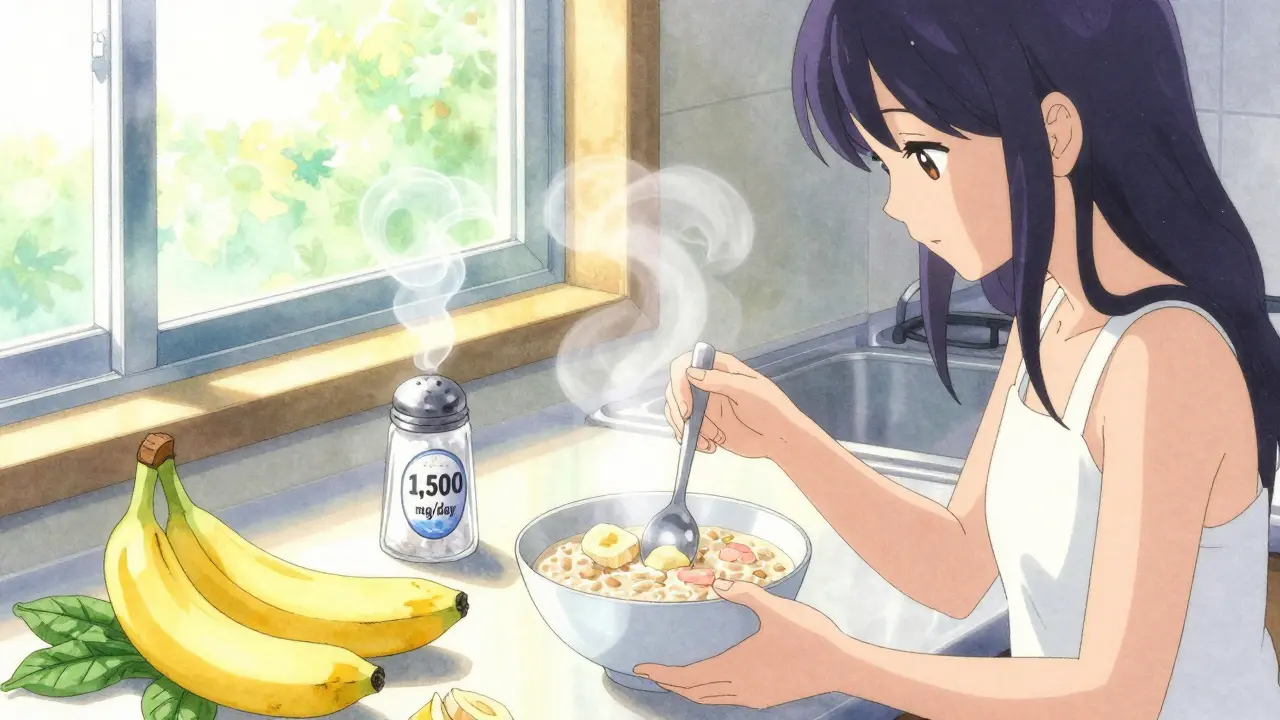
When you live with Meniere’s disease, sudden dizziness, ringing in the ears, and that heavy, full feeling in your head can turn ordinary days into chaos. You’ve tried medications, maybe even vertigo exercises, but nothing seems to stick. What if the key to quieter days and clearer hearing wasn’t a pill-but your plate?
Why Your Salt Intake Matters More Than You Think
Meniere’s isn’t just about bad luck or aging. It’s a fluid problem inside your inner ear. Too much fluid builds up in the endolymphatic sac, creating pressure that messes with your balance and hearing. And sodium? It’s the main driver of that fluid buildup. When you eat too much salt, your body holds onto water. That water doesn’t just swell your ankles-it floods the tiny chambers of your inner ear. The result? More vertigo attacks, worse tinnitus, and a drop in hearing clarity. Studies show that cutting sodium directly reduces this pressure. In a 2024 trial with 50 patients, those who dropped their sodium to 1,500 mg a day saw their hearing thresholds improve by over 12 decibels in just six months. That’s not a small gain-it’s the difference between missing a word in conversation and hearing it clearly.The Magic Number: 1,500 to 2,000 mg of Sodium Per Day
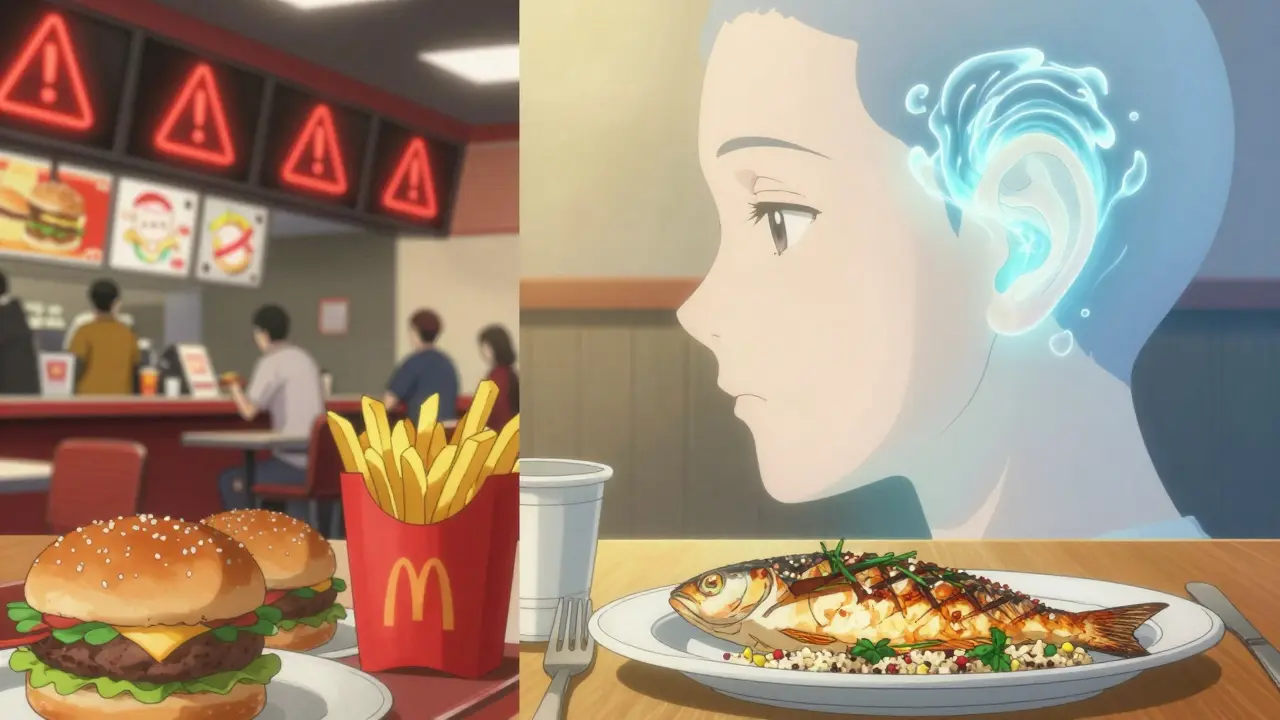
You don’t need to go salt-free. You need to go sodium-aware. Most experts agree: aim for 1,500 to 2,000 mg of sodium daily. That’s less than one teaspoon of table salt. But here’s the catch: most of your sodium doesn’t come from the salt shaker. Over 77% of the sodium in the average diet comes from packaged, processed, and restaurant food. A single slice of store-bought bread can have 230 mg. A cup of canned soup? 800 mg. A small burger from a fast-food chain? Over 1,000 mg before you even add condiments. So the real goal isn’t to stop adding salt. It’s to stop eating the foods that hide it.What to Eat: Simple, Real Foods
Stick to whole, unprocessed foods. They’re naturally low in sodium and rich in the nutrients your inner ear needs.- Fresh vegetables and fruits-spinach, broccoli, apples, bananas
- Lean proteins-chicken, fish, tofu, eggs (not breaded or pre-seasoned)
- Whole grains-brown rice, quinoa, oats (check labels; some instant varieties are loaded)
- Unsalted nuts and seeds-almonds, pumpkin seeds, sunflower seeds
- Herbs and spices-garlic, ginger, cumin, paprika, lemon juice, black pepper
Hydration Isn’t About Drinking More-It’s About Drinking Right
You might think, “If salt makes me retain water, shouldn’t I drink less?” Wrong. Dehydration makes your body hold onto even more fluid, worsening the pressure in your inner ear. The 2024 Acta Otolaryngologica study found the sweet spot: 35 milliliters of water per kilogram of body weight per day. For someone weighing 70 kg (about 154 lbs), that’s just under 2.5 liters-roughly 10 glasses. Spread it out. Don’t chug it all at once. Sip slowly, especially if you’re active or in a warm climate. Avoid drinks that make things worse. Caffeine (coffee, tea, soda) and alcohol constrict blood vessels in the inner ear. That reduces circulation, making it harder for your body to flush out excess fluid. Skip the afternoon espresso. Swap your evening wine for sparkling water with lime.What to Avoid: The Hidden Sodium Traps
These are the sneaky culprits that sabotage even the best intentions:- Condiments: Ketchup, mustard, relish, soy sauce, Worcestershire sauce
- Processed meats: Deli ham, bacon, sausages, hot dogs
- Snacks: Chips, pretzels, crackers, popcorn (even “lightly salted”)
- Canned and frozen meals: Even “healthy” ones often have 800+ mg per serving
- Restaurant food: Especially fast food, pizza, and Asian cuisine
Why This Works Better Than Pills
Doctors often prescribe diuretics like hydrochlorothiazide to flush out fluid. But these drugs can cause dehydration, dizziness, kidney stones, and electrolyte imbalances. They treat the symptom, not the cause. Dietary sodium restriction? It’s safer, cheaper, and more sustainable. A 2018 study found that 68% of patients who stuck to a low-sodium diet saw major symptom reduction-with zero side effects. Compare that to diuretics, which help only 50-70% of people and come with a long list of risks. And it’s not just about vertigo. The same 2024 study showed tinnitus scores dropped by almost half. Dizziness handicap scores improved by over 50%. That’s not just less spinning-it’s regaining your life.
What If You Can’t Stick to It?
Let’s be honest: this isn’t easy. Social dinners, travel, stress-all of it makes low-sodium eating feel isolating. One in five people quit within months because food tastes bland or they feel deprived. Start small. Pick one major source of hidden sodium to cut first. Maybe it’s canned soup. Or breakfast cereal. Or the salted butter on your toast. Replace it with a low-sodium version or a simple swap. Use spice blends. Try Mrs. Dash, lemon pepper, or homemade herb mixes. A pinch of smoked paprika or a splash of balsamic vinegar can bring flavor back without salt. Ask for no salt when you eat out. Most restaurants will accommodate. Bring your own seasoning packets if you’re nervous. And give yourself grace. You don’t have to be perfect. Even cutting sodium by 500 mg a day can make a difference.What Comes Next? Beyond the Plate
Diet isn’t a cure. But it’s the most powerful tool you have-especially early on. If your symptoms don’t improve after 3-6 months of strict low-sodium eating and proper hydration, talk to your doctor about next steps: steroid injections, vestibular rehab, or other therapies. Right now, the NIH is running a major trial (NCT04567891) comparing 1,500 mg vs. 2,300 mg sodium limits over 12 months. Results are expected in late 2025. Until then, the evidence we have is clear: what you eat directly affects what you feel.Real-Life Example: Sarah’s Story
Sarah, 52, from Manchester, had three vertigo attacks in one month. Her hearing dropped 15% in her left ear. She was prescribed a diuretic but felt tired and dizzy all the time. Her ENT told her to try a low-sodium diet. She started by swapping her morning toast with jam for oatmeal made with unsalted water. She stopped buying canned beans and switched to dried ones she soaked overnight. She stopped eating out except for one dinner a week, and only ordered grilled chicken with steamed veggies. Within six weeks, her attacks dropped from three a month to one. After four months, she had none. Her tinnitus faded from a constant buzz to a faint whisper. Her hearing test improved by 11 dB. She didn’t need surgery. She didn’t need more pills. She just changed what was on her plate.Can I ever eat salt again if I have Meniere’s disease?
You don’t need to eliminate salt completely, but you should keep your daily intake under 2,000 mg-ideally closer to 1,500 mg. Occasional higher-sodium meals won’t ruin everything, but frequent spikes can trigger symptoms. Think of it like blood pressure: occasional treats are okay, but daily habits matter most.
Is there a difference between sea salt and table salt for Meniere’s?
No. Sea salt, kosher salt, Himalayan salt-they’re all mostly sodium chloride. A teaspoon of any of them contains about 2,300 mg of sodium. The mineral traces in sea salt are too small to make a difference in fluid balance. What matters is the total sodium, not the type.
How long does it take to see results from a low-sodium diet?
Some people notice less dizziness or quieter tinnitus in 2-4 weeks. For measurable improvements in hearing or fewer vertigo attacks, most studies show results after 3-6 months of consistent low-sodium eating. Patience is key-your inner ear doesn’t reset overnight.
Can I drink alcohol with Meniere’s disease?
Alcohol can trigger or worsen symptoms by affecting blood flow to the inner ear and disrupting fluid balance. Even small amounts can cause dizziness or increase tinnitus. Many people find that eliminating alcohol leads to fewer attacks. If you choose to drink, limit it to rare, very small amounts and monitor how you feel afterward.
Do I need to take supplements on a low-sodium diet?
Not usually. A balanced diet rich in fresh foods provides all the nutrients you need. Avoid potassium supplements unless your doctor recommends them-too much can be dangerous. Focus on getting potassium naturally from foods like sweet potatoes, spinach, beans, and bananas. These help balance sodium in your body without side effects.
What if my doctor says diet doesn’t work for Meniere’s?
Many doctors still think dietary changes are just “ancillary,” but that’s changing. A 2022 survey found 92% of U.S. otolaryngologists recommend sodium restriction. If your doctor dismisses it, ask for the latest research-especially the 2024 Acta Otolaryngologica study. You have the right to try evidence-based, low-risk strategies before moving to injections or surgery.
Coy Huffman
February 4, 2026 AT 08:00man i tried this diet after my last vertigo episode and honestly? it’s like my head finally stopped feeling like a water balloon. i didn’t believe it at first, but cutting out the canned soup and swapping bread for plain oats? game changer. still sneak a salty snack sometimes 😅 but now i know why my ears feel like they’re gonna explode after pizza night.
Amit Jain
February 5, 2026 AT 01:19simple truth: less salt = less spinning. i have Meniere’s too. no magic pills, just real food. eat rice, veggies, eggs. avoid packaged things. drink water slow. it works. no need to overcomplicate.
Keith Harris
February 6, 2026 AT 17:03oh please. you people are falling for the ‘low sodium is the cure’ cult. if this were true, why are half the people on this diet still getting vertigo attacks? the real cause is probably neural inflammation or autoimmunity. sodium restriction is just a placebo with extra steps. also, who the hell eats 1,500 mg a day? that’s like living on air and regret. i’ve had Meniere’s for 12 years and the only thing that helped was steroids. diet? lol.
Kunal Kaushik
February 6, 2026 AT 22:50really appreciate this post. 🙏 i started this diet 3 months ago and my tinnitus went from a constant alarm clock to a quiet hum. still hard to say no to chips but i’m learning. also, i drink 2.5L of water every day now - no more soda. life is better. 🌿💧
Mandy Vodak-Marotta
February 7, 2026 AT 16:10okay so i’ve been doing this low-sodium thing for 8 months now and i swear to god my ears feel lighter? like, i can actually hear my cat purring without her voice sounding like it’s underwater? also i used to hate cooking but now i’m making this insane turmeric-ginger broth with lemon and it’s like a warm hug for my inner ear?? i even convinced my mom to try it and she’s now obsessed with coconut aminos. i know it sounds crazy but i think the hydration part is just as important as the salt thing - like, your body’s trying to hold onto water because it’s scared? and if you give it enough clean water it’s like ‘ohhh okay we’re safe now’ and stops hoarding fluid in your ear? i don’t know science but i know how i feel and i feel like a human again.
Nathan King
February 8, 2026 AT 12:25While the anecdotal evidence presented is compelling, one must remain cognizant of the methodological limitations inherent in the referenced 2024 trial. The sample size of fifty subjects, while not negligible, lacks statistical power to establish causality without controlling for confounders such as concurrent vestibular rehabilitation, medication adherence, and comorbid hypertension. Furthermore, the assertion that dietary sodium restriction supersedes pharmacological intervention is premature without comparative randomized controlled trials. One must not conflate correlation with therapeutic efficacy.
Alec Stewart Stewart
February 10, 2026 AT 10:57to anyone just starting this: you’re not alone. i was skeptical too. but i started with one change - no more instant oatmeal. switched to plain oats with cinnamon and banana. tiny step. now i don’t get dizzy when i stand up. you don’t have to be perfect. just try one thing this week. and if you slip? that’s okay. you’re not failing. you’re learning. 🌱
Janice Williams
February 10, 2026 AT 12:16This is the most dangerously misleading piece of pseudoscience I’ve seen on Reddit in months. You’re encouraging people to abandon proven medical treatments in favor of a fad diet that has no robust, peer-reviewed validation beyond a single uncontrolled trial. And to suggest that people can ‘regain their life’ by eating kale? That’s not just irresponsible - it’s cruel to those who’ve tried this and still lost their hearing. You’re giving false hope to vulnerable people. Shame on you.
Roshan Gudhe
February 12, 2026 AT 11:52the body is a system. sodium isn’t the villain - imbalance is. if you drink too little water, you hold onto salt. if you eat too much salt, you hold onto water. it’s a loop. cutting salt helps, but only if you also hydrate right. and sleep. and stress less. this isn’t a diet. it’s a lifestyle reset. i’ve been doing this for 5 years. no vertigo since. not because i’m perfect - but because i’m consistent. not a cure. just a way to live.
Antwonette Robinson
February 13, 2026 AT 16:53Oh wow, so if I just stop eating salt, my ears will magically un-flood? And I guess my inner ear just forgot how to regulate fluid because I ate one too many chips in 2019? Maybe if I whisper ‘I’m not a water balloon’ three times while eating organic kale, the vertigo will politely leave? 🙄
Ed Mackey
February 15, 2026 AT 15:31i read this and thought ‘yeah this makes sense’ but then i tried it and my wife kept putting salt on my food because she thinks i’m ‘being weird’ so i gave up after 2 weeks. i didn’t even notice a difference anyway. maybe i’m just lazy. or maybe it doesn’t work for everyone. 🤷♂️
caroline hernandez
February 17, 2026 AT 11:41as a vestibular PT, i see this daily. low sodium + hydration + rhythm (consistent meals, sleep, water intake) = biggest predictor of symptom reduction. not a cure, but the most powerful non-invasive tool we have. patients who stick with it for 6+ months? 70%+ report >50% improvement. the key? consistency over perfection. and tracking. write down what you eat. you’ll be shocked where the sodium hides. you got this.
Jhoantan Moreira
February 19, 2026 AT 06:48thank you for this. 🌍 i’m from the UK and we’re all about the crisps and gravy here - but i switched to roasted chickpeas and lemon-turmeric rice. my attacks dropped from weekly to once every 3 months. still not perfect, but i can hold my grandkids now without fearing a fall. small wins matter. keep going. you’re not crazy for trying.
Joseph Cooksey
February 19, 2026 AT 14:21Let’s be honest - this whole low-sodium crusade is just a thinly veiled attempt to sell you $20 jars of ‘Meniere’s Miracle Spice Blend’ and $40 ‘Ear-Friendly’ cookbooks. You think you’re healing yourself, but you’re just feeding the wellness-industrial complex. And let’s not forget: the people who benefit most from this are the ones who never had severe Meniere’s to begin with. The rest of us? We’re just collateral damage in a feel-good narrative that ignores the brutal reality of neurological decay. You’re not ‘regaining your life.’ You’re just pretending you can control the uncontrollable. And that’s the most tragic part.