Medication Combination Evidence Guide
Select a medication combination type below to understand its clinical evidence level and typical therapeutic goal.
Combination Name
Evidence LevelCOMMON EXAMPLE
Example drugs
PRIMARY GOAL
The intended therapeutic outcome
Please select a combination from the dropdown to see the clinical data.
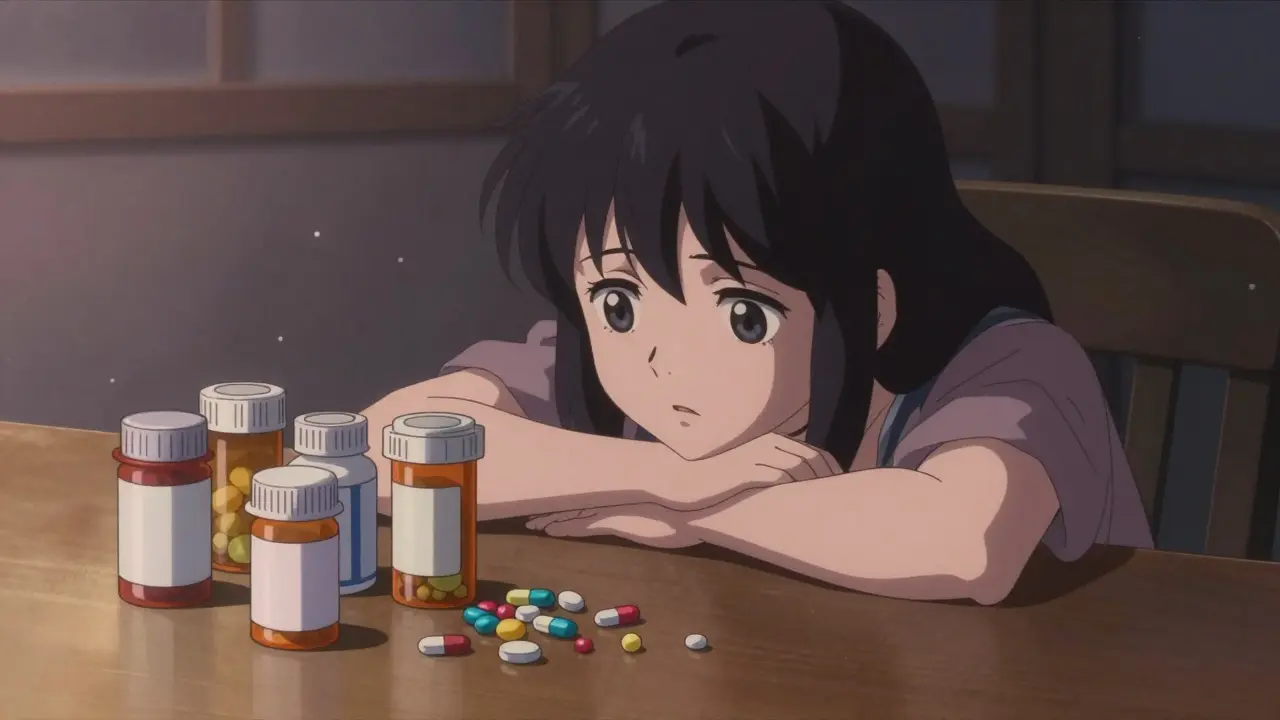
Imagine taking one pill for anxiety, another for sleep, a third for mood stability, and a fourth for blood pressure. For many people living with complex mental health conditions, this isn't a hypothetical-it's their daily routine. When a person takes multiple psychiatric medications at once, it's called psychiatric polypharmacy is the concurrent prescription of two or more psychiatric medications to a single patient. While the goal is usually to tackle stubborn symptoms that one drug alone can't fix, adding more pills to the mix creates a chemical cocktail that can sometimes do more harm than good.
The a-ha moment: Why is polypharmacy happening?
Doctors don't usually start with five different medications. Most polypharmacy begins as a response to treatment-resistant conditions. If a patient with schizophrenia doesn't respond to a standard dose of an antipsychotic, a clinician might add a second one or a mood stabilizer to "boost" the effect. This is often a targeted strategy, but over time, it can slide into what some experts call the "kitchen sink" approach-simply adding more drugs without checking if the existing ones should be adjusted first.
The numbers show a worrying trend. Research in JAMA Psychiatry highlighted a massive jump in antipsychotic polypharmacy among Medicaid enrollees with schizophrenia, climbing from about 3.3% in 1999 to 13.7% by 2005. Even more striking is the shift in mood disorder treatments; between the 1970s and the 1990s, the percentage of patients taking three or more medications skyrocketed from 3.3% to 43.8%. We are seeing a systemic shift toward more complex regimens, often without a corresponding increase in proven clinical benefits.
Where the science backs it up (and where it doesn't)
Not all medication combinations are guesswork. Some are evidence-based and widely accepted as safe and effective. For example, adding bupropion to citalopram is a recognized strategy for people who only partially respond to antidepressants. Similarly, using antipsychotics alongside mood stabilizers for acute mania or pairing benzodiazepines with antidepressants for a short window during major depression is often clinically justified.
The grey area appears when clinicians prescribe two different antipsychotics at the same time. Unlike the combinations mentioned above, this practice is largely supported by case reports and open-label trials rather than gold-standard double-blind randomized controlled trials. This means we're often guessing if the second antipsychotic is actually helping or if the patient is just enduring more side effects for an unproven gain.
| Combination Type | Common Example | Evidence Level | Primary Goal |
|---|---|---|---|
| Antidepressant Augmentation | Citalopram + Bupropion | High | Improve response in partial responders |
| Mood Stabilization | Antipsychotic + Mood Stabilizer | High | Control acute manic episodes |
| Psychotic Depression | Antidepressant + Antipsychotic | High | Treat depression with psychotic features |
| Dual Antipsychotics | Two different antipsychotics | Low/Mixed | Address treatment-refractory schizophrenia |
The ripple effect: Physical health and drug interactions
Psychiatric drugs don't live in a vacuum. They interact with the rest of the body and any other medicines a person might be taking. This is where multimorbidity-having multiple chronic physical health conditions-makes things dangerous. Many people with severe mental illness also struggle with diabetes, hypertension, or cardiovascular issues. When you mix psychiatric meds with heart or metabolic drugs, the risk of a drug-drug interaction spikes.
For older adults, this risk is even higher. Aging kidneys and livers don't process medications as efficiently, leading to a buildup of drugs in the system. The American Psychiatric Association (APA) warns that this population is far more susceptible to the side effects of antipsychotics, which can include severe sedation or metabolic shifts. A CDC study found that people taking five or more medications concurrently reported a significantly lower health-related quality of life, specifically in physical functioning scores, even if their psychological distress didn't change.
Personalizing the pill bottle: Modern solutions
So, how do we get out of this "more is better" cycle? One promising tool is pharmacogenomic testing. This involves analyzing a person's DNA to see how they metabolize specific drugs. Instead of the traditional "trial and error" method-where a patient might try four different meds over a year-doctors can use genetic data to pick the drug most likely to work with the fewest side effects. Some research suggests this could reduce adverse drug reactions by as much as 30% to 50%.
Another strategy is "deprescribing." This is the planned, gradual reduction of medications that are no longer needed or are causing too much harm. A recent retrospective study showed that when clinicians followed a structured plan over 18 months to reduce unnecessary psychotropics, patients didn't just feel better-their physical health improved. There were measurable drops in BMI, blood pressure, and HbA1c levels, proving that clearing out the chemical clutter can actually heal the body.
The hurdle to a simpler regimen
If reducing medications works, why isn't everyone doing it? The reality is that it's scary for both the patient and the provider. About 65% of clinicians report a fear of destabilizing a patient-triggering a relapse or a psychotic episode-while reducing a dose. Patients, too, often feel apprehensive, fearing that the only thing keeping them stable is the sheer volume of their medication. This is why structured protocols, like those used in Early Psychosis Intervention Programmes, are so vital; they replace guesswork with a roadmap.
What exactly is polypharmacy in mental health?
Psychiatric polypharmacy occurs when a patient is prescribed two or more psychiatric medications at the same time. While sometimes necessary for complex cases, it can increase the risk of side effects and dangerous drug interactions.
Is taking multiple mental health medications always bad?
Not necessarily. Some combinations, such as an antidepressant paired with a mood stabilizer, are evidence-based and clinically recommended. The danger arises when medications are added without a clear evidence-based guideline or a systematic review of the patient's current response.
How does age affect medication interactions?
Older adults are at a higher risk because their liver and kidney functions typically decline, which slows down how the body clears medication. This can lead to higher concentrations of the drug in the bloodstream and a greater likelihood of severe side effects.
What is pharmacogenomic testing?
It is a type of genetic test that looks at how your body processes different medications. By understanding your genetic makeup, doctors can choose a drug that is more likely to be effective and less likely to cause an adverse reaction, potentially reducing the need for multiple trial-and-error prescriptions.
What is deprescribing and is it safe?
Deprescribing is the supervised process of reducing or stopping medications that may no longer be beneficial or may be causing harm. When done through a structured titration protocol under medical supervision, it can improve overall health outcomes and reduce the burden of side effects.
Next steps for patients and caregivers
If you or a loved one are taking a complex array of medications, start by requesting a comprehensive medication review. Don't just list the drugs; ask your doctor why each one is necessary and what the specific goal of that medication is. If a drug has been on the list for years without a clear reason, ask if it's a candidate for a gradual titrationK. Remember, the goal isn't just the absence of symptoms, but the highest possible quality of life with the lowest possible chemical burden.
Shaylia Helland
April 13, 2026 AT 12:48it is just so heavy to think about how many people are just drifting through life on a cloud of chemicals without really knowing if it is helping or just numbing the edges of their soul and i have seen so many friends in my community struggle with this exact thing where they feel like a science experiment instead of a human being and it really makes you realize how much trust we put into a system that is often just guessing based on a thirty minute appointment every few months
Billy Wood
April 13, 2026 AT 21:50Get that DNA test now!! Total game changer!!!
Clint Humphreys
April 14, 2026 AT 02:54It is honestly just so funny how they call it a a-ha moment when in reality the pharma companies are probably just laughing all the way to the bank while they push these cocktails on us to keep us docile and dependent because if you are on five different meds you are a customer for life and it is just such a friendly little cycle they have created to make sure no one actually gets fully well since a cured patient is a lost revenue stream and it is all just a big game of chemical chess played by people who do not even know your name
melissa mac
April 15, 2026 AT 21:56I think it's really important to remember that everyone's journey with medication is unique and while the systemic trends are worrying, we should support patients in having these open conversations with their providers to find a balance that works for them.
Haley Moore
April 16, 2026 AT 03:53Omg please 🙄 like, the audacity to call this a roadmap when most doctors can't even remember your middle name
I tried one of these 'evidence-based' combos and I felt like a zombie for three months 💅 total disaster! 🙄
john chiong
April 17, 2026 AT 11:16absolute poppycock this whole medical industrial complex is just a masquerade for incompetence draped in a white coat and it is a moral travesty that we allow these chemical concoctions to be flung at patients like spaghetti on a wall to see what sticks while the poor souls suffer the fallout of this reckless alchemy
Catherine Mailum
April 19, 2026 AT 02:18oh wow imagine believing the a-ha moment actually comes from a doctor and not from the patient finally realizing they are a walking pharmacy because the system is just so incredibly efficient at making us feel better right
Jasmin Stowers
April 19, 2026 AT 18:05deprescribing sounds like a great way to start
Clare Elizabeth
April 20, 2026 AT 19:50You guys can do this!! Just keep advocating for yourselves and stay positive because better options like genomic testing are finally becoming a thing and we are all going to get through this together