
Imagine spending a dinner party feeling like everyone is speaking through a thick wall. You can tell people are talking, but the words just don't click. For over 1.5 billion people worldwide, this isn't just a bad night-it's daily life. The good news is that we've moved far beyond the bulky, whistling beige boxes of the past. Today, hearing aids is a sophisticated class of electronic medical devices designed to amplify sound and improve auditory perception for individuals with hearing loss. Whether you're looking for a discreet plug-in or a high-powered prescription device, the tech has shifted from simple amplification to AI-driven sound processing.
Choosing the Right Style for Your Ears
Not all ears are shaped the same, and not all hearing loss is equal. The style you choose affects not only how you look but how much power the device can pack. If you have severe hearing loss, you'll likely need more hardware; if you just struggle with high-frequency sounds, something smaller might work.
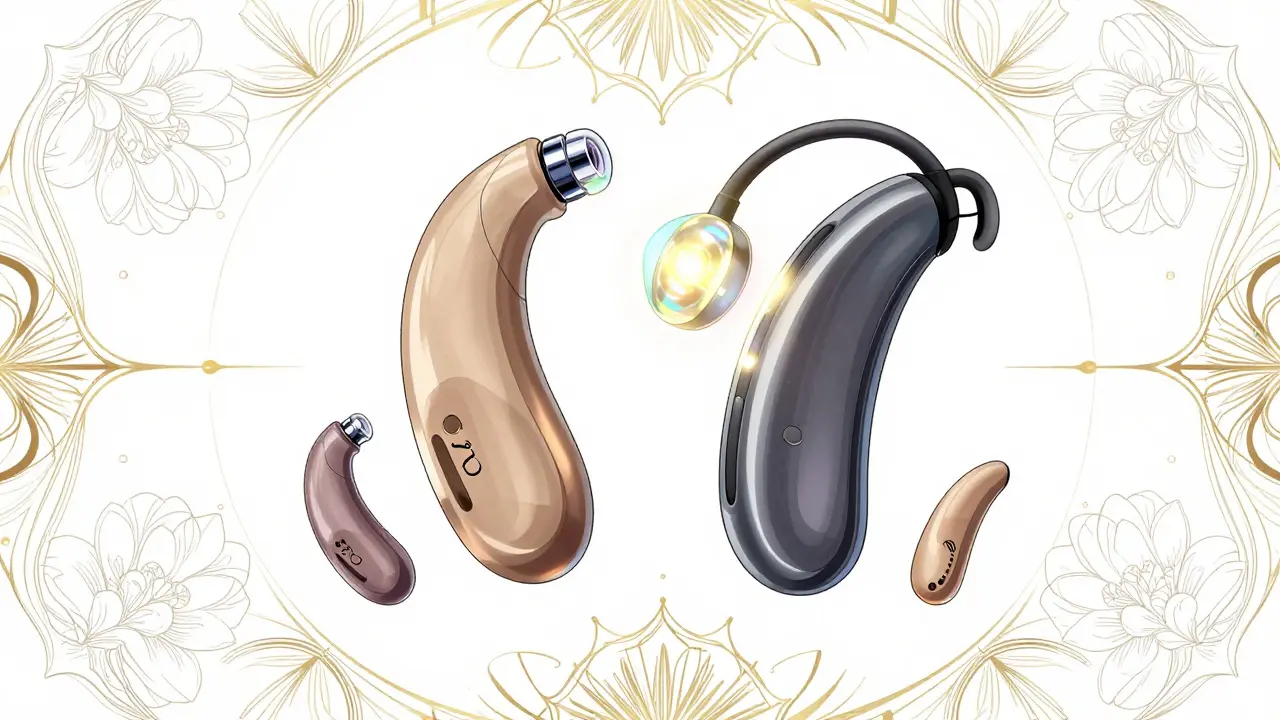
- Behind-the-Ear (BTE): These are the workhorses. A device like the Phonak Naída Lumity L-UP sits behind the pinna and sends sound through a tube. They are ideal for profound loss and offer the best battery life, sometimes lasting up to three weeks.
- Receiver-in-Canal (RIC): Currently the most popular choice. The amplifier sits behind the ear, but the speaker (receiver) is placed directly in the canal. The Jabra Enhance Select 700 is a prime example, offering a natural sound and a sleek profile with IP68 water resistance.
- In-the-Ear (ITE): These fit entirely within the outer ear. Models like the Signia Active Pro IX are great for those who don't want anything hooking over their ear and often include Bluetooth 5.2 for direct streaming.
- Invisible Options (CIC and IIC): Completely-in-Canal (CIC) and Invisible-in-Canal (IIC) devices, such as those from Eargo, are for the discreet. However, there's a trade-off: smaller size means smaller batteries (often lasting only 16-20 hours) and fewer advanced features.
| Style | Best For | Typical Battery Life | Discretion |
|---|---|---|---|
| BTE | Severe to Profound Loss | 1-3 Weeks | Low |
| RIC | Mild to Severe Loss | ~24 Hours | Medium |
| ITE | Mild to Moderate Loss | Up to 34 Hours | Medium-High |
| IIC/CIC | Mild to Moderate Loss | 16-20 Hours | Very High |
The Magic Behind the Mic: Amplification Technology
Old hearing aids were like a volume knob for the whole world-they turned everything up, including the annoying background noise. Modern amplification technology doesn't just make things louder; it makes them clearer using digital signal processing (DSP).
One of the biggest breakthroughs is dual-chip architecture. For example, the Phonak Audéo Infinio uses two chips to process sound almost instantly. This reduces sound delay to a staggering 0.4 milliseconds. Why does that matter? Because when the delay is too high (industry averages are 5-7ms), your own voice sounds like an echo in your head, which is incredibly distracting.
Then there's the AI revolution. The Starkey Edge AI platform analyzes roughly 290 million data points per second. It can tell the difference between a crowded restaurant and a quiet library and adjust the settings in real-time. Some of these devices even include real-time language translation, turning your hearing aid into a personal interpreter.
We're also seeing a shift in how sounds are delivered. ReSound's Vivia platform introduced MAV (Microphone Acoustic Vent) technology. This helps solve the "occlusion effect"-that feeling like you're talking inside a barrel-by reducing that sensation by 45%.
Fitting: Professional Care vs. DIY
Getting a device is only half the battle; getting it right is where the real work happens. There are now two primary paths to ownership: the clinical route and the Over-the-Counter (OTC) route.
The Prescription Path: This is the traditional approach involving an audiologist. It usually takes 3 to 4 appointments over a few weeks. You get a full diagnostic test, a physical fitting, and follow-up tweaks to ensure the amplification matches your specific hearing loss profile across different frequencies. It's expensive-premium pairs often cost between $3,500 and $7,500-but it's the safest bet for complex hearing loss.
The OTC Path: Thanks to FDA rules updated in 2022, adults with mild-to-moderate loss can buy devices without a prescription. Brands like Jabra Enhance offer self-fitting via mobile apps. It's much cheaper ($199 to $1,299) and faster, often taking only a couple of hours to set up. However, it's a gamble. Some clinical trials show that up to 68% of OTC users experience suboptimal amplification because they don't have a professional to fine-tune the settings.
Real-World Performance and User Pitfalls
On paper, every hearing aid looks great. In the real world, things get messy. For instance, a device might score perfectly in a quiet lab but fail miserably at a noisy family reunion. Lab tests from 2025 showed that some models, like the Rexton Reach R-Li T, perform well in quiet settings but struggle significantly in noise, which is where most people actually need the help.
Another common issue is the "wax factor." Earwax blockage affects about 42% of users every month. It can completely mute your device or cause intermittent static. The pro tip here is simple: weekly cleaning using the tools provided by the manufacturer can reduce malfunctions by 67%. If you live in a humid climate, keeping silica gel packets in your storage case can also stop moisture from killing your electronics.
Connectivity is the new frontier. LE Audio (Low Energy Audio) is changing the game for music streaming and phone calls. Users report a massive jump in sound quality compared to older Bluetooth models. Additionally, keep an eye out for "Auracast," which allows you to tune into a public broadcast, like a TV at an airport or a presentation in a conference room, directly through your aids.

The Cost of Hearing Better
The price gap in the market is huge. If you're shopping, you'll likely encounter these three pricing tiers:
- Budget/OTC: $200 - $1,300 per pair. Best for mild loss and tech-savvy users who are comfortable with app-based fitting.
- Retail/Warehouse: $1,400 - $3,000 per pair. (e.g., Costco's Rexton offerings). A middle ground offering some in-store support.
- Premium Clinical: $3,500 - $7,500+ per pair. The gold standard for those with severe loss or those who want the latest AI features and a dedicated professional.
While the cost is high, the value is increasingly tied to health. The next wave of devices isn't just about sound. Roadmaps for 2026 indicate that hearing aids will soon monitor blood oxygen levels and even detect when a user has fallen, turning a hearing device into a comprehensive health monitor.
Can I fit my own hearing aids with an OTC device?
Yes, OTC devices like Jabra Enhance are designed for self-fitting through mobile apps. While about 85% of users successfully set them up, there is a risk of "suboptimal amplification" because you aren't using professional diagnostic data to calibrate the sound.
How long do hearing aid batteries actually last?
It varies wildly by style. Large BTE models can last 1-3 weeks. RIC and ITE models typically provide 24-34 hours. The smallest IIC models are the shortest, often lasting only 16-20 hours, though some users report even less in real-world usage.
What is the "occlusion effect" and how is it fixed?
The occlusion effect is the sensation that your own voice is booming or echoing in your head because the ear canal is plugged. New technologies like ReSound's MAV (Microphone Acoustic Vent) help by venting sound more efficiently, reducing this feeling by up to 45%.
Will AI actually make a difference in how I hear?
Absolutely. AI allows the device to analyze millions of data points per second to distinguish between speech and background noise. This means in a loud restaurant, the AI can suppress the clinking of plates and amplify the person speaking directly in front of you.
Are hearing aids water-resistant?
Many modern models, including the Phonak Naída and Jabra Enhance series, carry an IP68 rating. This means they are highly resistant to dust and can withstand being submerged in water for short periods, though you should always check your specific model's manual.
Next Steps and Troubleshooting
If you're just starting, your first move should be a professional hearing test. Even if you plan to buy OTC, knowing your exact decibel loss across different frequencies prevents you from buying a device that is too weak to help. If you already have aids and they feel "off," check your wax filters first-this solves a huge percentage of perceived "broken" devices.
For those struggling with the physical size of BTE models, talk to your provider about RIC options, which move the bulkier components away from the canal. If you're experiencing a lot of feedback (whistling), ensure the dome is fitting snugly against the ear canal to prevent sound from leaking out and being re-amplified.
Olushola Adedoyin
April 19, 2026 AT 06:03AI in the ears?! This is some straight up sci-fi nightmare fuel right here. You really think they just want you to hear the dinner party better? Nah, they're probably collecting every single whisper in the room for some giant database in the cloud. Once they get you to accept a "health monitor" that checks your blood oxygen, it's game over. They'll be tracking your heart rate to see when you're nervous about the truth. Pure madness!
Tanya Rogers
April 19, 2026 AT 06:54The obsession with "discretion" in hearing aid design is a fascinating study in societal insecurity. Why must we hide the augmentation of our senses as if it were a shameful secret? The aesthetic of the BTE is far more honest, whereas the IIC is merely a cowardly attempt to preserve a facade of biological perfection that is, in reality, entirely illusory.
Quinton Bangerter
April 19, 2026 AT 23:53Typical corporate propaganda pushing the "FDA approved" OTC route. If you actually think a mobile app can replace a decade of clinical training, you're more delusional than I thought. The 68% failure rate is probably a low estimate to keep us from rioting. It's all a scheme to move people away from expensive doctors and into a subscription-based hardware ecosystem where they own your auditory data.
Truman Media
April 21, 2026 AT 15:43It is such a wonderful thing to see how technology brings us closer together! 😊 The idea of a person being able to hear their family again is truly a blessing. Let us all be grateful for these small miracles of science that help us love one another better. 🌟
Akshata Kembhavi
April 22, 2026 AT 21:43The part about the wax factor is so real lol. I've had a pair for years and always thought they were dying when it was actually just a tiny bit of gunk in the filter.
Grace Grace
April 24, 2026 AT 12:19I am absolutly devestated that some people are still using those old beige boxes!! It is a travesty of the highest order! We must encourage every single person to upgrade their llife immedately to these new AI marvels. The sheer tragedy of missing a single word at a dinner party is simply too much to bear for any soul!!
Aman Tomar
April 25, 2026 AT 00:10The way this explains the occlusion effect is really hearttouching because so many of us struggle with that barrel sound without even knowing what it is called. It's truly a struggle to feel like a stranger in your own head. I've seen so many people in my community avoid these devices just because of that weird feelin. It's a huge barrier to connectin with the world around us.
Arthur Luke
April 26, 2026 AT 20:49I wonder if the Auracast feature will actually be implemented in most public spaces or if it'll be like those fancy 3D TVs that nobody actually used. It sounds great on paper, but the infrastructure needs to be there for it to be useful.
Cynthia Didion
April 27, 2026 AT 15:22American engineering is simply superior. The FDA's 2022 update proves we lead the world in medical accessibility.
Venkatesh Venky
April 28, 2026 AT 13:57Definitely gotta check those DSP specs! The latency reduction is a total game changer for the UX. Keep pushing the boundaries!
anne camba
April 29, 2026 AT 03:13The duality of sound... and silence... is a heavy burden!!! To be trapped in a world of muffled echoes is to experience a peculiar kind of isolation... a solitude of the senses... that few can truly comprehend... until they face it themselves!!!
caesar simpkins
April 30, 2026 AT 04:24It's wild how far we've come from the whistling boxes. Just imagine the peace of mind for someone who finally gets their world back in high definition. Truly an epic shift in quality of life.