
The Science of Why Muscles Give Out
To understand why this happens, we have to look at the neuromuscular junction-the tiny gap where a nerve tells a muscle to move. Normally, a chemical called acetylcholine crosses this gap and hits a receptor, triggering a contraction. In people with MG, the body produces antibodies that block or destroy these receptors. Not all cases are the same. Most people (about 80-90%) have antibodies against the acetylcholine receptor ( AChR) . However, a smaller group (5-8%) deals with antibodies against muscle-specific kinase ( MuSK) , which is a protein that helps keep the receptors in place. There are also "seronegative" patients who have the symptoms but no detectable antibodies in standard tests. This distinction is vital because a MuSK-positive patient might react completely differently to a drug than an AChR-positive patient.Spotting the Patterns of Fatigue
MG doesn't hit every muscle at once. It usually follows a specific path, though it varies by person. About 85% of people first notice issues with their eyes. This might look like ptosis (a drooping eyelid) or diplopia (double vision). For some, the disease stays "ocular" for years, but in 50-80% of cases, it eventually spreads to other parts of the body. When it becomes generalized, it hits the "bulbar" muscles-those that control swallowing and speaking. You might notice your voice sounding nasal or struggle to swallow pills. Then there are the limb muscles. You might find that you can walk a block easily, but by the second block, your legs feel like lead. The hallmark here is that rest actually helps. A 20-minute nap or a cool compress on the eyes can often temporarily restore function, which is a huge clue for doctors during a diagnosis.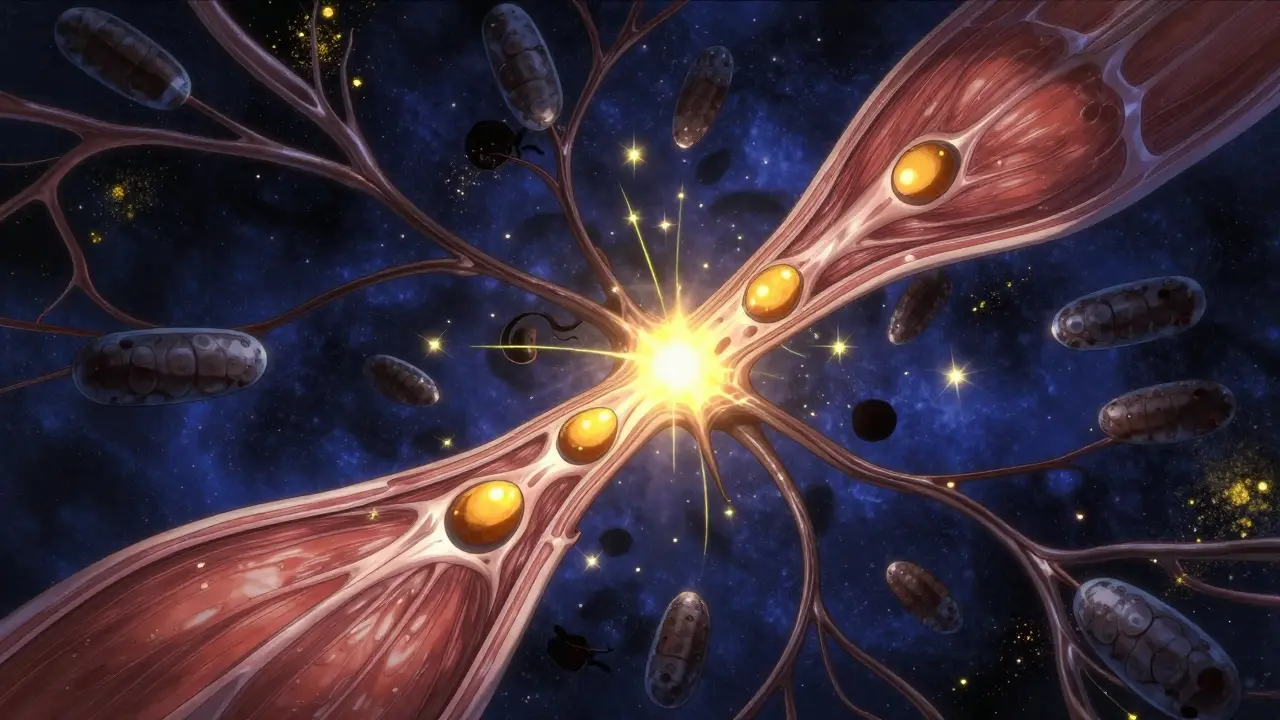
The Immunotherapy Toolkit: From Basics to Biologics
Treating MG is about balancing the need to suppress the immune system with the need to avoid long-term side effects. Doctors generally follow a stepwise approach, starting with symptomatic relief and moving toward more aggressive immune modulation.| Treatment Type | Common Example | How it Works | Typical Efficacy/Speed |
|---|---|---|---|
| Symptomatic | Pyridostigmine | Blocks AChE to keep acetylcholine active longer | Fast relief, but doesn't stop the disease |
| First-Line Immunosuppression | Prednisone | Broadly suppresses the immune response | 70-80% show marked improvement |
| Steroid-Sparing Agents | Azathioprine | Reduces need for long-term steroids | 60-70% effective after 12-18 months |
| Rapid Response | IVIG or PLEX | Filters antibodies or neutralizes them | Improvement in 2-7 days; lasts 3-6 weeks |
| Targeted Biologics | Efgartigimod | Blocks neonatal Fc receptor (nFcR) to lower IgG | 68% achieve minimal manifestation (ADAPT trial) |
The Role of Steroids and Sparing Agents
Glucocorticoids like prednisone is often the first heavy hitter. While it works for the vast majority of people, the side effects are the real problem. Chronic use often leads to weight gain, mood swings, and bone loss. To fight this, doctors introduce "steroid-sparing" agents like azathioprine or mycophenolate mofetil. These take longer to kick in-sometimes several months-but they allow patients to lower their steroid dose while keeping the disease under control.
Rapid Interventions for Crises
When a patient enters a "myasthenic crisis"-where breathing or swallowing becomes dangerous-they need an immediate fix. Plasmapheresis ( PLEX) and Intravenous Immunoglobulin ( IVIG) are the gold standards here. PLEX literally cleans the antibodies out of the blood, working in as little as 2-3 days. IVIG provides healthy antibodies that distract the immune system, usually taking 5-7 days to work. While PLEX is slightly faster, IVIG is generally easier on the patient because it doesn't require the same complex vascular access.
The New Era: nFcR Antagonists and Complement Inhibitors
The biggest shift in recent years is the move toward precision. Efgartigimod is a game-changer. It targets the neonatal Fc receptor (nFcR), which normally recycles antibodies. By blocking this receptor, the body quickly clears out the harmful IgG antibodies that cause muscle weakness. In the ADAPT trial, this approach allowed a significant number of patients to reach minimal manifestation quickly without the harsh side effects of steroids.
Surgical Options: Does the Thymus Gland Matter?
For many, the root of the problem is the thymus gland, located in the chest. In early-onset MG (people under 50), the thymus is often enlarged (hyperplasia). In older patients, it might develop a tumor called a thymoma . Removing the gland via a thymectomy isn't always an immediate cure, but it can lead to long-term remission. For AChR-positive patients, removing the thymus increases the odds of reaching a state where they no longer need medication. About 35-45% of early-onset patients achieve complete remission five years after surgery. It is essentially a way to "turn off" the factory producing the problematic antibodies.
Pitfalls and Red Flags to Watch For
Not every medication is safe for every MG patient. There are several "danger zones" that both patients and doctors must navigate:- Drug-Induced Worsening: Certain antibiotics and beta-blockers can actually make MG symptoms worse. Always provide a full list of your medications to any new doctor.
- Immune Checkpoint Inhibitors: Some newer cancer treatments (ICIs) can trigger a sudden, severe form of MG. In some reported cases, 60% of these patients also developed myocarditis, making the condition life-threatening.
- Tapering Too Fast: Reducing immunosuppressants too quickly is a common mistake. Research suggests a relapse rate of 40-50% if drugs are tapered before a patient has been stable for at least two years.
- Liver Toxicity: Azathioprine can be hard on the liver. Regular blood tests are mandatory to ensure the dose isn't causing hepatotoxicity.
Navigating Your Long-Term Journey
Living with MG is a marathon of adjustments. You'll likely move through different phases of treatment as your body responds. A common pathway looks like this:- Symptomatic Phase: Starting with pyridostigmine to manage the daily fatigue.
- Induction Phase: Adding prednisone to bring the overall inflammation down.
- Maintenance Phase: Introducing a steroid-sparing agent (like azathioprine) to lower the prednisone dose.
- Refinement Phase: If the first options fail, moving to biologics like Rituximab (especially for MuSK-positive cases) or efgartigimod.
Can Myasthenia Gravis be cured?
While there is no one-time "cure" that works for everyone, many patients achieve full clinical remission, especially after a thymectomy in early-onset cases. Most people, however, manage it as a chronic condition using immunotherapy to maintain a state of minimal manifestation where symptoms are barely noticeable.
What is the difference between AChR and MuSK MG?
The difference lies in which protein the antibodies attack. AChR-positive MG involves antibodies attacking the acetylcholine receptors. MuSK-positive MG involves antibodies attacking the protein that stabilizes those receptors. This matters because MuSK-positive patients often respond much better to targeted therapies like Rituximab than they do to standard steroids.
How does IVIG differ from Plasmapheresis (PLEX)?
PLEX is a physical cleaning process that removes antibodies from the plasma, offering a very fast response (2-3 days) but requiring a machine and vascular access. IVIG infuses healthy antibodies to modulate the immune system; it's generally better tolerated and easier to administer, though it takes slightly longer (5-7 days) to show results.
Are there any lifestyle tips for managing fatigable weakness?
Since MG symptoms worsen with activity and heat, many patients find it helpful to schedule demanding tasks for the morning when they are freshest. Using air conditioning or cool compresses can help reduce ocular symptoms, and resting between activities is essential to allow the neuromuscular junctions to "reset."
What are the risks of long-term steroid use in MG?
Long-term use of prednisone can lead to weight gain (seen in about 70% of chronic users), osteoporosis, high blood pressure, and an increased risk of infections. This is why neurologists prioritize adding "steroid-sparing" agents like azathioprine as soon as possible to lower the steroid dose.
Akshata Kembhavi
April 21, 2026 AT 06:56Actually had a cousin deal with this and the whole 'resting a bit' thing is a real lifesaver. Just taking those little breaks makes a huge difference.
Mike Beattie
April 22, 2026 AT 10:00The dichotomy between AChR and MuSK pathways is fundamentally understated here. If you're operating under a MuSK-positive phenotype, the pharmacodynamics of standard steroids are often suboptimal, leading to a paradoxical exacerbation of bulbar symptoms. It's all about the molecular targeting of the IgG antibodies; failing to differentiate these isn't just a clinical oversight, it's practically negligence in a high-acuity setting. Most people just glaze over the nFcR mechanism, but that's where the actual efficacy lies for those of us who actually understand the biochemistry of the neuromuscular junction.
Bob Collins
April 23, 2026 AT 18:50Fair point on the MuSK side of things. It's definitely a different beast.
Lesley Wimbush
April 25, 2026 AT 08:26Honestly, the whole 'drug-induced worsening' part is just so terrifying! Like, imagine just taking a basic antibiotic and suddenly you can't swallow? Truly a nightmare scenario, but it's so important to be aware of these things. I always tell my friends that being a patient is basically a full-time job these days, but at least we have the fancy new biologics now. I mean, efgartigimod sounds like something out of a sci-fi movie, but if it stops the drooping, I'm all for it!
Tokunbo Elegbe
April 26, 2026 AT 04:40It really is a journey... and staying patient with the tapering process is absolutely vital!!! Many people rush it... and then they end up right back where they started... it's such a heartbreaking cycle!!!
Lucy Kuo
April 27, 2026 AT 19:30Oh, the sheer tragedy of the bulbar muscles failing is simply heart-wrenching! To lose one's voice is to lose a piece of one's soul. We must embrace a more holistic understanding of this struggle, ensuring every individual feels seen and supported in their most vulnerable moments of weakness. It is truly an odyssey of the spirit to maintain dignity while the body betrays its most basic functions.
caesar simpkins
April 28, 2026 AT 21:43That part about the cool compress on the eyes is such a great tip. Simple things often make the biggest impact when you're feeling totally drained.
Don Drapper
April 29, 2026 AT 08:04The statistical correlation between ICI-induced MG and myocarditis is utterly appalling. We are witnessing a catastrophic failure in pharmacological foresight. One must wonder how these agents were fast-tracked when the risk of systemic immune collapse is this pronounced. It is an absolute travesty that patients are thrust into these life-threatening scenarios due to an obsession with novel cancer modalities over basic patient safety. The data is clear, yet the clinical implementation remains recklessly haphazard.
Grace Grace
May 1, 2026 AT 02:07I realy feel for anyone dealing with the side effects of prednison. The mood swings are just... wow. Its like you're a different person some days! But keeping the faith is so important for recovery!
dallia alaba
May 2, 2026 AT 07:37For those looking at the surgical route, remember that the timing of the thymectomy can vary. Some find it helpful to stabilize with meds first, while others go straight to surgery to stop the antibody production at the source. It's a big decision, but the 35-45% remission rate for early-onset cases is a very promising statistic for many.
Wendy Ajurín
May 3, 2026 AT 22:17The use of the Quantitative Myasthenia Gravis Score is an excellent way to remove subjectivity from the clinical assessment. By quantifying the weakness, patients and providers can make evidence-based decisions regarding the escalation of therapy, which minimizes the risk of under-treating a potentially dangerous crisis.
Truman Media
May 5, 2026 AT 15:10Every day is a new chance for a win! :) Just keep moving forward slowly and keep a smile on your face. We are all in this together!
Stay strong everyone! :)
aman motamedi
May 6, 2026 AT 13:39I appreciate the detailed breakdown of the treatment phases. It provides a structured perspective on a very complex medical journey.