NSAID Risk Assessment Calculator
This tool helps you assess your personal risk of gastrointestinal bleeding when taking NSAIDs based on medical factors. The American College of Gastroenterology guidelines show that certain factors significantly increase risk.
Your Risk Factors
Your Risk Assessment
Based on American College of Gastroenterology guidelines
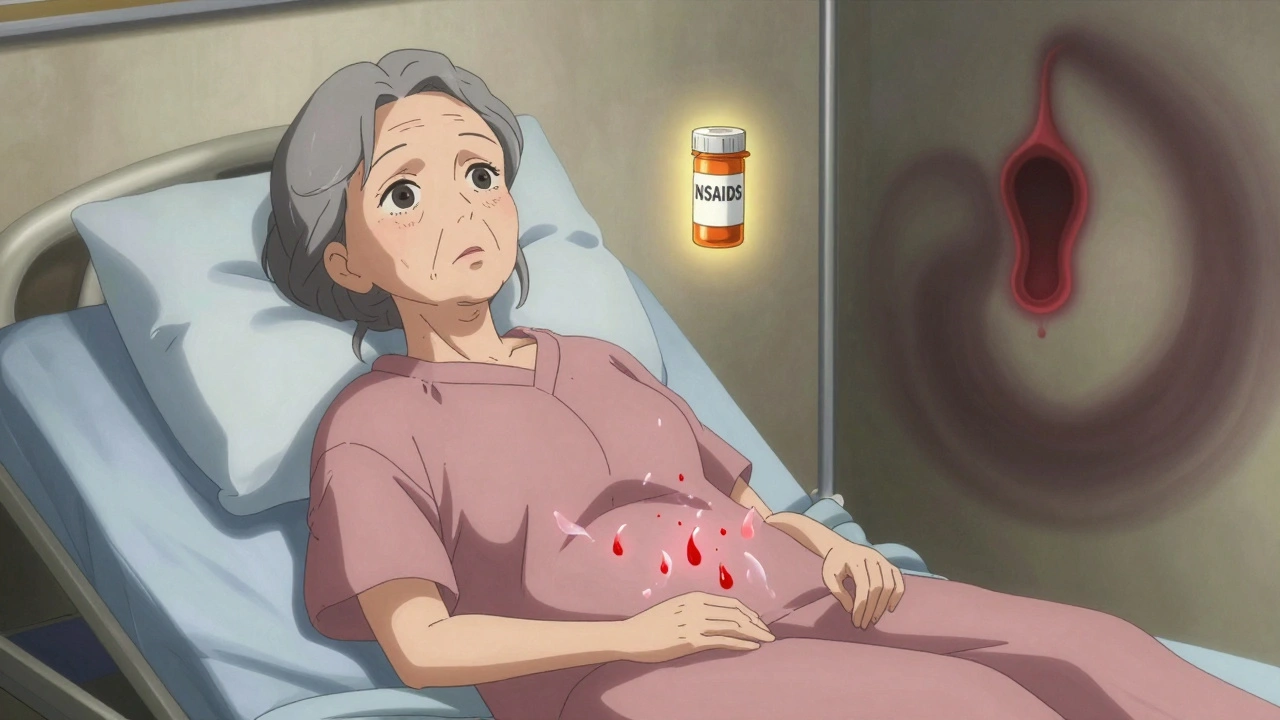
Every year, millions of people reach for ibuprofen, naproxen, or diclofenac to ease joint pain, headaches, or backaches. These are NSAIDs-non-steroidal anti-inflammatory drugs-and they work. But for many, especially older adults or those with existing health issues, they come with a silent danger: gastrointestinal bleeding. It doesn’t always come with sharp pain or vomiting blood. Sometimes, it starts as fatigue, dizziness, or iron deficiency anemia that gets ignored for months. By the time it’s caught, it’s already serious.
How NSAIDs Damage the Gut
NSAIDs block enzymes called COX-1 and COX-2. COX-2 causes inflammation and pain, so blocking it helps. But COX-1 protects the stomach lining by making mucus and keeping blood flowing to the gut. When that protection drops, the stomach and intestines become vulnerable. Even a short course of NSAIDs can cause tiny erosions. Long-term use? That’s when deep ulcers form-some so severe they bleed into the digestive tract.It’s not just the stomach. About one-third of NSAID-related bleeding comes from the lower intestine, not the stomach at all. That’s why some people develop iron deficiency without ever having heartburn or stomach pain. The bleeding is slow, hidden, and easy to miss. A 2021 review found that 86% of patients with lower GI bleeding had taken NSAIDs-even if they didn’t have a diagnosed ulcer.
The Real Risk Numbers
The risk isn’t theoretical. A 2020 meta-analysis in JAMA Internal Medicine showed NSAID users are 3.2 to 4.2 times more likely to suffer upper GI bleeding or perforation than non-users. That’s not a small increase. For someone over 65, the risk climbs even higher. And it’s worse if you’re on other meds: blood thinners, steroids, or multiple NSAIDs. A 2017 study found that using two NSAIDs together nearly doubles your risk.Over-the-counter NSAIDs are a big part of the problem. A 2021 review found 26% of users take more than the recommended dose, and most never tell their doctor. That’s dangerous because the line between "a little extra for pain" and "too much" is thin-and invisible until it’s too late.
Not All NSAIDs Are the Same
Some NSAIDs are riskier than others. Traditional ones like naproxen and diclofenac hit both COX-1 and COX-2, so they’re harder on the gut. COX-2 inhibitors like celecoxib were designed to avoid that. A 2000 Lancet study showed celecoxib cut complicated ulcers by half compared to ibuprofen.But there’s a trade-off. The same COX-2 drugs that protect the stomach raise the risk of heart attacks. Rofecoxib (Vioxx) was pulled from the market in 2004 after studies showed it doubled heart attack risk. Celecoxib still carries a warning, though it’s safer than rofecoxib. That’s why doctors now weigh heart risk against gut risk before choosing.

Who’s Most at Risk?
Not everyone who takes NSAIDs bleeds. But certain factors make it much more likely:- Age over 65 (risk doubles every decade)
- History of peptic ulcer or GI bleeding
- Taking blood thinners like warfarin or aspirin
- Using corticosteroids (like prednisone)
- Taking more than one NSAID
- Having heart failure, kidney disease, or liver problems
A 2021 guideline from the American College of Gastroenterology uses a simple scoring system: 2 points for age over 70, 2 for past ulcer, 2 for anticoagulants, and 1 for steroids. If your score is 2 or higher, you’re high risk-and you need protection.
How to Protect Your Gut
If you’re high risk, you don’t have to avoid NSAIDs. You just need backup. The most effective strategy? Adding a proton pump inhibitor (PPI). Drugs like omeprazole, esomeprazole, or pantoprazole reduce stomach acid and help the lining heal. A 2017 Cochrane review of over 13,000 patients found PPIs cut NSAID-related ulcers by 75%.Another option is misoprostol. It rebuilds the stomach’s protective layer, but it causes diarrhea in up to 20% of users and can trigger cramps. That’s why most doctors skip it unless PPIs aren’t an option.
Now there’s a newer solution: combo pills. Vimovo combines naproxen with esomeprazole in one tablet. A 2022 trial showed it reduced ulcer complications from 25.6% (with naproxen alone) to just 7.3%. It’s not cheap, but for high-risk patients, it’s a game-changer.
What Patients Are Saying
Real people are noticing the difference. On Drugs.com, 78% of users on celecoxib reported little to no stomach trouble. But on forums like HealthUnlocked and Reddit, stories of silent bleeding are common. One user described their 78-year-old mother needing three blood transfusions after months of fatigue and low iron-no pain, no vomiting, just a slow leak from the small intestine caused by daily ibuprofen.And it’s not rare. A 2022 Arthritis Foundation survey found 42% of NSAID users stopped taking them because of stomach issues. That’s almost half. Many didn’t realize the connection until it was too late.

What Doctors Recommend Now
The latest guidelines from the American College of Rheumatology (2023) are clear:- If you have one risk factor (like age over 65), use the lowest NSAID dose for the shortest time possible.
- If you have two or more risk factors, avoid traditional NSAIDs. Use a COX-2 inhibitor like celecoxib with a PPI.
- For anyone with a past ulcer or GI bleed, COX-2 inhibitor + PPI is the gold standard. Studies show it prevents one ulcer complication for every 16 patients treated over 12 weeks.
And don’t forget: if you’ve been on NSAIDs for more than a few weeks, ask your doctor for a blood test. Iron levels, hemoglobin, and stool tests for hidden blood can catch problems before they become emergencies.
The Bigger Picture
NSAIDs are cheap, effective, and everywhere. In the U.S. alone, they cause over 107,000 hospitalizations and 16,500 deaths each year. The cost? $2.2 billion annually. Globally, the market is worth over $11 billion. That’s a lot of pills-and a lot of preventable harm.But they’re not going away. For arthritis, back pain, and inflammation, they still work better than most alternatives. The goal isn’t to stop them. It’s to use them smarter.
What You Can Do Today
If you take NSAIDs regularly:- Ask your doctor: "Do I have any risk factors for bleeding?"
- Get your blood checked yearly if you’re over 60 and on NSAIDs.
- Don’t take more than the label says-even "just one extra" can tip the scale.
- If you feel tired, dizzy, or notice dark stools, don’t wait. Get it checked.
- Ask about PPIs if you’re high risk. They’re not just for heartburn.
NSAIDs are tools. Like any tool, they can help or hurt depending on how you use them. The key isn’t fear-it’s awareness.
Can I take ibuprofen if I’ve had a stomach ulcer before?
No, not without protection. If you’ve had a peptic ulcer or GI bleed, taking ibuprofen or other traditional NSAIDs alone carries a very high risk of recurrence. The American College of Gastroenterology recommends using a COX-2 inhibitor like celecoxib combined with a proton pump inhibitor (PPI) like omeprazole. This combo reduces the risk of another ulcer by up to 90% compared to NSAIDs alone. Never restart NSAIDs after a past bleed without talking to your doctor.
Are over-the-counter NSAIDs safer than prescription ones?
No. Over-the-counter NSAIDs like ibuprofen and naproxen are the same drugs as prescription versions-they’re just sold in lower doses. But people often take them longer and at higher doses than recommended. A 2021 review found 26% of OTC NSAID users exceed the daily limit, and most don’t tell their doctor. That increases bleeding risk just as much as prescription misuse. Just because it’s available without a prescription doesn’t mean it’s safe for long-term use.
How do I know if NSAIDs are causing hidden bleeding?
Hidden (occult) bleeding doesn’t cause pain or black stools. Instead, it leads to iron deficiency anemia. Signs include fatigue, weakness, shortness of breath, pale skin, or dizziness when standing. A simple blood test can check your hemoglobin and iron levels. If they’re low and you’re on NSAIDs, your doctor should test your stool for hidden blood. This is especially important if you’re over 60, female, or have arthritis.
Is it safe to take aspirin with NSAIDs?
It’s risky. Low-dose aspirin is often taken for heart protection, but it also damages the stomach lining. When combined with other NSAIDs, the risk of bleeding skyrockets. A 2017 study found the odds of GI bleeding triple when aspirin is taken with NSAIDs. If you need both, you must also take a proton pump inhibitor (PPI). Never combine them without medical advice.
What are the alternatives to NSAIDs for chronic pain?
For chronic pain like arthritis, alternatives include acetaminophen (Tylenol), which doesn’t harm the stomach but doesn’t reduce inflammation. Physical therapy, weight loss, heat/cold therapy, and topical creams (like diclofenac gel) can help too. In some cases, doctors prescribe duloxetine or pregabalin for nerve-related pain. For severe cases, joint injections or surgery may be options. The goal is to reduce or eliminate NSAID use where possible, especially if you’re high risk.
How long should I wait before starting a PPI if I’m going on NSAIDs?
Start the PPI at the same time as the NSAID. Waiting increases your risk. A 2017 Cochrane review showed that starting PPI therapy before or at the same time as NSAIDs reduces ulcer complications by 74%. Waiting even a few days can allow damage to begin. If you’re high risk and your doctor recommends a PPI, don’t delay-take them together from day one.
Rawlson King
December 13, 2025 AT 18:30sharon soila
December 15, 2025 AT 05:58Tommy Watson
December 15, 2025 AT 21:32Karen Mccullouch
December 16, 2025 AT 21:19Jennifer Taylor
December 18, 2025 AT 09:12Shelby Ume
December 18, 2025 AT 21:51Jade Hovet
December 19, 2025 AT 23:22nithin Kuntumadugu
December 20, 2025 AT 20:48John Fred
December 21, 2025 AT 02:13Harriet Wollaston
December 22, 2025 AT 07:33Lauren Scrima
December 22, 2025 AT 14:00