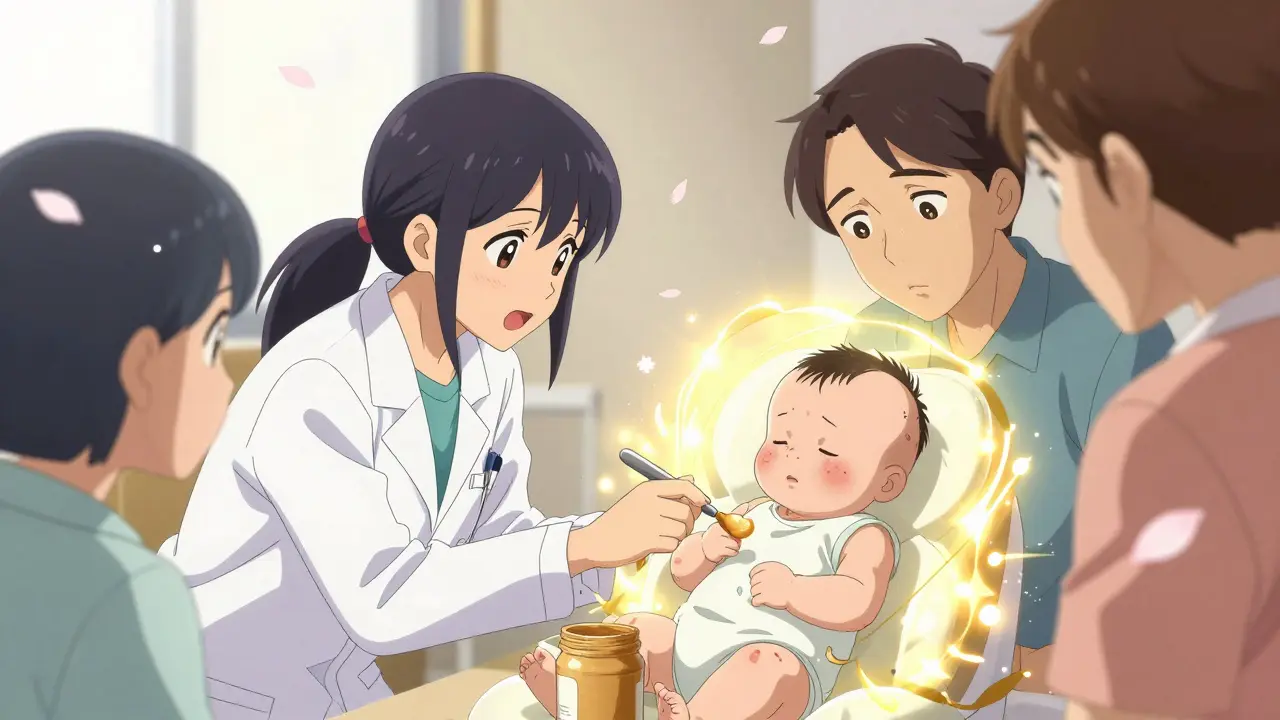
For years, parents were told to wait until their child was 2 or 3 years old before giving them peanuts. The logic was simple: delay exposure, reduce risk. But by 2015, peanut allergies had tripled in the U.S. since the 1990s. Something was wrong. Then came the LEAP study-a landmark trial that turned everything upside down. It showed that waiting didn’t protect kids. It made them more likely to develop a life-threatening allergy. Today, the science is clear: introducing peanut early can prevent peanut allergy in most at-risk infants. And the change isn’t just theoretical-it’s saving lives.
Why Early Introduction Works
The old advice to delay peanuts came from fear, not data. Pediatricians worried that early exposure might trigger a reaction. But the real danger wasn’t exposure-it was avoidance. The Learning Early About Peanut Allergy (LEAP) study, led by researchers at King’s College London, followed over 600 high-risk infants. Half were given peanut-containing foods regularly from 4 to 11 months. The other half avoided peanuts completely. By age 5, 17% of the avoidance group had developed a peanut allergy. Only 3% of the group that ate peanut regularly did. That’s an 80% drop in allergy risk. The same pattern showed up in other studies like EAT (Enquiring About Tolerance). Together, they proved that the immune system learns to tolerate peanut when exposed early, not later.
This isn’t just about peanuts. It’s about how the immune system works. When a baby’s skin is exposed to allergens (like from eczema), and their gut isn’t, the body mistakes peanut as a threat. But when peanut enters the gut early-through food-the immune system sees it as harmless. That’s why timing matters so much. The sweet spot? Between 4 and 6 months. After 6 months, the chance of prevention drops. By age 1, it’s often too late.
Who Should Introduce Peanut Early?
Not all babies need the same approach. The NIAID guidelines (from the National Institute of Allergy and Infectious Diseases) break infants into three risk groups:
- High-risk: Infants with severe eczema or egg allergy. These kids have the highest chance of developing peanut allergy. They should be evaluated by a doctor before introducing peanut, usually between 4 and 6 months. Skin or blood tests may be done first. If results are negative, peanut is introduced under medical supervision the first time, then at home three times a week.
- Moderate-risk: Infants with mild to moderate eczema. These babies can start peanut at home around 6 months, with no testing needed. Just make sure they’re ready for solids-head control, interest in food, no pushing food out with their tongue.
- Low-risk: Infants with no eczema or food allergies. Peanut can be introduced whenever you start solids, usually around 6 months. No special steps needed.
Here’s the kicker: even babies with severe eczema can safely eat peanut if tested first. The fear of anaphylaxis is real, but the risk of not introducing peanut is higher. In the LEAP study, no child had a severe reaction during supervised introduction. And if a child already has a peanut allergy? Early introduction is not for them. It’s not a treatment. It’s a prevention tool.
How to Safely Introduce Peanut
Don’t give a child a whole peanut. Ever. Choking risk. Never. Whole nuts, chunks, or sticky peanut butter are dangerous for babies under 4. Instead, use safe forms:
- Smooth peanut butter mixed with warm water, breast milk, or formula until it’s thin and runny.
- Peanut flour or peanut powder stirred into pureed fruits, vegetables, or oatmeal.
- Specialized infant peanut products like Bamba (a puffed corn snack with peanut) or spoonable peanut butter pouches.
The goal is 2 grams of peanut protein, three times a week. That’s about 2 teaspoons of smooth peanut butter. Or 21 peanuts ground into powder. Consistency matters more than one-time exposure. It’s not a one-shot deal. You need to keep giving it regularly-once or twice a week-for months. Stopping after a few weeks can undo the protection.
Start small. Give a quarter teaspoon the first time. Wait 10 minutes. Watch for swelling, hives, vomiting, or trouble breathing. If nothing happens, you can give the rest. Then continue weekly. If there’s a reaction, stop and call your doctor. Most reactions are mild-redness or a few hives. Severe reactions are rare during supervised introduction.

What About Oral Immunotherapy (OIT)?
Oral immunotherapy (OIT) is different. It’s not prevention. It’s treatment. OIT is for kids who already have a peanut allergy. They eat tiny, increasing doses of peanut under medical supervision to build tolerance. It doesn’t cure the allergy. It just raises the threshold-so a crumb won’t send them to the ER. The FDA approved Peanut (AR101) in 2020 for children 4 to 17. But it’s not perfect. Side effects include stomach pain, vomiting, and occasional anaphylaxis. It’s expensive. It requires months of daily dosing. And if you stop, the allergy often comes back.
Early introduction avoids OIT altogether. It’s prevention, not management. That’s why it’s so powerful. If you introduce peanut early, you might never need OIT. That’s why doctors now say: Don’t wait for allergy to happen. Stop it before it starts.
Why Isn’t Everyone Doing It?
Despite clear guidelines, only about 39% of high-risk infants in the U.S. are getting peanut early. Why? Parents are scared. Pediatricians aren’t always trained. And misinformation still circulates.
A 2022 survey found 62% of parents worried about choking or anaphylaxis. Many don’t know how to prepare peanut safely. Others think, “My cousin ate peanut at 2 and was fine,” not realizing that’s the old, outdated advice. Even doctors get it wrong. A 2023 study showed only 54% of pediatricians knew the current guidelines.
And there’s a deeper problem: inequality. Black and Hispanic infants are 22% less likely to get early peanut introduction than White infants. That’s not because of choice. It’s because of access. Fewer specialists in underserved areas. Less education from providers. Fewer products available in local stores. That’s why peanut allergy rates haven’t dropped equally across all groups.

What’s Changed Since 2017?
The shift has been dramatic. In 2015, peanut allergy affected 2.2% of U.S. children. By 2023, that number dropped to 1.6%. That’s about 300,000 fewer children with peanut allergy. The biggest drop? In high-risk kids. Children with mild eczema saw an 85% reduction. Moderate eczema? 87%. Severe eczema? Still a 67% drop. The protection lasts. The LEAP follow-up study showed kids stayed protected even after avoiding peanut for a year. That’s not just desensitization-it’s true tolerance.
Products have evolved too. You can now buy peanut powder designed for infants. Spoonable pouches. Pre-mixed formulas. The market for these products grew 27% annually from 2018 to 2023. Companies are responding to the science. And researchers are looking ahead. The PRESTO trial, funded by the NIAID, is testing even earlier introduction-some as young as 3 months. Results are expected in 2026.
What’s Next?
The future isn’t just about peanuts. The EAT study showed that introducing multiple allergens-egg, milk, soy, tree nuts-at the same time can prevent more than one allergy. So if you’re introducing peanut, consider egg too. Both are best started between 4 and 6 months. The same rules apply: safe forms, regular doses, watch for reactions.
And while probiotics, vitamin D, or maternal diet changes were once thought to help, studies now say they don’t. Only early exposure works. No supplement. No special diet. Just food. Real food. At the right time.
Key Takeaways
- Peanut allergy can be prevented-by introducing peanut between 4 and 6 months.
- High-risk infants (severe eczema or egg allergy) should be evaluated by a doctor first.
- Use smooth peanut butter, powder, or infant-safe products. Never whole peanuts.
- Give 2g of peanut protein three times a week, consistently.
- Oral immunotherapy (OIT) treats existing allergy. Early introduction prevents it.
- Only 39% of high-risk infants are getting peanut early. You can change that.
Can I introduce peanut before 4 months?
No. Infants should not be introduced to peanut before 4 months. Their digestive and immune systems aren’t ready. Wait until they show signs of readiness for solids-head control, interest in food, ability to swallow. The optimal window is 4 to 6 months. Starting earlier doesn’t add benefit and may increase risk.
What if my baby has eczema but no egg allergy?
If your baby has moderate to severe eczema, they’re considered high-risk-even without egg allergy. Talk to your pediatrician or allergist before introducing peanut. They may recommend skin or blood testing. If results are negative, start peanut between 4 and 6 months, beginning with a supervised first dose. Don’t wait until 6 months if eczema is severe.
Is peanut butter safe for babies?
Only smooth peanut butter, thinned with water, breast milk, or formula. Never chunky, sticky, or straight from the jar. Whole peanuts, peanut pieces, or crunchy peanut butter are choking hazards. Use 2 teaspoons of smooth peanut butter mixed with 2-3 tablespoons of liquid to make it runny. That’s the standard dose used in studies.
How long do I need to keep giving peanut?
Keep giving peanut at least 3 times a week for several months. Studies show protection builds over time. Stopping after a few weeks may mean the allergy risk returns. Once your child is eating peanut regularly, include it in their diet often-don’t treat it as a one-time intervention.
Does early introduction work for older kids?
No. Early introduction is only effective if started before 6 months. Once a child is over 12 months old and has avoided peanut, the chance of preventing allergy drops sharply. For older kids with peanut allergy, oral immunotherapy (OIT) is the option-not early introduction. Prevention only works in infancy.
John McDonald
February 8, 2026 AT 19:28Finally, some common sense. I remember when my cousin’s kid got banned from preschool because someone brought peanut butter crackers. Now we know that fear-based avoidance was the real problem. My daughter had eczema as a baby - we started peanut at 5 months with a thinned spoonful. No reaction. Now she eats PB&J like it’s oxygen. This isn’t rocket science - it’s biology.
Chelsea Cook
February 8, 2026 AT 22:01So let me get this straight - we spent 20 years telling parents NOT to feed their kids peanut butter… and now we’re saying the ONLY thing that works is… feeding them peanut butter? 😂
Also, why is it that the same people who told us to avoid peanuts are now the ones selling peanut powder pouches for $12 a jar? Someone’s making bank off our collective panic.
Andy Cortez
February 9, 2026 AT 21:03peanut allergey? more like peanut paranoia
they say 'introduce at 4-6 months' but what about the 30% of moms who dont even know what '4 months' looks like? also why is it always peanut? what about tree nuts? soy? shellfish? oh right because peanuts are cheap and easy to test on. this whole thing feels like a pharma play disguised as science. also i think my dog is allergic to peanut butter. so there.
Joshua Smith
February 10, 2026 AT 22:20Just wanted to add - my son had moderate eczema and we started peanut at 6 months using peanut flour in his oatmeal. We did it three times a week, like the guidelines say. No issues. He’s 2 now and eats peanut butter straight off the spoon. I’m so glad we didn’t listen to the old 'wait till 3' advice. It’s wild how much has changed in less than a decade.
Jessica Klaar
February 11, 2026 AT 06:02As a mom of two, one with severe eczema, I can’t stress this enough: get tested before you start. My first kid had a mild reaction at home - just a rash - but it scared me so much I almost quit. Then I found a pediatric allergist who walked me through it. The first time we did it in the clinic, I cried. Not from fear - from relief. We’re talking about preventing life-altering allergies, not just snacks. This isn’t just science. It’s peace of mind.
PAUL MCQUEEN
February 13, 2026 AT 05:24Why are we still talking about this? It’s 2025. We’ve had the data since 2015. If you’re still waiting until 2 years old to give your kid peanut butter, you’re not being careful - you’re being negligent. And don’t even get me started on the 'my cousin ate it at 2 and was fine' crowd. That’s like saying 'my uncle smoked 2 packs a day and lived to 90' - irrelevant and dangerous.
glenn mendoza
February 13, 2026 AT 22:24It is with profound gratitude and scientific reverence that I acknowledge the paradigm shift in pediatric immunology precipitated by the LEAP trial. The empirical evidence, peer-reviewed and replicated across multiple longitudinal cohorts, unequivocally supports the early introduction of allergenic proteins during the critical window of immune tolerance development. This represents not merely a clinical guideline, but a moral imperative in preventive medicine.
Patrick Jarillon
February 14, 2026 AT 21:23They want you to feed peanut at 4 months? LOL. That’s the same time they told us to give babies cereal in bottles to help them sleep. Remember that? We all know how THAT turned out. This is just Big Peanut pushing their agenda. What’s next? Introducing gluten at birth? Vaccines in the nursery? They’re conditioning us to trust food like it’s medicine. It’s not. It’s a product. And they’re monetizing your fear.
Randy Harkins
February 16, 2026 AT 13:01My 8-month-old eats peanut butter mixed with banana every other day. No issues. Just wanted to say - if you’re scared, start small. Like, seriously, a quarter teaspoon. Watch for 10 minutes. If nothing happens, you’re golden. And don’t forget - consistency > perfection. Miss a day? No biggie. Just keep going. 🥜❤️
Chima Ifeanyi
February 16, 2026 AT 21:50The epidemiological data is compelling, yet the implementation framework remains deeply stratified. Structural inequities in healthcare access, particularly in LMICs and marginalized communities, render these guidelines functionally exclusionary. The 22% disparity in uptake between racial cohorts is not a statistical anomaly - it is a systemic failure of public health infrastructure. Without targeted policy intervention - subsidized infant peanut products, community-based allergist outreach, and culturally competent education - we are merely redistributing risk, not eliminating it.
THANGAVEL PARASAKTHI
February 18, 2026 AT 08:11my sister gave her baby peanut at 3 months cause she read online it was good. now baby got rash. so maybe wait till 4? also i use peanut powder in rice porridge. works fine. no need to buy expensive pouches. just mix in home. simple. cheap. real food. 😊
Chelsea Deflyss
February 19, 2026 AT 15:45you mean i was supposed to give my kid peanut at 5 months? i waited till 1. now he’s allergic. thanks for the heads up. 🙃