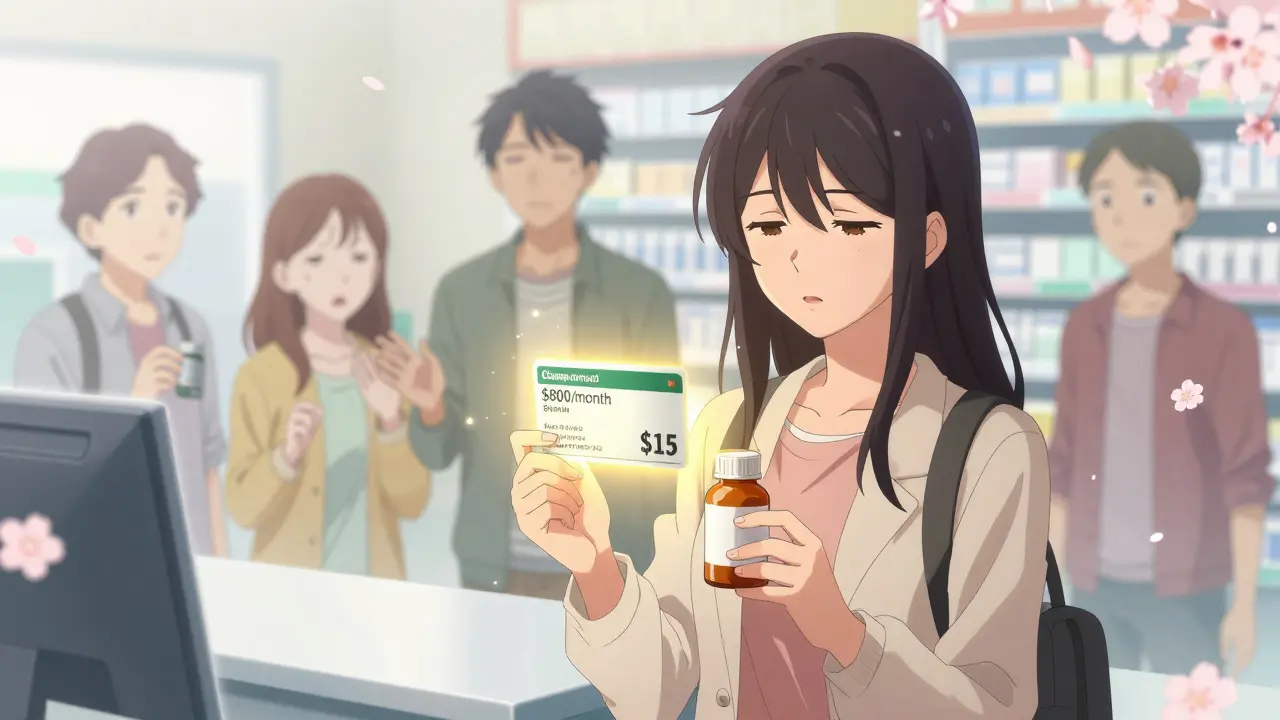
When you’re prescribed a life-changing medication-say, for diabetes, asthma, or rheumatoid arthritis-and the price at the pharmacy is $800 a month, it’s not just expensive. It’s impossible. That’s where prescription assistance programs come in. These are direct support systems run by drug manufacturers themselves, not insurance companies or government agencies. They exist to keep people on their meds when the cost would otherwise force them to skip doses, split pills, or go without.
There are two main types: copay assistance programs and Patient Assistance Programs (PAPs). They sound similar, but they serve completely different groups of people and work in totally different ways.
Copay Assistance: For the Insured Who Still Can’t Afford It
Copay assistance programs are for people who have insurance but still get hit with high out-of-pocket costs. Think of it like a discount card you get directly from the drugmaker. When you show it at the pharmacy, the manufacturer pays part-or all-of your copay or coinsurance. You might walk out paying $10 instead of $200.
These programs are mostly for brand-name drugs, especially specialty medications. According to PhRMA’s 2023 report, 68% of all copay assistance programs are tied to specialty drugs like those for multiple sclerosis, cancer, or rare autoimmune conditions. These are drugs with no cheap generics, and they often cost over $1,000 per month.
But there are limits. About 45% of these programs cap the total amount they’ll pay in a year-sometimes as low as $1,000, sometimes up to $25,000. Monthly limits are also common. For example, a program might cover up to $150 per month. If your drug costs $500 and your copay is $400, you’re still on the hook for $250 after the assistance.
Some programs even require you to pay a small fee-like $10 per prescription-as a way to show commitment. The Asthma and Allergy Foundation of America notes this is common with inhalers like Dulera. If you qualify, you might pay as little as $15 per prescription, with a maximum savings of $90 per fill.
Patient Assistance Programs (PAPs): For Those Without Insurance
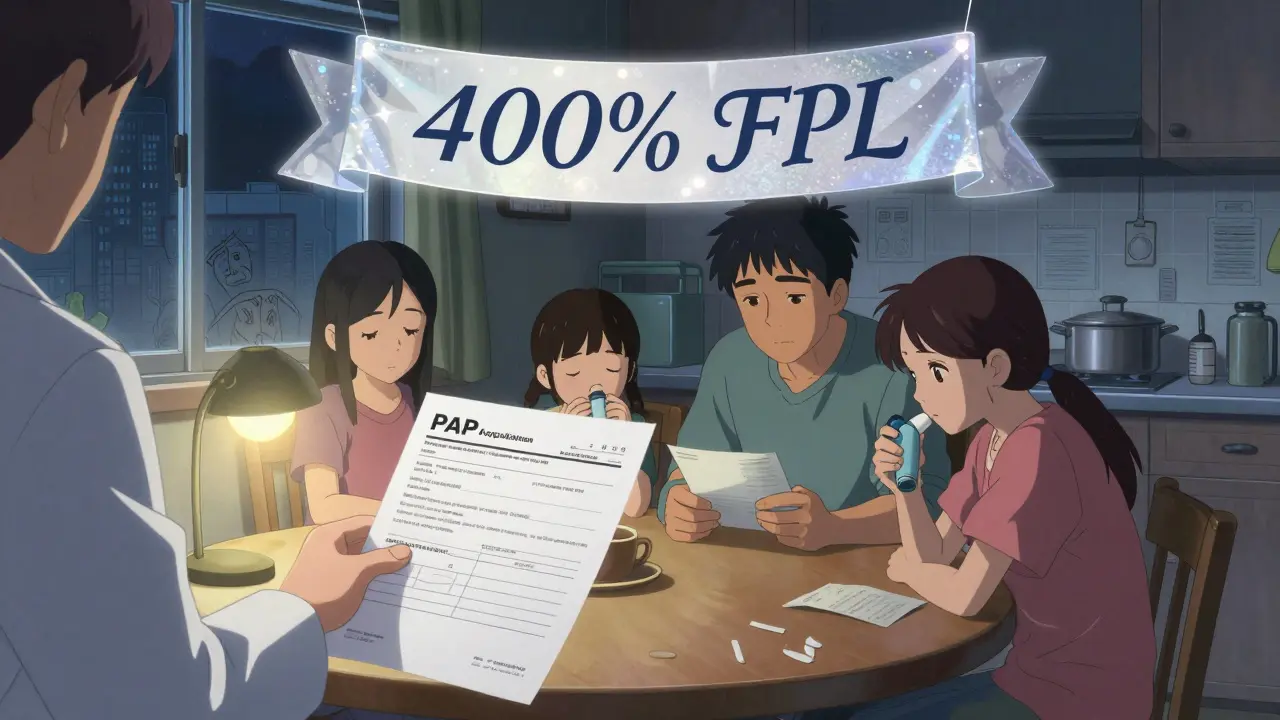
PAPs are the lifeline for people without insurance-or with insurance that doesn’t cover their drug. These programs give medications for free or at a deeply reduced price, often under $10 per month. Eligibility is based on income. Most require you to earn less than 400% of the Federal Poverty Level. In 2023, that meant a family of four making under $60,000 a year.
PAPs aren’t new. They started in the 1980s during the HIV/AIDS crisis when drug companies began giving away antivirals to those who couldn’t pay. Today, 92% of major pharmaceutical manufacturers run at least one PAP. In 2022 alone, these programs gave out $24.5 billion in assistance, helping 12.7 million people, according to PhRMA.
But getting into a PAP isn’t easy. You need proof of income-tax returns, pay stubs, or government benefit letters. You need to prove you’re a U.S. resident. You need a doctor to fill out paperwork confirming the drug is medically necessary. The average application takes 45 to 60 minutes. And if you’re on Medicaid or Medicare, many PAPs won’t touch you. CMS guidelines from January 2024 show that 62% of PAPs exclude patients with government insurance.
The Big Catch: What Insurance Plans Don’t Tell You
Here’s the hidden problem: even if you have copay assistance, your insurance plan might not let it count toward your deductible.
More than 78% of major insurers now use something called a “copay accumulator.” That means the money the manufacturer pays doesn’t get added to your out-of-pocket total. So even if you’ve paid $5,000 in copays thanks to coupons, your insurance still sees you as having paid $0. That keeps you stuck in the coverage gap longer-especially bad for Medicare Part D users.
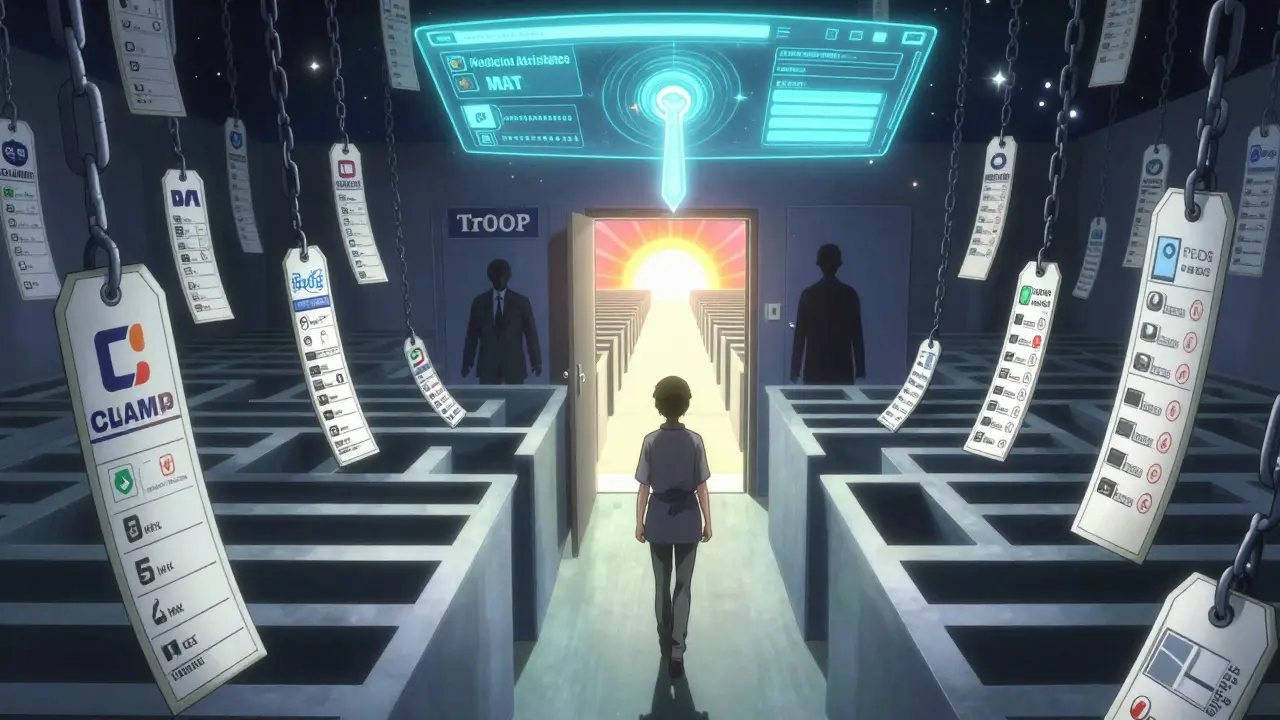
And here’s another twist: PAP assistance doesn’t count toward your Medicare Part D true-out-of-pocket cost (TrOOP). That’s the number that determines when you hit catastrophic coverage. So if you’re on Medicare and getting free drugs through a PAP, you’re not moving closer to the point where your costs drop dramatically. You’re stuck paying full price forever, even though you’re not paying anything.
Some states are pushing back. As of January 2024, 22 states have passed laws to limit or ban manufacturer copay assistance. California’s SB 1424, which took effect in 2024, forces drugmakers to publicly report how much they spend on these programs. Why? Because critics say these programs push people toward expensive brand-name drugs instead of cheaper generics-even when the generic is just as effective.
How to Find and Apply
You don’t have to guess which program might help you. The Medicine Assistance Tool (MAT), run by PhRMA, is a free, confidential search engine that lists over 900 assistance programs from more than 200 manufacturers. Just enter your drug name, insurance status, and income level. It tells you exactly which programs you qualify for.
For copay cards: Once you find a match, download the card, print it, and bring it to the pharmacy. The pharmacist swipes it like a credit card, and the discount is applied automatically. No paperwork. No waiting.
For PAPs: You’ll need to fill out an application-usually online. Some programs let your doctor’s office submit it for you. Others require you to mail documents. Keep copies of everything. If you’re denied, ask why. Many times, it’s just a missing signature or an outdated tax form.
Don’t assume you’re not eligible just because you have insurance. Some PAPs help people with high-deductible plans if their out-of-pocket costs exceed a certain percentage of their income. Always check.
Who Gets Left Out?
Despite all this help, millions still fall through the cracks. In 2023, 28 million Americans had no health insurance at all, according to the Census Bureau. Many of them can’t afford even $10-a-month medications. And while PAPs exist, they’re not guaranteed. Some programs run out of funds mid-year. Others only cover one drug, not the full cocktail a patient needs.
Even if you qualify, awareness is low. A 2022 survey by the Patient Advocate Foundation found only 37% of eligible patients knew about manufacturer assistance programs. That means two out of three people are paying full price because they never heard these programs existed.
Is This the Real Solution?
Let’s be honest: these programs are a band-aid. They help people today, but they don’t fix why drugs cost so much in the first place. Critics argue they let manufacturers keep prices sky-high because they know they can offset them with coupons. A 2022 JAMA Internal Medicine study estimated copay assistance increased total drug spending by $1.4 billion a year by steering people away from cheaper alternatives.
But for someone choosing between insulin and groceries, or an inhaler and rent, this isn’t about systemic reform. It’s about survival. The fact that 12.7 million people got help last year shows how essential these programs are.
Right now, the system is broken. But if you’re struggling to pay for your meds, you don’t have to wait for Congress to fix it. The help is already here-waiting for you to ask for it.
Can I use copay assistance if I have Medicare?
Yes, you can use copay assistance if you have Medicare, but it won’t count toward your true-out-of-pocket costs (TrOOP) that lead to catastrophic coverage. The manufacturer’s payment is treated as separate from your Medicare Part D benefits. This means you may stay in the coverage gap longer, even if you’re paying less each month. Always check with your plan and the drugmaker’s program for details.
Do I need to reapply every year for a Patient Assistance Program?
It depends on the program. Some require annual re-enrollment, meaning you must submit updated income documents each year. Others offer continuous coverage as long as you remain eligible and refill your prescription. Always ask when you apply-this is one of the most common points of confusion.
Can I use both a copay card and a PAP for the same drug?
No. You cannot use both simultaneously for the same medication. If you qualify for a PAP (which gives you the drug for free or nearly free), you won’t need a copay card. If you have insurance and are using a copay card, you’re not eligible for a PAP. Programs are designed to be mutually exclusive to avoid double-dipping.
Are there programs for people who make too much for Medicaid but still can’t afford their drugs?
Yes. Many PAPs have income limits up to 400% of the Federal Poverty Level, which for a family of four in 2023 was $60,000. That means if you earn $55,000 and have no insurance, you may still qualify. Some programs also consider medical expenses when calculating eligibility. Always apply-even if you think you make too much.
Why won’t my Medicaid or Medicare cover the copay assistance card?
Most Medicaid programs prohibit the use of manufacturer copay assistance because they believe it drives up drug prices by encouraging brand-name use over cheaper generics. Medicare doesn’t block it, but it doesn’t count the assistance toward your out-of-pocket total. This is a policy decision, not a technical limitation. The goal is to prevent inflated pricing, but it leaves many patients confused and struggling.
Alex Ogle
February 7, 2026 AT 18:06Look, I’ve been on insulin for 12 years. I know what it’s like to stare at a $900 co-pay and wonder if your kid’s birthday party is more important than your next dose. These programs? They’re not perfect. But they’re the difference between life and a hospital bed. I’ve used PAPs when I lost my job, and copay cards when I got insurance but still couldn’t afford the deductible. No one’s handing out free money-but they’re handing out free medicine. And that’s something.
It’s not a fix. It’s a lifeline. And honestly? I’d rather have a lifeline that’s frayed than none at all.
Chima Ifeanyi
February 8, 2026 AT 17:36The entire pharmaceutical assistance ecosystem is a structural distortion masquerading as benevolence. Manufacturer-sponsored copay assistance artificially inflates demand for high-margin branded agents by circumventing cost-sharing mechanisms designed to incentivize therapeutic substitution. This creates perverse incentives: payers absorb the fixed costs of formulary inclusion while manufacturers retain premium pricing power under the guise of patient aid. The 1.4B annual increase in aggregate drug spending cited in JAMA is not a byproduct-it’s the business model.
PAPs, meanwhile, function as a regulatory arbitrage mechanism: exploiting income thresholds to exclude Medicaid/Medicare beneficiaries while maintaining eligibility for privately insured populations. This is not charity. It’s differential market segmentation disguised as social responsibility.
Ashlyn Ellison
February 8, 2026 AT 22:23I just applied for a PAP last month. Took me three days. Had to fax my tax return, my doctor’s note, and a signed affidavit from my landlord. All for a $15/month drug. I didn’t even get approved until the fourth try.
But I got it. And I’m alive. So yeah. It’s broken. But it works. Sometimes.
Frank Baumann
February 9, 2026 AT 09:50I can’t believe people still think these programs are some kind of moral victory. They’re not. They’re a cover-up. The drug companies know exactly what they’re doing. They raise prices to $1,200 a month so they can ‘help’ you with a $1,100 coupon. Then they pat themselves on the back in their annual CSR reports.
And don’t get me started on the copay accumulators. That’s not a loophole-that’s a trap. You’re paying $5,000 in out-of-pocket costs, but your insurance acts like you paid $0. So now you’re stuck in the donut hole forever. It’s like they’re designing the system to keep you in debt. And you’re grateful for the $10 card.
It’s sickening. And everyone who says ‘at least it helps’ is part of the problem.
Random Guy
February 11, 2026 AT 00:33so like… you’re telling me i can get my $800/month asthma inhaler for $15… but only if i fill out 47 forms, convince my doctor to write a novel, and prove i’m not rich enough to afford a new pair of shoes?
cool. cool cool cool. thanks for the ‘help’.
Brett Pouser
February 12, 2026 AT 09:45I’m Nigerian-American. Back home, my uncle had to drive 3 hours to a clinic just to get his blood pressure meds. Here, we’ve got apps that find free medicine for you. That’s wild.
But I get it-this system is a mess. It’s like having a fire extinguisher in a house where the whole roof is on fire. You can put out one flame, but the structure’s still collapsing. Still… I’d rather have the extinguisher than nothing. And I’m glad someone made it easy to find. MAT saved my sister’s life last year. No hype. Just facts. And that’s worth something.
Karianne Jackson
February 13, 2026 AT 18:10I cried when I got approved for the PAP. Not because I was happy. Because I was so tired of feeling like a burden.
My mom worked two jobs. I still didn’t qualify for Medicaid. But I got my insulin. For free.
Don’t tell me this doesn’t matter.
Chelsea Cook
February 14, 2026 AT 00:52Oh, so now we’re pretending this is a ‘band-aid’? Honey, it’s not even a band-aid. It’s duct tape on a leaking submarine. And we’re all pretending the water isn’t rising.
But guess what? People are still breathing. Because someone, somewhere, decided to hand them a straw. Don’t you dare act like that’s not heroic.
Andy Cortez
February 15, 2026 AT 18:19you know what’s funny? the same people who scream ‘free market!’ when someone says drug prices are too high are the ones who cheer when pharma gives away free pills. so which is it? capitalism or socialism? pick one.
also, 62% of pap’s won’t help medicaid users? that’s not a glitch. that’s a feature. they want the rich ones. the ones with insurance. the ones who’ll keep buying.
and don’t get me started on the ‘$10 fee’ to prove you’re ‘committed.’ like, i’m not trying to win a prize. i’m trying not to die.
Andrew Jackson
February 16, 2026 AT 21:31It is an affront to the principles of fiscal responsibility and national sovereignty that American citizens are dependent upon corporate benevolence for essential medical care. The Founding Fathers did not envision a republic where survival hinges on the goodwill of multinational pharmaceutical conglomerates. This is not a healthcare system; it is a feudal arrangement wherein the patient is a serf, the insurer is a lord, and the drugmaker is the benevolent monarch who dispenses grace in exchange for silence.
Let us not confuse charity with justice. Let us not mistake a subsidy for a solution. The state must act. The state must regulate. The state must restore dignity to the American people by guaranteeing access-not through corporate handouts, but through sovereign obligation.
Joseph Charles Colin
February 17, 2026 AT 12:45For those asking about Medicare Part D TrOOP: the CMS guidance is clear-manufacturer assistance does not count toward TrOOP because it is classified as a third-party payment, not patient expenditure. This is intentional under 42 CFR §423.1012. To reach catastrophic coverage, you must pay out-of-pocket using your own funds. PAPs and copay cards are excluded because they are not considered ‘patient payments’ under federal statute. This is not a loophole. It’s codified policy.
However, some state Medicaid agencies allow PAP assistance to count toward state-level cost thresholds-check your state’s program. Also: if you’re on Medicare and qualify for Extra Help (Low-Income Subsidy), you may be eligible for dual coverage. Contact your State Health Insurance Assistance Program (SHIP) for personalized guidance.
John Sonnenberg
February 18, 2026 AT 18:19They say ‘apply through MAT.’
They don’t say the website crashes every time you click ‘submit.’
They don’t say your doctor’s office has a 6-week waitlist just to sign the form.
They don’t say that if you miss one signature, you start over.
They don’t say that half the programs are ‘temporarily suspended’ because ‘funding ran out.’
They don’t say that you have to reapply every 90 days if you’re on Medicaid.
So yeah. It’s ‘easy.’
Like climbing Everest in flip-flops is easy.
Joshua Smith
February 19, 2026 AT 18:12I’ve been helping people apply for these programs at my local community center. I didn’t know how deep the cracks were until I started. One woman came in because she was splitting her 50mg insulin pill in half-literally using scissors. She was scared to go to the ER. We got her on a PAP. She cried. So did I.
It’s not perfect. But showing up? That matters. Asking? That changes things. If you’re reading this and you’re struggling-reach out. Someone out there will help you. You’re not alone.