
QT Prolongation Risk Calculator
Your Personal Risk Assessment
Risk Assessment Results
Key Risk Factors
What You Should Do
When a medication slows down your heart’s electrical recovery, it’s not just a lab number-it’s a potential life-or-death signal. QT prolongation isn’t something you feel, but it can trigger a deadly rhythm called Torsades de Pointes, leading to sudden cardiac death. This isn’t rare. Over 100 commonly prescribed drugs carry this risk, from antibiotics to antidepressants. And yet, most people-patients and doctors alike-don’t know what to watch for.
What QT Prolongation Really Means
The QT interval on an ECG measures how long it takes your heart’s lower chambers to recharge after each beat. When that interval gets too long, the heart becomes electrically unstable. It’s like a delayed reset in a camera shutter-too slow, and you get a blur. In the heart, that blur can turn into a chaotic, uncoordinated quiver instead of a strong pump.
A corrected QT interval (QTc) above 450 milliseconds in men or 470 in women is considered prolonged. But the real danger kicks in when QTc hits 500 milliseconds or more-or when it jumps more than 60 milliseconds from your baseline. These aren’t arbitrary numbers. They’re backed by decades of data showing a sharp rise in sudden death risk at these thresholds.
What’s more, the shape of the T-wave matters just as much as its length. Studies show that a longer time between the start and peak of the T-wave is the strongest predictor of sudden cardiac death, increasing risk by 21% for every standard deviation increase. That’s why newer guidelines now look at T-wave morphology, not just QTc.
Medications That Carry the Highest Risk
Not all QT-prolonging drugs are created equal. Some are high-risk by design; others are accidental offenders.
- Class III antiarrhythmics like dofetilide and sotalol are made to prolong repolarization-and they do it well. Dofetilide causes Torsades de Pointes in 3.3% of patients even at standard doses.
- Antibiotics like moxifloxacin can push QTc up by 6-15 milliseconds. Ciprofloxacin? Barely a blip. Erythromycin, especially when taken with drugs that block CYP3A4 metabolism (like grapefruit juice or some antifungals), raises sudden death risk five-fold.
- Antidepressants vary wildly. Citalopram at 40 mg daily adds about 8.5 milliseconds to QTc. Escitalopram at the same dose? Only 4.2. That’s why guidelines now recommend citalopram max doses of 20 mg.
- Antipsychotics like haloperidol and ziprasidone are notorious. Even at therapeutic levels, they can tip vulnerable patients into arrhythmia.
The problem isn’t just the drug itself-it’s the combo. Taking two QT-prolonging meds together? Risk multiplies. Add in low potassium, slow heart rate, or heart disease? The danger skyrockets.
Who’s Most at Risk?
It’s not just about the medication. It’s about the person taking it.
- Women are more susceptible. Their baseline QTc is naturally longer, and hormonal shifts make them more vulnerable to drug effects.
- Older adults take an average of 7.8 medications. One in three over 65 is on at least one QT-prolonging drug. Polypharmacy isn’t just messy-it’s deadly.
- People with heart disease face 10 to 100 times higher risk than those with healthy hearts. Structural damage makes the heart more sensitive to electrical chaos.
- Those with electrolyte imbalances-especially low potassium or magnesium-are sitting on a ticking bomb. Correcting potassium to above 4.0 mEq/L cuts QT risk by 62%.
- People on CYP3A4 inhibitors (like clarithromycin, fluconazole, or even some HIV meds) can’t break down QT-prolonging drugs properly. This turns a moderate-risk drug into a high-risk one.
And here’s the twist: genetics play a role too. Some people have silent mutations in ion channel genes that make them unusually sensitive. That’s why two people on the same drug, at the same dose, can have wildly different outcomes.
Why ECGs Don’t Tell the Whole Story
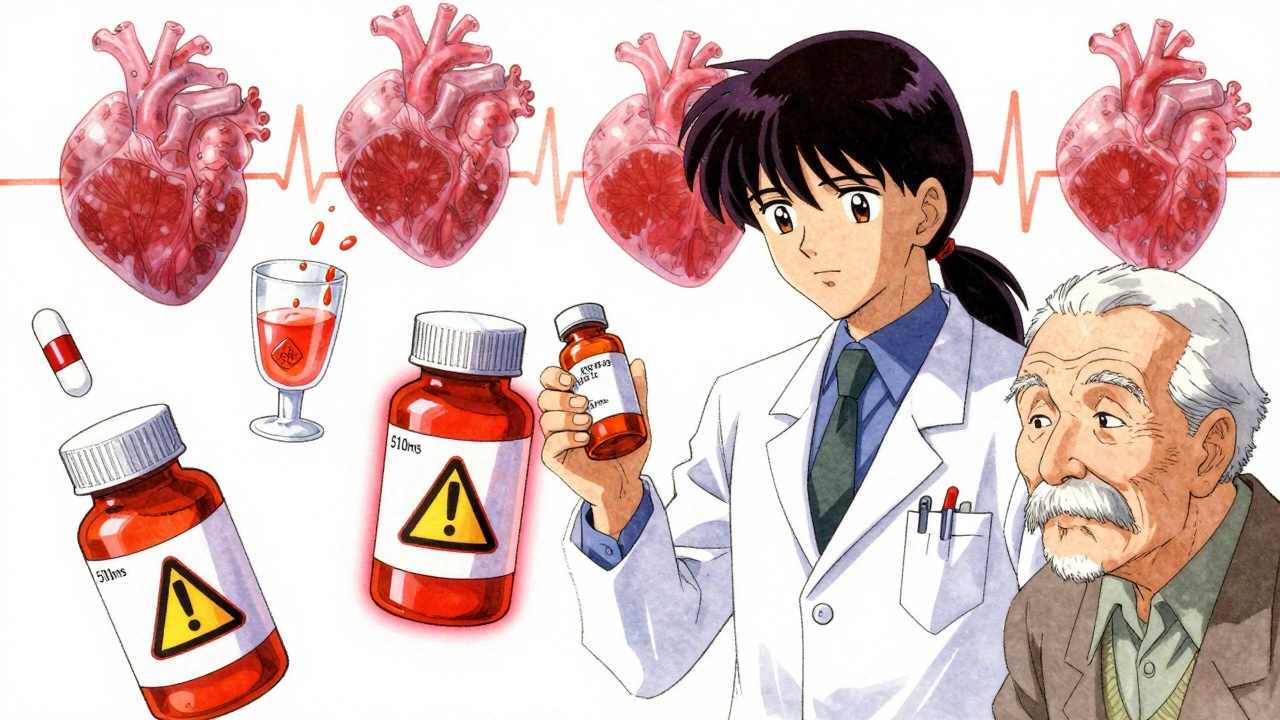
Doctors often order ECGs when a patient starts a new drug. But automated QTc readings are unreliable. Manual measurements can differ by up to 40 milliseconds. That’s the difference between "normal" and "dangerous."
And false alarms are everywhere. One study found 78% of QTc alerts in hospitals were false positives. That leads to "alarm fatigue"-clinicians start ignoring them. Meanwhile, real risks slip through.
Even worse, some providers stop useful medications just because QTc crept up a little. The European Heart Rhythm Association warns that 15-20% of heart failure patients had their meds pulled unnecessarily-increasing their risk of death from their original condition.
It’s not about avoiding every QT-prolonging drug. It’s about knowing when the risk is worth it.
What You Can Do: A Practical Risk Checklist
Before starting any new medication, ask these questions:
- Is my QTc already long? If it’s over 450 (men) or 470 (women), proceed with extreme caution.
- Am I taking more than one QT-prolonging drug? Even two low-risk drugs can add up.
- Do I have low potassium or magnesium? Get a blood test. Correcting these can cut your risk by over half.
- Am I on a CYP3A4 inhibitor? Check your full med list. Grapefruit juice, certain antifungals, and some HIV meds can dangerously slow drug metabolism.
- Do I have heart disease, kidney failure, or a history of fainting? These aren’t just background details-they’re red flags.
If you’re on citalopram, escitalopram, or any other antidepressant, don’t panic. Most people tolerate them fine. But if you’re over 60, on multiple meds, or have a heart condition, your doctor should check your QTc before starting-and again after a few weeks.
The Bigger Picture: Regulation, Technology, and the Future
Regulators are catching up. The FDA’s CiPA initiative, launched in 2013, replaced outdated lab tests with more accurate models that simulate human heart cells. It’s now used by 92% of major drugmakers.
AI is helping too. QTguard, approved by the FDA in 2023, uses machine learning to spot real danger signals and cut false alarms by over half. It’s not perfect-but it’s better than counting milliseconds on a screen.
And in the future, genetic testing may tell us who’s at risk before they even take a pill. The NIH’s All of Us program is collecting DNA from a million people to find hidden variants that make QT prolongation more likely.
For now, the best defense is awareness. Know your meds. Know your numbers. Ask questions.
What Happens If You Ignore This?
Sudden cardiac death doesn’t come with a warning. It’s silent. One moment, you’re fine. The next, you’re gone.
Between 2010 and 2023, the FDA flagged 12 new medications with QT-related deaths. Each one cost the U.S. healthcare system an estimated $200 million in avoidable hospitalizations. That’s not just money-it’s lives.
And yet, most of these deaths were preventable. They happened because someone didn’t check potassium. Or didn’t know about a drug interaction. Or assumed the ECG was "normal" because the machine said so.
QT prolongation isn’t a bug. It’s a feature of how these drugs work. The question isn’t whether they’re dangerous-it’s whether the risk was properly assessed.
Can a normal ECG rule out risk for QT prolongation?
No. A single normal ECG doesn’t guarantee safety. QT prolongation can develop over days or weeks after starting a drug. Some people have genetic sensitivity that only shows up after repeated doses. Repeated monitoring, especially after dose changes, is critical for high-risk patients.
Are over-the-counter drugs safe for QT prolongation?
Some aren’t. Cold and allergy meds containing pseudoephedrine or diphenhydramine can prolong QT, especially in older adults or those on other medications. Herbal supplements like licorice root can lower potassium, increasing risk. Always check with your pharmacist before combining OTC drugs with prescriptions.
What should I do if I feel dizzy or have palpitations while on a new medication?
Don’t wait. Stop the medication and contact your doctor immediately. Dizziness and palpitations are early warning signs of arrhythmia. If you faint, seek emergency care. These symptoms could signal Torsades de Pointes, which can turn fatal within minutes if not treated.
Is QT prolongation reversible?
Yes, in most cases. Stopping the offending drug, correcting electrolytes (especially potassium and magnesium), and avoiding triggers usually reverses the prolongation within days. But if an arrhythmia has already occurred, treatment may require defibrillation or medications like magnesium sulfate. Early action is key.
Why do some doctors still prescribe QT-prolonging drugs despite the risks?
Because the benefits often outweigh the risks-for the right patient. For example, a patient with severe depression and no heart disease may safely take escitalopram with monitoring. A person with life-threatening infection may need moxifloxacin even with a slightly prolonged QT. The goal isn’t to avoid all risk-it’s to minimize it through smart, individualized decisions.
Christian Landry
December 9, 2025 AT 16:58Katie Harrison
December 9, 2025 AT 23:40Mona Schmidt
December 11, 2025 AT 13:15Sarah Gray
December 13, 2025 AT 05:29Michael Robinson
December 14, 2025 AT 11:45Kathy Haverly
December 14, 2025 AT 14:55Tejas Bubane
December 16, 2025 AT 14:53Ajit Kumar Singh
December 17, 2025 AT 03:26Angela R. Cartes
December 17, 2025 AT 18:21Andrea Beilstein
December 18, 2025 AT 13:12