
Triple-negative breast cancer (TNBC) doesn’t respond to hormone therapy or HER2-targeted drugs. That’s not a mistake-it’s the definition. About 1 in 10 breast cancers are this type, and it’s among the most aggressive. It grows fast, comes back often, and has fewer treatment options than other subtypes. But things are changing. In 2025, the way doctors treat TNBC is no longer just about chemo. It’s about matching the right drug to the right patient, based on their tumor’s biology. And for the first time, there’s real hope beyond the old standard.
Why TNBC Is So Hard to Treat
Most breast cancers have receptors that act like antennas for hormones or growth signals. Tamoxifen blocks estrogen. Herceptin shuts down HER2. But TNBC has none of these. No estrogen receptors. No progesterone receptors. No HER2 protein. That means the drugs that work for the majority of breast cancer patients just don’t work here.
That leaves chemotherapy as the main tool. And while chemo can shrink tumors, it’s blunt. It kills fast-growing cells-cancer and healthy ones. Side effects are brutal: fatigue, nausea, hair loss, nerve damage, and a high risk of infection. Even when it works, TNBC has a high chance of returning within the first three to five years after treatment. That’s why survival rates for metastatic TNBC are still only around 12-15%, compared to nearly 28% for other types.
But here’s the key: not all TNBC is the same. Under the surface, tumors vary wildly. Some have BRCA mutations. Some are rich in immune cells. Others have strange gene changes that make them vulnerable to new drugs. The goal now isn’t just to kill cancer-it’s to find the right weapon for each tumor’s specific weaknesses.
Standard Treatment Today: Chemo, Surgery, and Beyond
For early-stage TNBC, the usual path starts with neoadjuvant chemotherapy-meaning chemo before surgery. The goal? Shrink the tumor so it’s easier to remove, and see how the cancer responds. A complete response-no cancer left in the breast or lymph nodes after treatment-is a strong sign the patient might be cured.
Common regimens include carboplatin or cisplatin combined with anthracyclines like doxorubicin, followed by taxanes like paclitaxel. This usually takes 18 to 24 weeks. Surgery follows, then more chemo or radiation if needed.
But a new approach from UT Southwestern Medical Center is turning this timeline upside down. Instead of waiting to give radiation until after chemo, they start with a single radiation session right at the beginning. Then they give just two doses of pembrolizumab (an immunotherapy drug), followed by chemo. The result? Same chance of tumor clearance-59%-but with only 41% of patients experiencing serious side effects. Compare that to the KEYNOTE-522 trial, where 82% had severe reactions. This isn’t just less toxic-it’s faster. The whole treatment phase wraps up in about 12 weeks.
Immunotherapy: Turning the Body’s Defenses Against Cancer
For patients whose tumors express PD-L1 (about 40% of metastatic TNBC), immunotherapy is now a first-line option. Pembrolizumab, combined with chemo, became standard after the KEYNOTE-522 trial showed it doubled the chance of a complete pathologic response in PD-L1-positive patients (64.8%) versus chemo alone (44.1%).
Another drug, atezolizumab, paired with nab-paclitaxel, also showed improved survival in the IMpassion130 trial. It’s approved for unresectable cases. But here’s the catch: these drugs only help if the tumor has immune cells nearby. That’s why testing for PD-L1 using the 22C3 pharmDx assay is now required before starting treatment.
And the timing matters. Giving immunotherapy early, before chemo, helps the immune system recognize cancer cells better. The UT Southwestern protocol proves you don’t need months of immunotherapy to get results. Just two doses, timed right, can make a difference.

PARP Inhibitors: Hitting BRCA Weaknesses
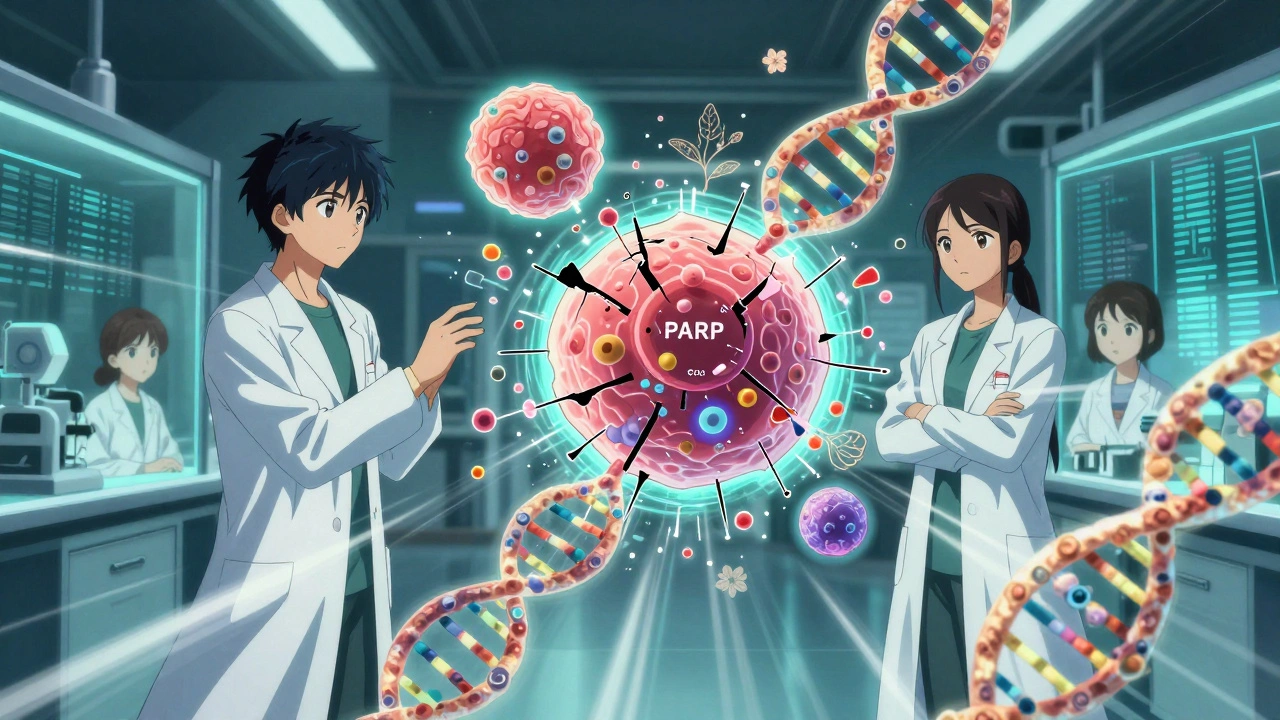
About 15-20% of TNBC patients carry a harmful BRCA1 or BRCA2 gene mutation. These genes normally fix broken DNA. When they’re broken, cancer cells rely on backup systems to survive. PARP inhibitors like olaparib and talazoparib block those backups. It’s called synthetic lethality-two failures, and the cancer cell dies.
The OlympiAD trial showed that for patients with germline BRCA mutations, olaparib improved progression-free survival by 7.8 months compared to standard chemo. It’s now a standard option for metastatic TNBC with BRCA mutations. Testing for these mutations is no longer optional-it’s recommended for everyone diagnosed with TNBC.
But not all BRCA mutations are the same. Some tumors have other defects in DNA repair, called homologous recombination deficiency (HRD). Tests for HRD are starting to help identify more patients who might benefit from PARP inhibitors, even without a clear BRCA mutation.
Antibody-Drug Conjugates: The Precision Missiles
These are drugs that combine a targeting antibody with a powerful poison. They deliver chemo directly to cancer cells, sparing healthy tissue. Sacituzumab govitecan (Trodelvy®) is the first approved for TNBC. It targets Trop-2, a protein found on most TNBC cells.
In the ASCENT trial, it cut the risk of disease progression by 56% and death by 57% compared to standard chemo in patients who’d already tried at least two prior treatments. The response rate was 35%, and the average time before the cancer worsened was nearly 5.6 months.
But it’s not gentle. About 61% of patients had severe neutropenia (low white blood cells), and 37% had serious diarrhea. Managing side effects is part of the treatment plan.
Another ADC, trastuzumab deruxtecan, is showing promise even in tumors with very low HER2 levels. In the DESTINY-Breast04 trial, it worked in 37% of TNBC patients with minimal HER2 expression. This blurs the lines between cancer types and opens doors for more patients.
The Future: Personalized Vaccines and Dual-Target Therapies
The most exciting frontier? Personalized vaccines. At Houston Methodist Hospital, researchers are sequencing a patient’s tumor, identifying unique mutations (neoantigens), and creating a custom vaccine in under six weeks. The vaccine is then combined with pembrolizumab to boost the immune system’s attack on leftover cancer cells.
Early results from phase I trials show immune activation in 78% of patients. It’s not a cure yet-but for patients who relapse after chemo, this could be a lifeline. And the platform isn’t limited to breast cancer. The same method could work for pancreatic cancer or other hard-to-treat tumors.
Another emerging strategy is dual-target inhibition. Instead of one drug, combine two that hit different cancer pathways at once. For example, blocking CDK12 and PARP together has shown 68% tumor growth inhibition in lab models-far better than either drug alone. Other combinations target CDK4/6 and PI3Kα, cutting off both growth signals and cell cycle progression.
But these are still in early trials. Toxicity is a concern. Not every patient will benefit. The challenge now is figuring out who will.
What’s Changing in 2025 and Beyond
The treatment landscape for TNBC has exploded since 2018. Five new drugs have been approved: pembrolizumab, atezolizumab, olaparib, talazoparib, and sacituzumab govitecan. More are coming. Datopotamab deruxtecan (a new ADC targeting TROP2) is in phase III trials. Adagloxad simolenin, a vaccine-like therapy, is also being tested.
By 2028, experts predict over half of TNBC treatment decisions will be guided by detailed biomarker profiles-not just BRCA and PD-L1, but tumor mutational burden, immune cell counts, and gene expression patterns. That’s precision medicine in action.
But access remains unequal. In low- and middle-income countries, only 35-40% of patients get proper biomarker testing. Without it, they’re stuck with older, less effective chemo regimens.
And while survival rates are improving, metastatic TNBC still has a grim outlook. The goal isn’t just longer life-it’s better life. Less chemo. Fewer side effects. More control.
What You Need to Ask Your Doctor
If you or someone you know has TNBC, here are the critical questions to ask:
- Has my tumor been tested for PD-L1 expression?
- Have I been tested for BRCA1/2 mutations-and HRD?
- Are there clinical trials I might qualify for?
- What are the side effects of each treatment option, and how do they compare?
- Is a shorter, less toxic treatment like the UT Southwestern protocol an option?
Don’t assume the first plan is the only one. TNBC treatment is no longer one-size-fits-all. The right combination of chemo, immunotherapy, targeted drugs, or even a vaccine trial could make all the difference.
Final Thoughts
TNBC is still dangerous. But it’s no longer a dead end. The old model-give chemo, hope for the best-is fading. The new model is smarter: test the tumor, match the drug, reduce toxicity, and personalize the path. The science is here. The drugs are approved. The trials are expanding.
The biggest barrier now isn’t science-it’s access. Making sure every patient, no matter where they live, gets the right tests and the right treatments. That’s the next frontier.
iswarya bala
December 9, 2025 AT 10:24omg this gave me hope 😭 my aunt just got diagnosed and i was so scared but now i feel like there’s actually a path forward
om guru
December 10, 2025 AT 21:46Early intervention with immunotherapy in neoadjuvant setting demonstrates significant reduction in toxicity while maintaining efficacy
Richard Eite
December 11, 2025 AT 07:53USA leads in cancer innovation again rest of the world is still stuck in the 90s
Katherine Chan
December 11, 2025 AT 11:37Every single one of these advances feels like a miracle. I know people who’ve been through this and seeing how far we’ve come in just five years gives me chills
Brianna Black
December 11, 2025 AT 16:51It is imperative to acknowledge the profound shift in therapeutic paradigms that has occurred within the oncological community. The transition from empirical chemotherapy to biomarker-driven intervention represents not merely a clinical advancement but a philosophical evolution in patient care
Stacy Tolbert
December 12, 2025 AT 01:29i just lost my sister to this and reading this makes me so angry that we didn’t know about any of this in time
Noah Raines
December 13, 2025 AT 05:36bro this is wild. two doses of pembrolizumab and boom cancer’s on the run 🤯
Lola Bchoudi
December 13, 2025 AT 18:12The PARP inhibitor paradigm leverages synthetic lethality in HRD-positive TNBC subsets, effectively exploiting DNA repair vulnerabilities. This is foundational to precision oncology
Darcie Streeter-Oxland
December 14, 2025 AT 01:02One wonders whether the enthusiasm for these novel agents is not disproportionate to their actual impact on overall survival. The data remains, at best, modest.
Sarah Gray
December 14, 2025 AT 13:51Most of these so-called breakthroughs are just chemo with a fancy label. If you don’t have the money for testing, you’re still getting the same brutal treatment.
Michael Robinson
December 15, 2025 AT 23:43Life doesn’t come with a manual. But cancer treatment is finally starting to read the room.
Andrea Petrov
December 16, 2025 AT 21:15Did you know the FDA approves these drugs because Big Pharma pays off the reviewers? They don’t care if it works, they just want the patent extension.
Suzanne Johnston
December 17, 2025 AT 16:38It’s not just about the science-it’s about who gets to access it. I’ve seen women in rural India wait months for a biopsy. That’s the real crisis.
Haley P Law
December 17, 2025 AT 21:03imagine if this was a Netflix doc 😭 the drama the tears the hope
George Taylor
December 19, 2025 AT 13:29And yet, despite all this... the five-year survival rate for metastatic TNBC remains at 12–15%. So what, exactly, have we accomplished? More expensive treatments? More side effects? More false hope?