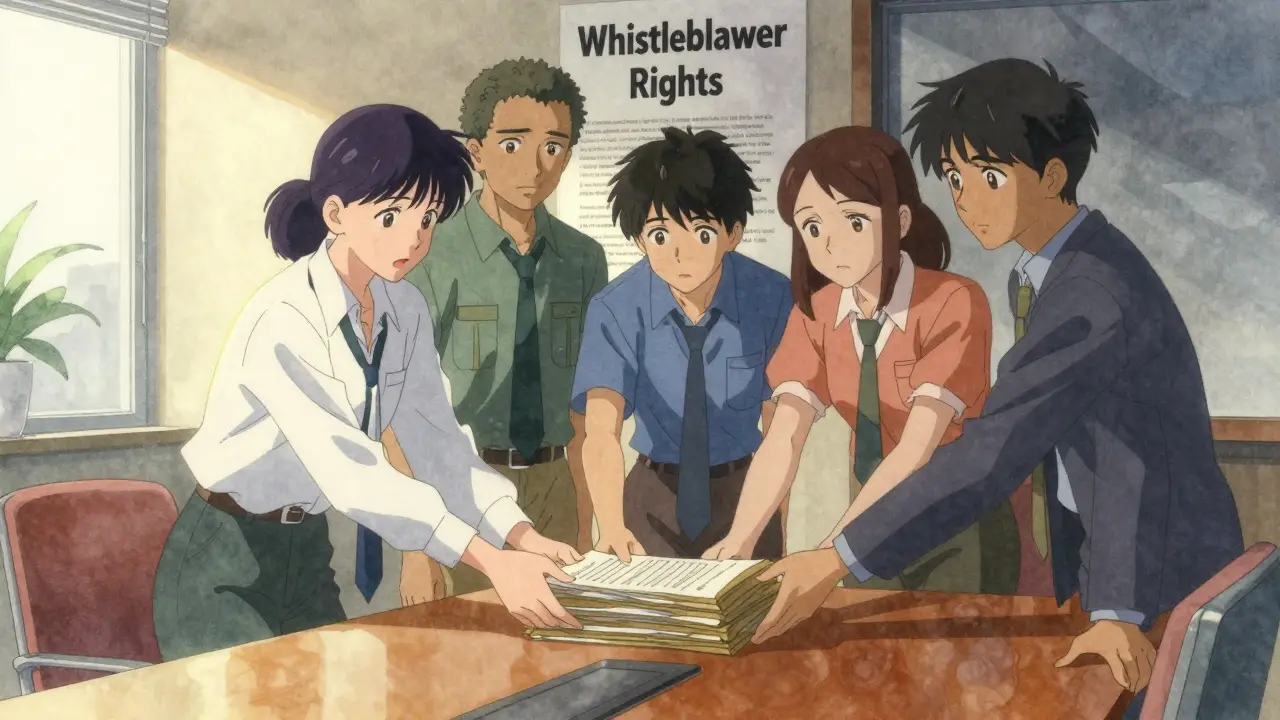
Reporting wrongdoing at work isn’t just the right thing to do-it’s protected by law. But knowing your rights isn’t enough. If you’ve seen unsafe conditions, financial fraud, or illegal practices and are thinking about speaking up, you need to understand exactly what protections exist, how they work, and where they fall short.
What Counts as Protected Whistleblowing?
Whistleblower laws don’t protect every complaint. They only cover reports of violations of specific laws-like safety rules, environmental regulations, financial fraud, or civil rights violations. You don’t need proof, just a reasonable belief that something illegal or dangerous is happening.In California, Labor Code Section 1102.5 is one of the strongest protections in the country. It covers reporting violations of any state or federal law to a supervisor or government agency. That means if you see a nurse being forced to skip patient checks, a factory dumping toxic waste, or an accounting team falsifying records, you’re protected when you speak out.
Federal laws are narrower. The Sarbanes-Oxley Act only protects employees of public companies reporting securities fraud. The False Claims Act covers fraud against government programs like Medicare or defense contracts. The Clean Air Act protects those reporting environmental violations-but only in specific industries. California’s law is broader because it doesn’t limit you by industry or type of law.
What Retaliation Looks Like (And How to Spot It)
Retaliation isn’t always firing someone. It’s often quieter, slower, and harder to prove.Common tactics include:
- Being moved to night shifts after reporting safety issues
- Sudden negative performance reviews with no prior warning
- Exclusion from meetings or projects
- Reduction in hours or pay
- Being denied promotions you were promised
- Being isolated or mocked by coworkers after speaking up
One nurse in California reported unsafe staffing levels and was later told her performance was “unsatisfactory” and forced to resign. She later won $287,000 in back pay after proving the evaluation was fabricated. That’s the pattern: retaliation disguised as normal management.
California law says even being perceived as a potential whistleblower is enough to trigger protection. If your boss suspects you’re going to report something-and punishes you for it-that’s still illegal.
California’s 2025 Changes: A New Standard
Starting January 1, 2025, every employer in California must post a clear, visible notice about whistleblower rights. It must include the state’s Whistleblower Hotline (1-800-952-5225) in at least 14-point font. This applies to offices, factories, warehouses, even remote workers’ home offices if they’re required to report in person.Why does this matter? Because most workers don’t know their rights. A 2024 survey by the California Chamber of Commerce found 65% of small business owners didn’t even know about the new posting rule. That means employees are walking into workplaces unaware they’re protected.
Violations come with teeth: up to $10,000 per act of retaliation. That’s far higher than most federal penalties. But here’s the catch: you can’t sue in federal court under California law. You’re limited to state labor boards, which can take years to resolve cases.

Federal Protections: Stronger in Some Ways, Weaker in Others
Federal laws offer something California doesn’t: access to federal courts. If you’re reporting fraud under the False Claims Act or securities violations under Dodd-Frank, you can take your case to federal court-and potentially earn a reward.The Dodd-Frank Act pays whistleblowers 10% to 30% of the money the government recovers if your tip leads to a successful case over $1 million. In 2023, the SEC paid out $637 million to 131 people. One Wall Street analyst received $279 million in 2023 for exposing a $1.6 billion fraud scheme.
But federal protections have big gaps. The Airline Industry Safety Act (AIR21) protects pilots and mechanics who report safety violations-but a major loophole lets airlines delay investigations indefinitely. The National Whistleblower Center is pushing to close it in 2025.
Also, deadlines are strict. You have:
- 30 days to file under the Clean Air Act
- 90 days for the Anti-Money Laundering Act
- 180 days for the Consumer Financial Protection Act
Miss the deadline, and you lose your case-even if the violation was real. OSHA, the agency that handles these claims, missed its own 90-day investigation deadline in 63% of cases in 2024.
What You Should Do Before Speaking Up
Don’t just walk into HR and say, “I think something’s wrong.” That’s how people get fired.Here’s what actually works:
- Document everything. Save emails, text messages, shift logs, safety reports. Write down dates, names, what was said. California’s Division of Labor Standards Enforcement requires “clear and convincing evidence” of retaliation.
- Know your deadline. Write down the statute that applies to your situation. Set a calendar alert 10 days before the deadline.
- Consult a lawyer first. The National Whistleblower Center says 78% of successful cases had legal representation. Many free legal aid groups specialize in whistleblower cases.
- Use official channels. Report to a supervisor, then to a government agency like OSHA (800-321-6742) or the California Labor Commissioner. Avoid posting on social media-it can hurt your case.
- Don’t quit. Quitting can be seen as voluntary resignation, not retaliation. Even if the work environment is toxic, staying gives you legal standing.

The Real Cost of Speaking Up
Whistleblowers don’t just risk their jobs-they risk their mental health, relationships, and financial stability.A 2024 survey of 500 whistleblowers found 68% experienced retaliation despite legal protections. 42% said HR told them their report “didn’t meet the legal threshold,” even when it clearly did. The average case takes 22 months to resolve in California. That’s two years without steady income, fighting a system stacked against you.
On Reddit, users describe being assigned graveyard shifts, having their access revoked, or being told their “attitude” was the problem. One person wrote: “I reported unsafe conditions. They didn’t fire me. They just made me want to quit.”
But there are wins. In 2023, a group of engineers at a California solar company exposed falsified safety certifications. They won reinstatement, back pay, and a company-wide safety overhaul. Their case was resolved in 14 months because they had documents, legal help, and filed within the 90-day window.
What’s Coming Next
The biggest change in 2025 isn’t in California-it’s in Washington, D.C. Senator Grassley introduced the AI Whistleblower Protection Act in May 2025. It would be the first federal law to protect tech workers who report unethical AI practices-like biased algorithms, hidden surveillance, or misuse of personal data.The Department of Labor is also working on new rules to cut investigation times from 90 to 60 days. That’s a big deal. Right now, OSHA is overwhelmed. Cases pile up. People wait years.
Global trends are shifting too. The European Union’s 2019 Whistleblower Directive forced all member states to create centralized reporting systems. The U.S. still has a patchwork of laws. But California’s 2025 rules are becoming the model. Other states are watching.
Where to Get Help
You don’t have to figure this out alone.- California Attorney General’s Whistleblower Hotline: 1-800-952-5225 (free, confidential, multilingual)
- OSHA Whistleblower Protection Program: 800-321-6742
- National Whistleblower Center: Offers free legal referrals and has helped over 1,200 people in 2024
- Legal aid clinics: Many state bar associations have whistleblower-specific programs
Whistleblower laws exist to protect people like you-not corporations. But the system isn’t perfect. It’s slow, confusing, and often hostile. The good news? You’re not powerless. With the right preparation, documentation, and support, you can expose wrongdoing and still come out on the other side.
Can I be fired for reporting a violation?
No. Under whistleblower laws, firing someone for reporting illegal or unsafe practices is illegal retaliation. If you’re fired after reporting, you can file a complaint with OSHA or your state labor agency. You may be entitled to reinstatement, back pay, and damages.
Do I need proof before reporting?
No. You only need a reasonable belief that a violation occurred. You don’t have to prove it upfront. The burden of proof shifts to the employer once you file a complaint. But having documentation-emails, photos, logs-greatly strengthens your case.
What if my company has a whistleblower policy?
Use it-but don’t rely on it. Many internal policies are designed to silence complaints, not protect them. Always document your report and follow up in writing. If you’re unsure, contact an external agency like OSHA or your state labor board. Internal reporting alone doesn’t always trigger legal protections.
How long do I have to file a complaint?
Deadlines vary by law. In California, you have one year under Labor Code 1102.5. Federally, deadlines range from 30 to 180 days depending on the statute. For example, you have 30 days under the Clean Air Act and 180 days under the Consumer Financial Protection Act. Missing the deadline means losing your rights.
Can remote workers be protected?
Yes. California’s whistleblower laws protect remote workers if they report violations related to their job. However, the 2025 posting requirement only applies to physical workplaces. Remote employees should request a digital copy of the whistleblower notice from their employer and keep it for their records.
Will I get paid if I win my case?
You may receive back pay, reinstatement, and compensation for emotional distress. Under federal laws like Dodd-Frank, you could also receive a reward of 10-30% of the government’s recovery if your tip leads to a successful enforcement action. In California, penalties of up to $10,000 per retaliation act go to the state, not the whistleblower.
What if I’m not sure what law applies to my situation?
Contact the National Whistleblower Center or a legal aid organization. They can help you identify which laws apply based on what you saw, where you work, and who you reported to. Don’t guess-get help before you act.
Aayush Khandelwal
December 31, 2025 AT 11:43Yo, this is some next-level shit. California’s 1102.5 is basically the whistleblower’s Excalibur-broad, brutal, and unapologetic. But let’s be real, most workers don’t have the bandwidth to navigate this labyrinth. The real win isn’t the law-it’s the cultural shift when HR stops treating whistleblowers like traitors and starts seeing them as early-warning systems. The 2025 posting mandate? Genius. If you’re forcing companies to scream the rights from the walls, maybe someone will actually listen before it’s too late.
Sandeep Mishra
January 1, 2026 AT 05:48Peace, everyone. 🌿 I’ve seen this play out in startups where people report safety gaps and get ‘restructured’ out. It’s not about legality-it’s about power. The system is designed to exhaust you. But here’s the quiet truth: every time someone speaks up, even quietly, they plant a seed. Not every seed grows into a tree, but the soil gets richer. And that’s worth more than any settlement.
Joseph Corry
January 2, 2026 AT 03:08Let’s deconstruct this with epistemological rigor. The entire framework assumes a binary: whistleblower = moral hero, corporation = evil entity. But institutions are not monolithic-they’re emergent systems shaped by incentive structures. The real issue isn’t retaliation-it’s the failure of organizational epistemology to integrate dissent as a data stream. Also, the $279M SEC payout? That’s not justice, it’s casino capitalism dressed in a suit.
Colin L
January 2, 2026 AT 05:22Look, I’ve been there. I reported a safety violation at my last job and within 72 hours, my access badge stopped working, my Slack messages went unanswered, and my manager started ‘accidentally’ CC’ing me on every email about ‘team cohesion.’ They didn’t fire me-they gaslit me into believing I was the problem. And now? I’m on disability. The system doesn’t protect you-it just gives you a pamphlet and a pat on the head while it quietly buries your case in a drawer labeled ‘Pending.’ And don’t even get me started on OSHA’s 90-day deadline. They miss it 63% of the time? That’s not incompetence. That’s complicity.
Hayley Ash
January 2, 2026 AT 16:25Wow what a surprise another article about how whistleblowers are heroes lol 🙄
Newsflash: most of these people are disgruntled ex-employees who got passed over for promotion and now want revenge dressed up as morality. And the ‘reasonable belief’ loophole? That’s just a free pass to ruin careers based on gossip. Also, 180 days to file? Please. I’ve seen cases where the whistleblower didn’t even know what law they were citing. This isn’t protection-it’s litigation tourism.
kelly tracy
January 3, 2026 AT 13:10STOP. JUST STOP. You people act like whistleblowing is some noble crusade. Newsflash: 80% of these reports are made by people who got caught doing something wrong themselves and are trying to deflect. And the ‘documentation’ advice? That’s just a recipe for creating a paper trail to sue your employer into oblivion. This isn’t justice-it’s a legal weaponization system. And now they’re forcing companies to post signs? Like that’s going to fix anything. You’re turning workplaces into war zones.
Nadia Spira
January 5, 2026 AT 01:11Let’s be intellectually honest: whistleblower laws are performative morality. They exist to make corporations look ethical while preserving structural impunity. The $10K penalty? Pocket change for a Fortune 500. The ‘reasonable belief’ standard? A legal loophole for amateur investigators. And the real winner? Lawyers. This entire ecosystem is a profit engine disguised as a civil rights mechanism. You don’t need more laws-you need a cultural reset where accountability isn’t a lawsuit but a value.
henry mateo
January 5, 2026 AT 06:33i just wanna say thank you for writing this. i work in a warehouse and i saw them falsifying safety logs last month. i was scared as hell. i printed everything, saved texts, wrote down dates. i called osha and they were nice. i didn’t get fired. i got moved to night shift. but i’m still here. i just wanted someone to know it’s possible. even if it’s ugly. you’re not alone. ❤️
Kunal Karakoti
January 5, 2026 AT 17:56It’s interesting how we frame whistleblowing as an act of courage, when perhaps it’s simply the last rational response to a system that has systematically eroded trust. If the only way to be heard is to risk your livelihood, then the problem isn’t the whistleblower-it’s the silence we’ve all been conditioned to accept. The law doesn’t fix that. Only collective awareness does.