Drug Withdrawal Process Simulator
Explore how drugs are withdrawn from the market when they fail to show real-world benefit. This simulator walks you through the critical decision points that determine whether patients remain exposed to ineffective treatments.
Imagine starting a new treatment for a serious condition, only to find out months later that the medication has been pulled from shelves. It’s not just a supply chain hiccup; it’s a regulatory alarm bell ringing. Drug withdrawals are regulatory actions where medications are removed from the market due to safety concerns, effectiveness issues, or violations. They happen when the benefits of a drug no longer outweigh its risks.
You might wonder how a medicine passes all those rigorous tests before hitting the pharmacy counter, only to be yanked away later. The answer lies in the evolving nature of medical evidence. What looks promising in a small clinical trial might fail in the real world, where thousands of diverse patients take the drug daily. Understanding why this happens isn’t just academic-it’s crucial for your health decisions.
The Two Main Reasons Medications Leave the Market
When you hear about a recall, it usually boils down to one of two things: safety or effectiveness. These aren’t vague concepts; they are strict legal and scientific thresholds enforced by agencies like the U.S. Food and Drug Administration (FDA).
- Safety Concerns: This accounts for roughly 60% of all withdrawals. A drug might cause unexpected side effects, organ damage, or fatal interactions that weren’t visible during initial testing. For example, if a heart medication is found to increase stroke risk in older adults, it gets flagged immediately.
- Lack of Effectiveness: This is trickier. A drug might be safe but simply doesn’t work as promised. In oncology, we’ve seen cases where drugs approved based on early signs of tumor shrinkage failed to extend patient lives in larger studies. If the benefit disappears, the drug stays gone.
Commercial reasons-like a company deciding to stop making a pill because it’s not profitable-are different. Those don’t trigger the same regulatory scrutiny unless there’s a hidden safety issue lurking underneath.
The Hidden Risk of Accelerated Approval
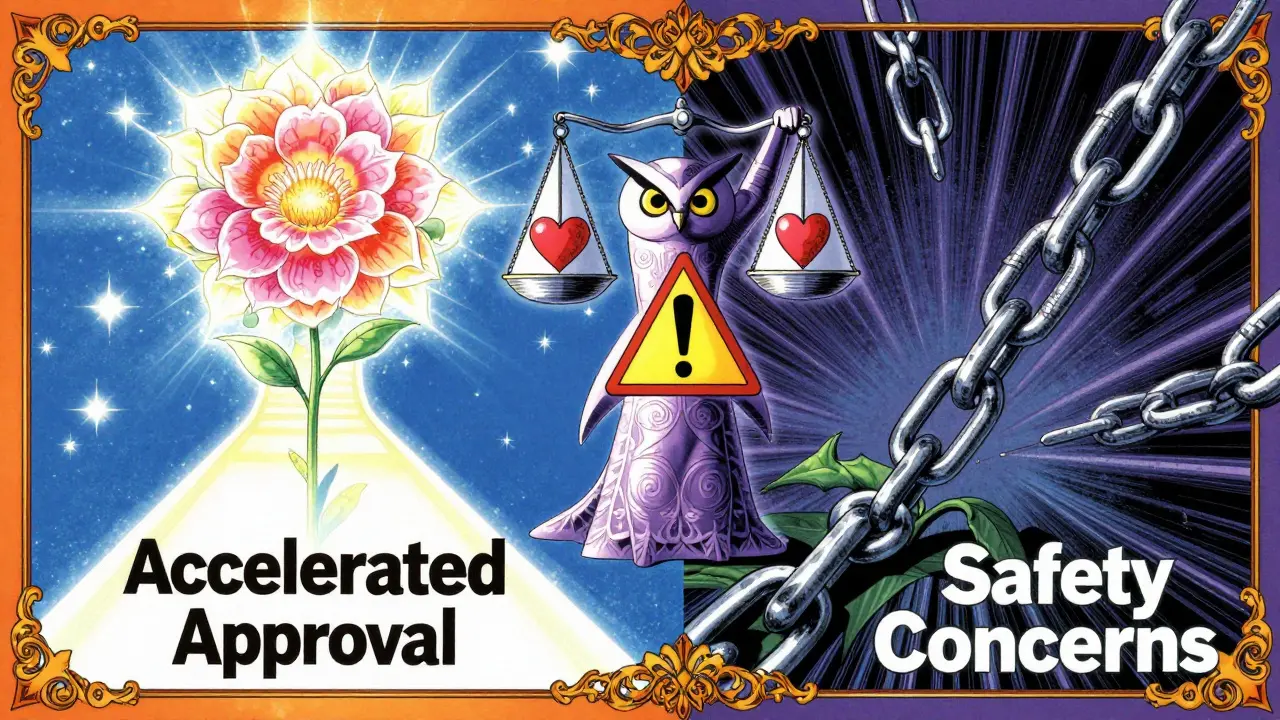
Here’s where things get complicated. To help patients with life-threatening conditions access treatments faster, regulators use Accelerated Approval. This pathway allows drugs to reach the market based on "surrogate endpoints"-indirect measures like tumor size reduction-rather than direct outcomes like survival time.
This sounds efficient, but it carries a heavy caveat: the manufacturer must conduct confirmatory trials to prove the drug actually helps patients live longer or better. If those later trials fail, the drug should be withdrawn. Historically, this process was painfully slow.
| Feature | Traditional Approval | Accelerated Approval (Pre-2023) |
|---|---|---|
| Basis for Approval | Proven clinical benefit (e.g., survival) | Surrogate endpoint (e.g., biomarker change) |
| Withdrawal Trigger | New safety data or manufacturing defect | Failed confirmatory trial proving lack of benefit |
| Average Withdrawal Time | Varies widely, often years | 46 months (approx. 3.8 years) on average |
| Patient Exposure Risk | Lower, as efficacy is proven upfront | High; up to 41% of eligible patients may receive ineffective drugs |
The Makena case is a stark example. Approved in 2011 to prevent preterm birth, it relied on surrogate data. When confirmatory trials showed no benefit in 2020, it took until 2022 for the FDA to fully withdraw approval. During that gap, an estimated 150,000 patients were exposed to a treatment that offered little value. That delay is what experts call a "systemic inefficiency."">
How the 2023 Reforms Changed the Game
Frustrated by these delays, lawmakers passed the Consolidated Appropriations Act of 2023. This legislation gave the FDA new teeth. Specifically, Section 3210 created an expedited withdrawal pathway for drugs granted accelerated approval.
Now, the FDA can pull a drug faster if four specific conditions are met:
- The sponsor fails to conduct required post-approval studies with due diligence.
- The confirmatory study fails to verify the predicted benefit.
- New evidence shows the drug is unsafe or ineffective.
- The sponsor spreads false or misleading promotional materials.
This isn’t just bureaucratic shuffling. It means the clock starts ticking much sooner. Instead of waiting years for a generic review, the FDA now has a structured timeline: sponsors have 30 days to respond to a notice, meetings happen within 60 days, and a final decision aims for 180 days. The goal? Slash the average withdrawal time from 46 months to under 12 months.
What This Means for Patients and Doctors
If you’re a patient, the most important takeaway is vigilance. Oncology communities, such as those on Smart Patients and Cancer Commons, frequently discuss experiences with withdrawn drugs. One metastatic breast cancer patient shared, "I was on a withdrawn drug for 18 months before the confirmatory trial failed... My oncologist said it was standard of care at the time, but now we know it didn’t actually help." Stories like this highlight the emotional toll of ineffective treatments.
For healthcare providers, the transition is logistical. When a drug is suddenly withdrawn, clinics report spending an average of 72 hours developing alternative treatment plans. Pharmacists also face challenges interpreting the Orange Book, the FDA’s list of approved drug products. A 2022 survey found that 63% of pharmacists struggled to understand which withdrawn products could still serve as references for generics.
However, the trend is moving toward transparency. The FDA now publishes detailed "Determination of Safety or Effectiveness" notices in the Federal Register. While only 42% of recent withdrawal notices included specific transition timelines for patients, this number is rising as the agency refines its communication strategies.
Looking Ahead: Real-World Evidence and Future Risks
The future of drug regulation relies heavily on Real-World Evidence (RWE). Starting in January 2024, the FDA launched pilot programs using data from platforms like Flatiron Health to monitor drug effectiveness continuously. This means we won’t have to wait for massive, expensive clinical trials to spot problems. Data from electronic health records will flag issues in real-time.
Industry analysts predict a 25% increase in withdrawal actions between 2023 and 2027. While this might sound alarming, it’s actually a sign of a healthier system. We’re catching ineffective drugs sooner. However, industry groups like BIO warn against being too aggressive, fearing that overly strict withdrawal rules could discourage innovation in high-risk areas like rare diseases.
The balance is delicate. We need fast access to breakthrough therapies, but we also need rapid removal of those that fail. The 2023 reforms aim to strike that balance, ensuring that fewer patients are exposed to medications that provide no benefit while carrying potential risks.
How long does it take for the FDA to withdraw a drug?
Historically, it took an average of 46 months (3.8 years) to withdraw failed drugs with accelerated approval. However, new laws enacted in 2023 aim to reduce this timeframe significantly, with a target of under 12 months for many cases through an expedited procedure.
What is the difference between a voluntary and mandatory drug withdrawal?
A voluntary withdrawal occurs when a manufacturer decides to stop selling a drug, often for commercial reasons or minor safety tweaks. A mandatory withdrawal is ordered by the FDA when serious safety or effectiveness issues are identified, forcing the drug off the market regardless of the company's wishes.
Why do some drugs get accelerated approval?
Accelerated approval is used for serious conditions where unmet medical needs exist. It allows drugs to be approved based on surrogate endpoints (like tumor shrinkage) rather than direct clinical benefits (like survival), enabling faster access to potentially life-saving treatments while confirmatory trials are conducted.
Can I still buy a drug after it has been withdrawn?
Generally, no. Once a drug is withdrawn for safety or effectiveness reasons, distribution ceases. However, temporary supply interruptions are not considered withdrawals. Patients currently taking the medication should consult their doctor for alternative treatments immediately upon hearing of a withdrawal.
How does the Orange Book relate to drug withdrawals?
The Orange Book lists approved drug products. When a drug is withdrawn for safety or effectiveness reasons, it is marked accordingly. This designation prevents other companies from using that withdrawn brand-name drug as a reference product for generic applications, ensuring generics are based on effective and safe originals.
Justina Ingram
May 19, 2026 AT 04:07ugh seriously? another article trying to explain why big pharma screws us over :/ i mean look at the data, its obvious they just want profits not patients. the whole accelerated approval thing is a scam designed to let bad drugs stay on shelves until stock prices drop. dont trust the FDA they are bought and paid for. we need real transparency not these fancy new laws that do nothing. its all corporate greed disguised as science. keep your money in your pocket people.
Mark Ronson
May 19, 2026 AT 17:25While I understand the frustration with pharmaceutical companies, it is important to recognize that the regulatory framework exists to balance innovation with safety. The 2023 reforms mentioned in the post actually represent a significant step forward in accountability. Previously, the delay of 46 months was indeed problematic, but the new expedited pathway aims to reduce this to under 12 months. This is not about corporate greed alone; it is about complex clinical data interpretation. We must appreciate the nuance here rather than dismissing the entire system. Real-World Evidence (RWE) will likely improve outcomes significantly in the coming years. Let us remain hopeful but critical.
Kris Wong
May 21, 2026 AT 01:55Wake up sheeple! 🚨 The FDA isn't protecting you, they're protecting the shareholders. 📉 Look at the Makena case, 150,000 patients exposed to useless drugs while executives cashed out. 💰 This isn't an accident, it's a feature of the system. They know the drugs don't work but they sell them anyway because the trials are rigged from the start. 🧪 The 'accelerated approval' is just a backdoor for snake oil salesmen. Don't believe the hype about RWE, it's just more data manipulation to cover their tracks. 🕵️♂️ Stay skeptical, the truth is buried deep. 👁️
Warren Brewer
May 21, 2026 AT 10:39I think this is a really good explanation for people who are confused. It helps to see the difference between safety issues and effectiveness issues. Many people think a recall means the drug is poisonous, but sometimes it just does not work well enough. That is a big deal too. The part about the Orange Book is also useful for pharmacists to know. It shows how connected everything is in the system. We should be glad that things are getting faster now. Patients deserve better answers sooner.
Mikey Mann
May 22, 2026 AT 07:27There is a profound philosophical tension here between the urgency of suffering and the rigidity of scientific proof. On one hand, we cannot deny the desperate need for immediate solutions in oncology and other life-threatening conditions. Accelerated approval attempts to bridge this gap, albeit imperfectly. However, the ethical weight of exposing patients to ineffective treatments is immense. The 2023 reforms seem to acknowledge this moral imperative by tightening the timeline for withdrawal. It is a delicate dance between hope and caution. Perhaps we can find a middle ground where compassion drives innovation without compromising integrity. The future looks cautiously optimistic if implemented correctly.
amit kumar
May 22, 2026 AT 11:48This is very interesting topic! 🌟 I learned a lot about how drugs are tested and removed from market. The table comparing traditional vs accelerated approval was very helpful to understand the differences. It is scary to think that some drugs stayed on market for so long without benefit. 😟 But the new laws give me hope that things will get better soon. We need to support systems that protect patients first. Thank you for sharing this info! 👍🏼
Lori Wildrick
May 23, 2026 AT 16:04I appreciate the detailed breakdown of the legislative changes. It is reassuring to see that there is a structured timeline for responses and decisions now. The collaboration between agencies and healthcare providers seems to be improving as well. I hope this leads to more open communication with patients during transitions. Everyone deserves to feel informed and supported during such stressful times.
Emma Olliff
May 24, 2026 AT 13:25It is truly disheartening to witness the sheer incompetence displayed by regulatory bodies when it comes to protecting public health. The notion that a 46-month delay is acceptable is nothing short of negligent. One would assume that basic competence is required to manage such critical processes, yet we see repeated failures. The elite in pharmaceuticals care little for the masses, focusing instead on their quarterly earnings. This systemic inefficiency is a direct result of prioritizing profit over human life. We must demand stricter accountability and higher standards from those who claim to safeguard our well-being. Anything less is an insult to intelligence and dignity.